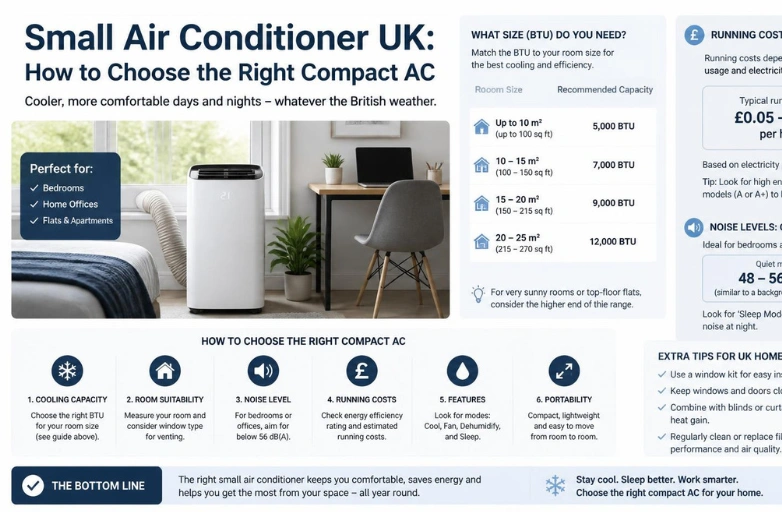
The right small air conditioner for a UK bedroom, flat or home office is a compressor-based unit that is correctly sized for the room, can vent hot air outside through your window, and runs quietly enough for the way you use the space. For many small rooms, portable models of roughly 7,000 to 9,000 BTU are a sensible starting point, but direct sun, large windows, a high ceiling or a poor window seal can all push the requirement higher.
Compact size on its own does not make a unit suitable. Many products sold as “mini AC” or “personal air conditioners” contain no refrigeration system at all and simply move or evaporate air. This guide explains how to tell the difference, how to size a unit for your room, how to deal with British casement windows, what it costs to run, and when a wall-mounted split system is the better buy.
Small-room cooling options at a glance
| Cooling option | Lowers room temperature? | Installation | Typical noise | Best suited to |
|---|---|---|---|---|
| Compact portable AC | Yes | Exhaust hose through a window | Noticeable | Bedrooms, offices, flats and rentals |
| Wall-mounted split system | Yes | Professional installation | Usually quieter indoors | Regular or long-term cooling |
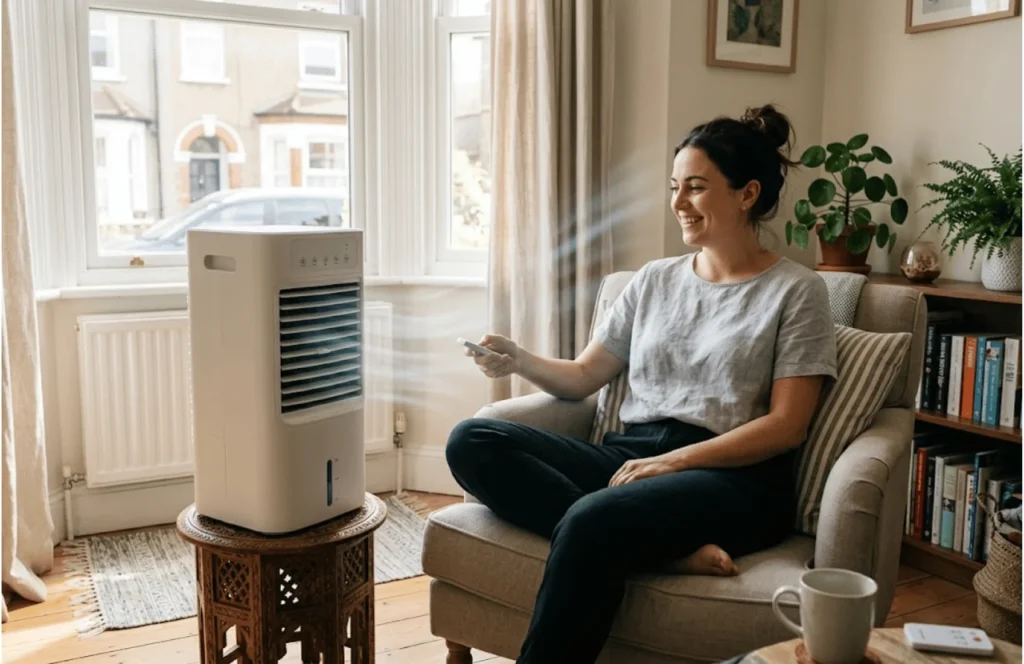
| Evaporative air cooler | Limited, local effect | None | Low to moderate | Personal cooling in drier conditions |
| Electric fan | No | None | Low | Low-cost personal cooling |
A compressor-based portable unit is usually the most straightforward choice if you rent or cannot make permanent alterations. A split system makes more sense when cooling performance, quieter operation and long-term use matter more than portability. A fan remains the cheapest option when you mainly want air moving over your skin rather than a lower room temperature.
The distinction matters because product listings often use terms like “mini AC” for devices with no refrigeration system. The Energy Saving Trust explains that portable air conditioning actively removes heat from a room, whereas fans cool the person rather than the room, and evaporative coolers work by passing air over water. Its UK advice on keeping a home cool in hot weather is worth reading alongside this guide.
How to choose a small air conditioner for a UK room

Start with the room rather than the appliance. A slim unit may tuck neatly beside a desk, but it will disappoint if its cooling output cannot cope with the space. Measure the room and compare it with the manufacturer’s recommended coverage instead of assuming the smallest machine will be enough.
Cooling capacity is usually shown in BTU (British thermal units), and some manufacturers also give output in kilowatts. In current UK-tested ranges, compact machines around the 7,000 BTU class are aimed mainly at smaller rooms, while more powerful models target larger spaces. Dimensions, hose length, weight and features vary considerably, even between machines with similar cooling capacity, so the nine checks below are worth working through before you buy.
1. Measure the room before comparing models
Measure the length and width of the room and note the ceiling height if it is higher than usual. Multiply length by width to get the floor area in square metres, then compare that figure with the room size stated for each model. Manufacturer guidance is a far better starting point than price or physical width. A box bedroom and a large open-plan lounge can need completely different capacities.
| Room type | Typical starting point | Move up a size if… |
|---|---|---|
| Box room or small single bedroom | Lower end of the compact range, around 7,000 BTU | It faces south or west, or sits under the roof |
| Double bedroom or home office | Around 7,000 to 9,000 BTU | Computers run all day or two people use it |
| Loft room, sunny lounge or larger flat room | 9,000 BTU or more, following the maker’s room-size guidance | There is lots of glazing or a high ceiling |
Treat these as rough starting points only. The exact model’s room-size rating, and the factors in the next step, should decide the final choice.
2. Allow for sunlight and glazing
South- and west-facing rooms can gain a lot of heat through their windows on sunny afternoons. Loft rooms, conservatories and rooms with large expanses of glass may need far more cooling than their floor area suggests. If several of these factors apply, avoid choosing a unit that sits at the bottom edge of its recommended room range.
Keeping heat out in the first place also reduces how hard the air conditioner has to work. UK hot-weather guidance recommends shading windows during the day and opening them when the outside air is cooler, typically in the evening or early morning. External shading, thermal curtains and reflective film all help; Readox covers glazing options in its guide to window film supplies and heat-control improvements.
3. Check that it is a genuine refrigerated AC
A true portable air conditioner has a compressor, refrigerant and an exhaust hose that carries heat outdoors. Small USB-powered or tabletop units with a water tank almost always belong in the evaporative-cooler category. They may make the air near your desk feel fresher, but they should not be compared directly with compressor cooling.
This check is especially useful when a price looks too good to be true. Genuine refrigeration needs more hardware, more electrical power and a route for heat to leave the room. A cheap device with no exhaust should not be expected to cool a closed bedroom the way a real AC does. Look for these signs in the specification:
- A stated cooling capacity in BTU or kW.
- A refrigerant type listed in the technical details.
- An exhaust hose and window kit in the box.
- A power rating in the hundreds of watts rather than a handful.
Some products are sold as “hoseless” portable air conditioners; if you are weighing one up, read our guide to the best portable air conditioner UK without hose to understand the trade-offs before you buy.
4. Think about the exhaust window before buying
Every portable compressor unit needs somewhere to send hot air, so the window is part of the purchase decision. Many kits are designed for sliding windows, but most UK homes have outward-opening casement windows, which usually need a fabric window seal or a compatible adapter. Check the supplied kit, the hose length and where the window is in relation to where the unit will stand.
A poor seal can undo much of the cooling because warm outside air leaks straight back in. The Energy Saving Trust advises closing gaps around the exhaust pipe and keeping internal doors shut while the unit runs. This simple setup detail can matter as much as the choice between two models with similar specifications.
5. Compare noise for bedrooms
With a portable AC, the compressor is inside the room, so expect more noise than you would get from a split system whose compressor sits outdoors. Noise matters most in bedrooms, because the compressor switching on and off can be more noticeable than the steady hum of a fan. Look at the stated decibel figure, but also read independent reviews, as the character of the sound affects comfort as much as its volume.
Recent UK testing illustrates this well: a 7,500 BTU model rated for rooms up to around 14 square metres suited small spaces, yet reviewers still flagged hose length and operating noise as practical concerns. A useful routine is to pre-cool the bedroom for an hour or so before bed, then switch to a quieter fan or sleep mode once you turn the light off.
6. Look at the footprint, not only the height
A unit described as compact can still take up a surprising amount of floor once you add the exhaust hose and the clearance the maker recommends around it. Check width and depth as carefully as height, and plan where the hose will run so it does not become a trip hazard. Castors help on a flat floor, but a unit of around 20 kg is not something most people will want to carry upstairs every evening.
Measure the spot where the unit will live before ordering. Leave space for air to flow around it and make sure furniture or curtains will not block the vents. In a cramped home office, a slightly taller, narrower model can be easier to live with than a squat one with a deep body.
7. Compare energy use and running costs
Air conditioning costs much more to run than a fan because it does real refrigeration work. Energy Saving Trust figures published in June 2026 put typical 24-hour portable AC use at roughly £4.62 to £5 in Great Britain, compared with about £0.14 to £0.30 for a fan. Its Northern Ireland figures are higher, so where you live and your tariff both matter.
To estimate your own costs, check the unit’s power input in kilowatts, multiply by the hours you expect to run it, and multiply that by the unit rate on your electricity bill. For example, a machine drawing 0.8 kW for six hours uses 4.8 kWh; your cost is 4.8 times your pence-per-kWh rate. Real use is often lower because the compressor cycles off once the room reaches the set temperature.
You rarely need to run a unit all day to benefit. Blocking direct sun, shutting doors to unused rooms and cooling only the room you are in all reduce unnecessary running time. The UK government’s hot-weather checklist for homes also recommends shading windows and ventilating when the air outside is cooler.
8. Prioritise useful features over a long feature list
A timer lets you cool a bedroom before sleep without leaving the machine on longer than needed. A dehumidifier mode is useful in warm, muggy weather, and a remote control helps if the unit sits away from your bed or desk. Washable filters save on replacements, although they still need regular cleaning.
Wi-Fi control is only worth paying for if you will actually use it, for example to switch the unit on before you get home. Decorative lighting, endless fan speeds and complicated displays add little. Spend your budget first on the right capacity, tolerable noise, a window kit that suits your home and a sensible physical size.
9. Check weight, drainage and storage
Portable does not always mean light. Many UK-tested machines weigh around 20 kg or more, so check the weight if you plan to move the unit between floors. Wheels help on level floors but not on stairs.
Also check how the unit handles condensation. Many models evaporate most of it through the exhaust, but some need emptying in certain modes, especially dehumidify. Finally, think about storage: the machine, hose and window kit need a dry place for the many months of the year when you will not use them. A model that fits your summer room perfectly can still be a nuisance if there is nowhere to put it in winter.
Portable AC vs wall-mounted split system: which is better?
| Factor | Compact portable AC | Wall-mounted split system |
|---|---|---|
| Upfront cost | Lower | Higher, including professional installation |
| Installation | Plug in and fit a window kit | Indoor and outdoor units, pipework and a qualified installer |
| Indoor noise | Higher, as the compressor is in the room | Usually lower, as the compressor sits outside |
| Efficiency | Often lower in real-world use | Usually higher |
| Floor space | Takes up floor and needs a hose | Mounted on the wall |
| Suits renters | Yes | Often needs landlord and sometimes planning consent |
| Can move between rooms | Yes | No |
A compact portable unit is the stronger choice for renters, people who only need cooling during heatwaves and households that want to move it between rooms. It avoids permanent installation and normally costs less upfront. The trade-offs are floor space, an exhaust hose, more indoor noise and lower efficiency in many real installations.
A wall-mounted split system is usually better for regular cooling in the same room. With the compressor outdoors, indoor operation is quieter, and there is no hose running to an open window. Installation cost and property restrictions, such as leasehold or listed-building rules, make it less suitable for anyone who needs a temporary solution. Many split systems can also run as heat pumps in winter; if heating is on your mind too, our Heater Guide UK covers the options.
Verdict
Choose a compact portable AC if flexibility and no permanent installation are your priorities. Choose a wall-mounted system if you own the property, expect to use it often and value quiet running. Readox’s home improvement section has more reading for anyone considering longer-term upgrades.
A quick small-room stress test
Floor area alone does not tell the whole story, so run through this checklist before choosing the lowest-capacity model in a range. If several points apply, move up within the recommended range or ask a specialist for sizing advice. This can stop a compact unit running flat out without ever reaching a comfortable temperature.
- The room gets strong afternoon sun.
- It sits directly below a poorly insulated roof.
- Large windows cover much of one wall.
- Two or more people use it for long periods.
- Computers, games consoles or other heat-producing equipment run for much of the day.
- The ceiling is noticeably higher than average.
- The window exhaust cannot be sealed well.
Setting up a portable AC: step by step
- Position the unit near the window on a level floor, leaving clearance on all sides as the manual specifies.
- Fit the window seal or adapter so the hose outlet is held securely and gaps are closed.
- Keep the exhaust hose as short and straight as possible; avoid kinks, sagging loops and stretching it to its limit.
- Close internal doors and draw blinds on sunny windows.
- Start on cool mode at a moderate setting rather than the lowest temperature, then adjust.
- Check the drainage arrangement on the first few days of use, particularly in humid weather.
Using compact air conditioning more efficiently
Begin by stopping unnecessary heat getting in. Close blinds or curtains when direct sun reaches the windows, switch off appliances you are not using and keep the cooled room separate from warmer parts of the home. Each of these reduces the amount of heat the machine has to remove.
Timing ventilation well also helps. Opening windows is useful when the air outside is cooler than inside, but doing so during the hottest part of the day can let more heat in. UK government advice follows the same principle, recommending airflow through the home during cooler periods when it is safe to do so.
Keep the filter clean and avoid crushing or over-extending the exhaust hose. Restricted airflow and poor heat rejection both reduce performance. Follow the manufacturer’s cleaning and drainage instructions rather than waiting for cooling to tail off.
Common mistakes to avoid
- Buying a desktop “mini cooler” expecting it to cool a whole bedroom.
- Choosing the smallest model for a sunny loft room.
- Leaving the window wide open around the hose with no seal.
- Extending the hose further than recommended.
- Running the unit with doors open to the rest of the house.
- Forgetting to clean the filter during a long hot spell.
Summer heat also tends to mean more time in the garden; if that is on your list, our guide to choosing a cordless strimmer covers another seasonal buy.
Bottom line: buying a small air conditioner
Shortlist models only once you know the room’s dimensions, the type of window and where the hose will go. Compare capacity, noise, footprint, hose reach, energy use and weight rather than picking the smallest-looking unit. For many small UK bedrooms and home offices, a compressor-based portable model of around 7,000 to 9,000 BTU, properly sealed and supported by good shading, will make hot spells far more bearable. For more practical household guides, browse the Readox homepage.
Frequently Asked Questions
What size small air conditioner is suitable for a bedroom?
There is no single capacity for every bedroom, because size, ceiling height, glazing and sun exposure all affect cooling demand. Compact portable models of around 7,000 to 9,000 BTU are commonly marketed and tested for smaller rooms, but follow the room-size guidance for the specific model. Size up if the room is sunny, poorly shaded or unusually warm.
Do mini air conditioners cool a whole room?
Some do, but only if they have a genuine refrigeration system and a way to exhaust heat outside. Many inexpensive “mini” desktop products are fans or evaporative coolers rather than true air conditioners. Read the technical specification rather than relying on the product title.
Can I use a portable AC with a UK casement window?
Yes, although you will usually need a fabric window seal or a compatible adapter for an outward-opening window. The aim is to let the hose vent outdoors while stopping warm air leaking back in. Check what window kit is supplied before you buy, as they vary considerably.
Is a small air conditioner expensive to run in the UK?
It costs considerably more to run than a fan because compressor cooling uses more electricity. The Energy Saving Trust estimates around £4.62 to £5 for 24 hours of portable AC use in Great Britain under its stated assumptions. Your actual cost depends on the unit’s power draw, your tariff, the thermostat setting and how many hours you run it.
Is a portable AC worth buying for a small room?
It can be worthwhile if a bedroom or office regularly gets uncomfortably hot and cheaper measures do not solve the problem. Portable units are especially practical for renters and anyone who cannot fit a fixed system. You will get the best results by sizing it correctly, sealing the window and reducing heat from the sun at the same time.
How can I make a portable air conditioner quieter at night?
Pre-cool the room before bed, then switch to a sleep or low fan mode. Place the unit on a level, solid floor away from the head of the bed and make sure it is not touching furniture, which can amplify vibration.