Searching for a portable air conditioner that works without an exhaust hose makes sense, especially in a UK flat, bedroom, rented property, or home with awkward casement windows. The problem is that many products sold as “ventless air conditioners” do not use refrigeration and cannot cool a whole room in the same way a conventional portable AC can. Understanding that difference before buying can save you money and prevent a disappointing purchase.
Quick answer: A genuine portable air conditioner needs a way to move heat outside, typically via an exhaust hose. Hose-free products are generally air circulators or evaporative air coolers. They can make you feel cooler, but if you need a measurable drop in whole-room temperature, a properly vented compressor AC remains the more effective option.
Can You Really Get a Portable Air Conditioner Without a Hose in the UK?
A true air conditioner removes heat from indoor air and transfers it elsewhere. With a conventional portable unit, the exhaust hose carries that unwanted heat through a window, door, or wall opening. Without an external heat-rejection route, the appliance cannot continuously remove heat from a closed room.
This is why the term “portable air conditioner without hose” can be misleading. Most hose-free appliances use either a standard fan or evaporative cooling, in which air passes over water before being blown towards the user. Energy Saving Trust clearly distinguishes these devices: fans mainly cool people through air movement; evaporative coolers use water to cool nearby air; and portable air conditioning actively lowers indoor air temperature.
That does not make hose-free products useless. They are cheaper to operate, easier to move, and much simpler to use in properties where installing a window seal is inconvenient. The important point is to buy one for the job it can actually perform rather than expecting a small water-filled cooler to behave like refrigerated AC.
Best Hose-Free Cooling Options in the UK at a Glance
Prices and manufacturer availability checked on 5 September 2026. Retailer stock can change quickly during hot weather.
| Product or option | What it actually is | Best for | Key advantage | Main limitation |
|---|---|---|---|---|
| MeacoFan Sefte 8″ | Portable air circulator | Bedrooms, desks and personal cooling | Quiet, cordless and very low energy use | Does not lower whole-room temperature |
| JML Chillmax Air Pure Chill 2.0 | Personal evaporative cooler | Desk, bedside and close-range cooling | £39.99 and compact | Designed for personal rather than whole-room cooling |
| Totalcool 3000 | Portable evaporative cooler | Caravans, motorhomes and off-grid use | Runs on 12V, 24V or mains power | £299 and not refrigerated AC |
| Igenix IG9704 | Evaporative air cooler | Larger indoor spaces needing a movable cooler | No venting and multifunction design | Adds moisture rather than dehumidifying |
| 7,000–9,000 BTU portable AC | Compressor air conditioner | Bedrooms and small rooms that genuinely overheat | Actually lowers room temperature | Requires an exhaust hose |
1. MeacoFan Sefte 8″: Best Hose-Free Choice for Bedroom Comfort
The MeacoFan Sefte 8″ is not an air conditioner, but that distinction is one reason it makes sense for many UK households. Instead of trying to imitate refrigeration with a water tank, it concentrates on efficient personal airflow, with 12 speeds, night and eco modes, a rechargeable battery, and airflow designed for close-range use. Manufacturer specifications put power consumption at just 1–18 watts, making it far cheaper to operate than a compressor-based portable AC.
Its main advantage is portability, as you are not tied to a window, a hose, or a water reservoir. You can move it from a home office to a bedroom, place it near the bed, and run it cordlessly for part of the day. At £79.99 direct from Meaco, it is also substantially cheaper than most proper portable air conditioners, although Meaco currently lists direct stock as returning in October 2026.
The limitation is equally important: this is still a fan, so it will not remove heat from a sealed bedroom. Energy Saving Trust notes that fans cool the person rather than directly lowering room temperature, so placement matters more than circulating air through an empty room. For typical British summer evenings, when personal comfort matters more than a thermostat setting, that trade-off may be perfectly reasonable.
Best for: Bedrooms, renters, desks, and people who want quiet personal cooling without water or a hose.
Skip it if your room remains extremely hot overnight and you specifically need its temperature reduced.
2. JML Chillmax Air Pure Chill 2.0: Best Budget Personal Air Cooler
The JML Chillmax Air Pure Chill 2.0 is a small evaporative cooler designed to sit near one person rather than cool an entire lounge. It uses water, a cooling filter, and two mist jets to produce cooler-feeling airflow, with four fan speeds and up to 10 hours of operation from a fill, according to JML. At the time of checking, JML lists it in stock for £39.99.
Its low price and compact dimensions make it appealing for a bedside table, desk, or small home office setup. You do not need to fit a hose, modify a window or move a heavy compressor unit whenever you change rooms. Recent customer feedback on Robert Dyas also consistently describes it as a personal or desk-level cooler rather than a substitute for whole-room air conditioning.
The biggest mistake would be placing it at the other side of a room and expecting the temperature on a wall thermometer to fall dramatically. Evaporative cooling is most effective near the airflow, and its performance depends partly on how readily water evaporates. Since evaporation also adds moisture, the Energy Saving Trust recommends keeping rooms well-ventilated when using this type of cooler.
Best for: Desk workers, bedside cooling and buyers wanting a low-cost personal cooler.
Skip it if: You need a whole bedroom cooled before sleeping.
3. Totalcool 3000: Best Without a Hose for Caravans and Motorhomes
The Totalcool 3000 has a more specialised purpose than most household coolers. It is an evaporative unit that can run on 12V, 24V, or AC mains power, making it useful in caravans, campervans, boats, and other situations where a conventional portable AC may be impractical. The manufacturer currently lists it at £299, with a 1.5-litre water capacity and power consumption ranging from 4 to 22 watts.
Its low electrical demand is particularly useful where available power is limited. It is also compact, at around 2 kg, and does not require an exhaust duct running through a caravan window. Those benefits explain why it can make more sense in mobile settings than a heavy 20 kg or 30 kg portable compressor AC.
However, Totalcool itself makes the important distinction that the TC3000 will not cool a room to a specific temperature like refrigerated air conditioning. That makes its marketing unusually useful because buyers can judge it as an evaporative personal-cooling appliance rather than as a miniature replacement for domestic AC. For a permanently overheated bedroom at home, £299 would be harder to justify unless its portability or low-power operation solves a specific problem.
Best for: Caravans, motorhomes, boats and low-power applications.
Skip it if your main goal is to reduce the temperature throughout a normal UK bedroom.
4. Igenix IG9704: Best Larger Multifunction Evaporative Cooler
The Igenix IG9704 provides another approach for people who want a larger freestanding appliance without installing an exhaust hose. It combines evaporative cooling with humidifying, ionising and heating functions, while castors allow it to be moved around the home. B&Q states that it requires no venting or permanent installation and includes a two-year guarantee.
Its main advantages over a tiny desktop cooler are its physical scale and flexibility. A larger appliance can produce a broader stream of moving air, making it more useful in a living area or workspace where several people may benefit from circulation. The heating function can also make the appliance useful outside summer rather than leaving it in storage for most of the year.
The trade-off is that it remains an evaporative cooler rather than refrigeration-based air conditioning. Adding water to indoor air may be undesirable if the room is already humid, and evaporative technology is generally most effective in dry conditions because the cooling process depends on efficient evaporation. The US Department of Energy similarly notes that evaporative coolers perform best in arid climates, which is why expectations should remain conservative during humid British weather.
Best for: Buyers seeking a larger, movable cooler with year-round functionality.
Skip it if: Your home already feels humid or you want dehumidification alongside cooling.
What About the Pro Breeze 5L Portable Air Cooler?
The Pro Breeze 5L model is worth considering because its specifications are more substantial than those of many generic “mini air conditioners”. It has a 5-litre tank, three fan speeds, multiple operating modes, and a stated 50-watt power draw, with B&Q listing operating noise at 54 dB. Pro Breeze normally prices it at £169.99.
It is not currently among our top recommendations because the manufacturer lists it as sold out as of this September 2026 update. Buying guides should distinguish a good specification from a product that readers can actually obtain, rather than continuing to rank unavailable stock for months. If availability returns, it could be a reasonable option for someone who specifically wants a larger evaporative cooler and understands its limitations.
It should still not be described as equivalent to a portable compressor air conditioner. Pro Breeze itself categorises these products separately from its portable AC range, while its true air conditioners include the venting equipment expected from refrigerated cooling. That category distinction is useful whenever a retailer uses vague phrases such as “air conditioning fan” or “windowless AC”.
Why a Real Portable Air Conditioner Needs an Exhaust Hose
A compressor air conditioner has an indoor cold side and a hot side created as heat is moved through the refrigeration cycle. In a split air-conditioning system, the hot components are outside the building, but a portable AC places most of that equipment in the room with you. The exhaust hose is therefore necessary to carry the collected heat outside.
Removing the hose would not magically remove that heat. If a compressor unit discharged both cold and hot air into the same sealed room, its electrical energy would eventually add to the total heat indoors. That is why genuine portable units provide an exhaust pipe and why Readox’s small air conditioner UK guide recommends checking the window arrangement before buying.
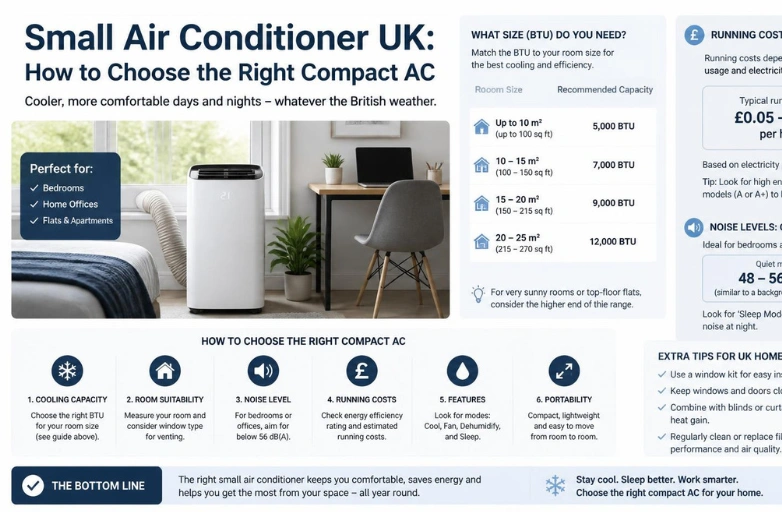
For a small UK bedroom or home office, a conventional unit around the 7,000–9,000 BTU range is often a more realistic starting point when real room cooling is required. Exact sizing still depends on room area, glazing, ceiling height, insulation, occupancy, and direct sunlight. A sunny loft bedroom can therefore require more cooling than a shaded ground-floor room of the same floor area.
Do Evaporative Air Coolers Work in the UK?

Evaporative coolers can produce noticeably cooler airflow near the machine, but they should not be expected to perform equally well in every type of weather. Their effectiveness depends on evaporation, so they generally perform better when the surrounding air is relatively dry. They also increase moisture levels by intentionally adding water to the passing air.
That matters in a UK home because a muggy room may already feel uncomfortable partly because sweat does not evaporate easily. Adding more moisture can eventually reduce the benefit you feel, particularly if windows and doors remain closed. Energy Saving Trust therefore recommends ventilation when running an evaporative cooler, rather than treating it like a refrigerated AC, which should normally be used with the cooled space closed off.
Think of an evaporative cooler as targeted comfort rather than precise climate control. Place it relatively close to where you sit or sleep and use fresh water according to the manufacturer’s cleaning instructions. If your priority is maintaining a specific room temperature during a severe heatwave, compressor cooling is the more predictable technology.
Air Cooler vs Fan vs Portable AC
| Feature | Fan / air circulator | Evaporative air cooler | Portable compressor AC |
|---|---|---|---|
| Needs exhaust hose | No | No | Yes |
| Actively lowers whole-room temperature | No | Limited | Yes |
| Adds humidity | No | Yes | Usually no |
| Dehumidifies | No | No | Often yes |
| Energy use | Very low | Low | Much higher |
| Best use | Personal comfort | Targeted cooling in suitable conditions | Genuine room cooling |
| Installation | Plug in | Add water and plug in | Exhaust through window or opening |
Energy Saving Trust estimates typical 24-hour electricity costs in Great Britain at about £0.14–£0.30 for a fan, £0.27–£0.39 for an evaporative cooler and £4.62–£5 for portable air conditioning. Those figures make the trade-off unusually clear: active refrigeration costs considerably more because it is actually removing heat from the room. A low-energy “air conditioner” using only a few dozen watts should therefore be treated cautiously if its marketing promises whole-room cooling.
Current electricity prices reinforce the same point. Ofgem’s average Direct Debit electricity unit rate for England, Scotland and Wales is 26.11p per kWh from 1 July to 30 September 2026, rising slightly to 26.32p from 1 October. Actual household costs vary by tariff and region, but checking the appliance’s wattage is a useful way to estimate running costs before buying.
How to Choose the Best Hose-Free Cooling Option
Decide Whether You Need to Cool Yourself or the Room
Start by deciding what result would make the purchase worthwhile. If you mainly need relief while working at a desk or sleeping, a fan or personal evaporative cooler can provide useful comfort without the cost and installation problems of AC. If you want a bedroom to fall from an uncomfortable temperature to a controlled setting, only genuine air conditioning is likely to satisfy that expectation.
This distinction also helps you ignore misleading product titles. Look for technical specifications rather than phrases such as “mini AC”, “air conditioning fan” or “arctic cooler”. If there is no compressor, refrigerant and external heat-rejection system, do not evaluate the appliance as though it were normal air conditioning.
Consider Humidity Before Buying an Air Cooler
A water-based cooler may suit a warm, relatively dry room better than an already humid one. Because direct evaporative cooling adds moisture, extended use in a poorly ventilated room can become counterproductive. A conventional fan may therefore be the simpler hose-free choice when humidity is already high.
If you do choose an evaporative unit, follow the ventilation guidance supplied by the manufacturer. Water tanks and cooling media should also be cleaned regularly rather than left damp for long periods. Choosing an easy-to-remove tank or accessible filter can make routine maintenance much less frustrating.
Check Noise for Bedroom Use
A product does not need a compressor to be annoying at night. High fan speeds, water pumps, oscillation mechanisms, and electronic beeps can all disturb light sleepers. Look for a genuine night mode, dimmable display, and published low-speed noise figures if the cooler will sit close to the bed.
Location can be just as important as the headline decibel number. A smaller unit placed close to you on a low setting may feel more comfortable than a larger machine operating at maximum speed from across the room. For personal cooling, improving airflow direction often works better than simply buying the most powerful appliance available.
Compare Power Consumption
Power use provides a quick clue about what the appliance is physically capable of doing. A fan consuming 18 watts or an evaporative cooler consuming 50 watts can be inexpensive to run because neither is operating a large refrigeration compressor. A genuine portable air conditioner typically consumes considerably more electricity because it is actively pumping heat outdoors.
Low consumption is an advantage when you only need air movement or personal cooling. It becomes a warning sign when a tiny USB-powered product claims it can chill an entire lounge. Match electricity use to the technology rather than assuming every low-wattage device represents a breakthrough in air conditioning.
How to Keep a UK Room Cooler Without Air Conditioning
Stopping heat from entering the room can sometimes make a bigger difference than upgrading from one fan to another. Current UK government hot-weather guidance recommends shading windows during hotter periods, opening them when outdoor air becomes cooler and switching off unnecessary heat-producing electrical equipment. These measures reduce the heat your cooling appliance has to handle in the first place.
South- and west-facing glazing deserves particular attention because direct sunlight can create substantial solar heat gain. Curtains, blinds and suitable solar-control films can reduce the amount of radiant heat entering the room, especially before the hottest part of the afternoon. Readox’s guide to window film supplies and solar-control options explains the main film types used for heat and glare control.
Timing your ventilation also matters. Opening every window at midday can make the room hotter when outdoor air is warmer than indoor air, while opening windows during cooler evenings and early mornings can help release accumulated heat. GOV. The UK and the Energy Saving Trust both recommend this cooler-outside-first approach rather than assuming that open windows are always beneficial.
So, What Is the Best Portable Air Conditioner in the UK Without a Hose?
There is no genuine whole-room portable air conditioner without an exhaust route that we would recommend as a direct replacement for conventional AC. If you need hose-free personal comfort, a strong air circulator is usually the safest expectation because it provides useful airflow without adding moisture. If you specifically prefer evaporative cooling, choose a properly specified water-based cooler and use it as targeted cooling rather than thermostat-controlled refrigeration.
For a desk or bedside setup, the £39.99 JML Chillmax Air Pure Chill 2.0 is one of the simplest options currently available. For caravans or low-power situations, the Totalcool 3000 has a much clearer specialist use case, while the MeacoFan Sefte 8” remains a strong fan-based option when stock is available. None of those products should be marketed as equivalent to a vented compressor AC.
If the room itself is the problem rather than simply feeling warm while sitting or sleeping, accepting an exhaust hose is usually the better purchase. Readox’s guide to choosing a small portable air conditioner in the UK covers BTU sizing, window arrangements, noise and running costs in more detail. You can also browse the Readox Home Improvement section for related ways to make a home more comfortable and efficient.
Frequently Asked Questions
Is There a Real Portable Air Conditioner That Does Not Need a Hose?
Not in the conventional whole-room sense. Refrigerated air conditioning must move the collected indoor heat outside the conditioned space, so standard portable units use an exhaust hose. Products without one are typically fans, evaporative coolers, or specialised personal cooling devices.
Do Windowless Portable Air Conditioners Work?
Products marketed as windowless portable air conditioners can provide useful personal cooling if they are fans or evaporative coolers. They do not typically provide the same temperature reduction as a compressor-based air conditioner because they do not transfer room heat outdoors. Always check the technology in the specification rather than relying on the product name.
Is an Evaporative Air Cooler Worth It in the UK?
It can be worthwhile for close-range cooling when conditions are suitable, and you do not expect full air-conditioning performance. Evaporative coolers consume relatively little electricity and require no exhaust hose, but they add moisture and perform best when water can evaporate efficiently. In humid conditions, a good fan may offer similar practical comfort with less maintenance.
What Is the Best Hose-Free Option for a Bedroom?
For many bedrooms, a quiet air circulator is the simplest option because it requires no water and can operate at very low power. A small evaporative cooler can also work close to the bed if the room is not already humid and receives adequate ventilation. If the bedroom remains dangerously or persistently hot, proper air conditioning may be the more appropriate solution.
Can I Use a Portable Air Conditioner With a UK Casement Window?
Yes, but you typically need an appropriate fabric window seal or a compatible adapter for the outward-opening window. The objective is to allow the exhaust hose to release hot air outside while reducing gaps that let warm air return. Always check the supplied window kit, as many portable units are packaged with hardware better suited to sliding windows.
Are Hose-Free Air Coolers Cheap to Run?
Generally, yes, because fans and evaporative coolers use much less electrical power than compressor-based air conditioning. Energy Saving Trust currently estimates around £0.27–£0.39 for 24 hours of typical evaporative-cooler use in Great Britain, compared with roughly £4.62–£5 for portable AC. Your actual cost depends on the appliance’s wattage, the electricity tariff, and how many hours it operates.
Final Verdict
The best portable air conditioner in the UK without a hose is ultimately not a conventional air conditioner at all. For straightforward personal comfort, choose a good fan or air circulator; for stronger close-range cooling in suitable conditions, consider an evaporative cooler. Both approaches avoid window hoses, cost relatively little to run, and are easier to move between rooms.
If your goal is genuinely to lower and control the temperature of an overheating room, do not let “hose-free AC” marketing steer you towards the wrong technology. A properly sized portable compressor air conditioner with a well-sealed exhaust arrangement remains the practical non-permanent solution for real room cooling. Spending a little more time understanding that difference is far cheaper than buying two cooling appliances because the first one never did the job.