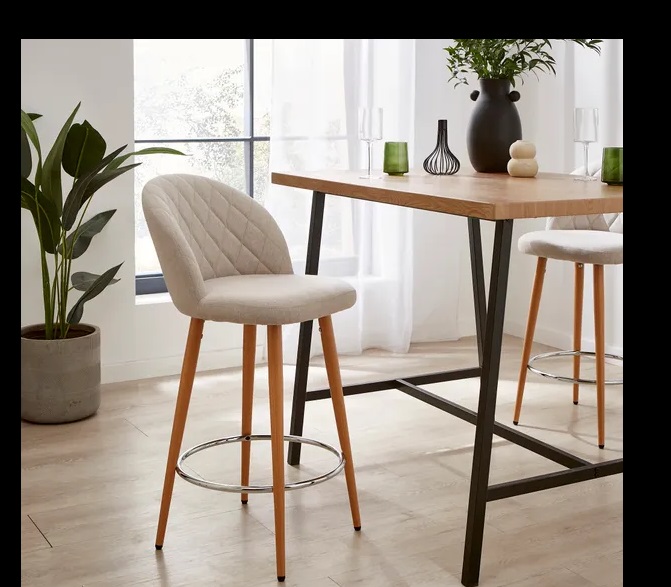
The defining features of Dunelm bar stools are a seat-height range spanning roughly 60cm to 85cm, four distinct assembly states rather than a single flat-pack standard, published maximum user weights of 110kg to 160kg, and prices that run from £29 for a stacking plastic stool to £599 for a ready-assembled oak pair. Every stool carries a product page listing seat height separately from overall height, a maximum user weight, a packed weight and a price history, and those four numbers between them settle almost every buying decision.
The figures below were checked against Dunelm’s live product pages in September 2026. They correct two things repeated across most bar stool guides: the range does not stop at £199, and the weight limits are considerably higher than the commonly quoted 100kg to 120kg. What follows is a practical breakdown of what the specifications actually mean in a real kitchen, with named models and current prices.

Seat Height: The Feature That Matters Most
More returned bar stools are sent back for height than for any other reason. UK kitchens use two common surface heights, and each needs a different stool.
| Surface | Typical UK height | Correct seat height | Stool type |
|---|---|---|---|
| Standard kitchen worktop / island | 90cm | 60cm – 68cm | Counter-height stool |
| Raised breakfast bar | 100cm – 110cm | 73cm – 80cm | Bar-height stool |
| Poseur or pub-style table | 110cm+ | 78cm – 82cm | Tall bar stool |
The rule of thumb used by kitchen fitters is to leave 25cm to 30cm of clearance between the top of the seat and the underside of the worktop. Less than 25cm and your thighs press against the overhang; more than 30cm and you are perching rather than sitting. Measure from the floor to the underside of the worktop, not the top, because a 40mm quartz or 20mm laminate edge changes the answer.
Dunelm lists seat height separately from overall height on every product page, and this is the number to use. Overall height includes the backrest and tells you nothing about legroom. The bar stool range clusters heavily around a 67cm fixed seat — the Astrid, Brodie, Hardy, Florine and Oakley all sit at exactly 67cm, which is the sweet spot for a 90cm worktop.
Real seat heights from current models
This is where published guidance tends to be vague. These are the actual figures from Dunelm’s own specification tables in September 2026:
| Model | Seat height | Overall height | Suits |
|---|---|---|---|
| Loxwood Solid Oak | 67cm fixed | 67cm (backless) | 90cm worktop |
| Brodie Counter Height, Rattan | 67cm fixed | 95cm | 90cm worktop |
| Astrid Counter Height, Fabric | 67cm fixed | 96cm | 90cm worktop |
| Salisbury Counter Height | 69cm fixed | 104cm | 90–95cm worktop |
| Elda Set of 2, Oak | 65cm fixed | 111cm | 90cm worktop |
| Rockport Pipework | 61–78cm adjustable | 78cm | Worktop to breakfast bar |
| Knox Adjustable Height Swivel | 60–82cm adjustable | 79–100cm | Worktop to poseur table |
| Jonas Adjustable Height, Velvet | 63–84cm adjustable | 89–109cm | Worktop to poseur table |
| Venice Round | 63–85cm adjustable | 63–85cm (backless) | Widest range in the range |
| Marley Gaslift | 64–77cm adjustable | 95–110cm | Worktop to breakfast bar |
Two things follow from that table. First, the widely repeated claim that Dunelm gas-lift stools adjust from “58cm to 78cm” is not accurate for the current range — the actual bottom of the adjustable band is 60cm to 64cm depending on the model, which means a very low worktop may not be served by an adjustable stool at all. Second, the Venice Round and the Knox cover the broadest span, so if you genuinely do not know your worktop height or if adults of very different heights share the same seats, those are the models to shortlist.
Watch for a naming trap. The Talullua is sold as “Height Adjustable” but its specification lists a fixed 63cm seat with an overall height of 77cm to 99cm — the adjustment is in the backrest assembly, not the seat. Read the seat line, not the product name.
How to measure for a bar stool in five steps
- Measure floor to underside. Run a tape from the finished floor to the underside of the worktop overhang at the point where knees will go, not at the wall end. Floors in older UK houses are rarely level, and a 1cm to 2cm difference along an island is common.
- Subtract 25cm to 30cm. The result is your target seat height. An 86cm underside gives a target of 56cm to 61cm; a 100cm underside gives 70cm to 75cm.
- Check the overhang depth. Measure how far the worktop projects past the cabinet face. Under 20cm, people sit side-on and knees hit the doors; 25cm to 30cm is comfortable; backless stools need the full depth if they are to tuck away completely.
- Measure the run length. Divide the usable length of the overhang by 60cm for a basic count of seats, or by 70cm for comfortable spacing, and round down.
- Measure the route to the kitchen. Check the narrowest door or turn the box has to pass through. A ready-assembled pair is far less forgiving on a tight staircase than a flat-packed one.
Write those five numbers on the same note before you open the product pages. Every Dunelm listing can then be checked in seconds against seat height, seat width, packed dimensions and assembly state.
The Three Mechanism Types
Fixed-leg stools
Four-leg or sled-base stools with no moving parts. They are the cheapest, the most stable, and the least likely to develop a fault. The trade-off is that you have to shuffle the whole stool to get in and out, which is awkward in a narrow galley kitchen. Fixed stools also sit at one height forever, so measuring correctly matters more. The Loxwood, Astrid, Brodie, Oakley and Elda are all fixed-height.
Swivel stools
A rotating plate between the seat and the base, usually offering 360-degree rotation, sometimes with a return-to-centre spring. Swivel makes a genuine difference in a busy family kitchen because you can turn to face the room without moving the stool. Look for a metal swivel plate rather than a plastic one; the plastic versions develop a click or a wobble after a couple of years of daily use.
Gas-lift stools
A hydraulic column, almost always paired with a round chrome or black base and a footring. Height-adjustable, swivel by default, and the most forgiving choice if you are not certain of your measurements. Dunelm now sells a dedicated gaslift sub-line — the Marley, Mylo and Lyle — alongside older adjustable models like the Knox and Jonas.
The gas cartridge is the component most likely to fail, typically by slowly sinking under weight after three to five years. It is a replaceable part, but check whether the stool uses a standard 28mm column before buying, because non-standard cartridges are difficult to source. Gas-lift stools are also the heaviest: the Marley weighs 11.5kg against 4.4kg for the fixed Hardy, which matters for returns, as explained below.
If you want a deeper comparison of rotating designs specifically, our guide to choosing swivel bar stools covers mechanism quality in more detail.
What Dunelm Bar Stools Actually Cost in 2026
The most commonly repeated price range for Dunelm bar stools, roughly £29 to £199, is out of date at the top end. Here are verified prices from Dunelm’s product pages, checked in September 2026. Prices move often, and several of these are reduced from a higher original, so treat them as a snapshot rather than a fixed list.
| Model | Price | Type | Customer rating |
|---|---|---|---|
| Hardy Stacking Barstool | £29 | Plastic and metal, stackable | — |
| Astrid Counter Height, Fabric | £39.50 (original £79) | Upholstered, fixed | 4.5 from 123 reviews |
| Venice Round | £45 | Backless, gas-lift | 4.8 from 181 reviews |
| Talullua Height Adjustable, Velvet | £62.30 (was £89) | Upholstered | — |
| Loxwood Solid Oak | £69 | Backless solid oak | 4.6 from 379 reviews |
| Jonas Adjustable Height, Velvet | £69 | Upholstered, gas-lift | 4.8 from 229 reviews |
| Oakley Counter Height, Boucle | £79 | Rubberwood frame, boucle | 4.7 from 19 reviews |
| Florine Backless Counter Height | £79.20 | Oak and plywood, backless | 5.0 from 4 reviews |
| Marley Gaslift, Faux Leather | £119 | Gas-lift with arms | — |
| Brodie Counter Height, Rattan | £119 | Rattan and metal | — |
| Rockport Pipework | £125 | Industrial, adjustable | 4.5 from 2 reviews |
| Draper Cantilever, Faux Leather | £129 | Cantilever frame | — |
| Brooklyn Set of 2, Faux Leather | £275 (£137.50 each) | Set of two | — |
| Elda Set of 2, Oak | £599 (£299.50 each) | Ready-assembled oak pair | 5.0 from 2 reviews |
The range is broader at both ends than most guides suggest. At the bottom, clearance pricing goes below £29 — the Knox Adjustable Height Swivel was listed at £12.25 and the Salisbury Counter Height at £14.75 when checked, both end-of-line reductions on models with strong review histories. At the top, the Elda pair at £599 is genuinely premium furniture pricing, and it is ready-assembled rather than flat-packed, which is part of what you are paying for.
Use the price history before you buy
A feature worth knowing about: Dunelm product pages now display a price history alongside the current price. The Astrid, for example, shows £79 in July 2024, £55.30 in December 2024 and £39.50 now. That turns a “50% off” badge from a marketing claim into something you can check. If a stool has sat at a reduced price for a year, the “original” number is largely notional and there is no urgency to buy. If it has genuinely just dropped from its long-run price, the saving is real.
Which Dunelm Bar Stool Suits Which Kitchen
Most buyers do not need to compare every model. They need the right stool for one specific situation. This shortlist is built from the specifications above and groups the range by the problem each stool solves best.
| Situation | What to prioritise | Models to shortlist |
|---|---|---|
| Small galley kitchen, 90cm worktop | Backless, tucks fully under | Loxwood, Florine, Venice Round |
| Family island used daily | Wipe-clean seat, low back, footrest | Astrid, Jonas, Oakley |
| Unknown or mixed surface heights | Widest adjustable seat range | Venice Round, Knox, Jonas |
| Working from home at the island | Deep seat, full back, arms | Marley Gaslift |
| Heavier users | Highest published weight rating | Hardy, Draper, Elda |
| Tight budget or occasional seating | Low price, stackable | Hardy Stacking Barstool |
| Industrial or loft-style scheme | Metal frame, adjustable | Rockport Pipework |
| Long-term investment piece | Solid oak, ready assembled | Elda Set of 2 |
Two practical notes sit behind that table. First, models move in and out of the range and clearance stock sells through quickly, so if a shortlisted stool has disappeared, use the same criteria on its replacement rather than settling for whatever looks similar. Second, seeing a stool in a store is worth the trip if you can make it. Sitting on a 67cm seat for two minutes at a display island tells you more about foam depth and back height than any specification table.
Frame Materials and What They Cost
| Frame | Typical price per stool | Strengths | Watch out for |
|---|---|---|---|
| Powder-coated steel | £29 – £79 | Light, cheap, slim profile | Chips at the footrest; can mark hard floors |
| Chrome-plated steel | £45 – £125 | Classic look, easy to wipe | Shows fingerprints and water spots badly |
| Solid rubberwood or beech | £59 – £139 | Warm, quiet, very stable | Joints loosen if not retightened annually |
| Solid oak | £69 – £300 | Matches Scandi and shaker kitchens; ages best | The step up to £299 per stool is steep |
| Rattan or natural fibre seat | £99 – £149 | Texture, no upholstery to stain | Not suitable for damp utility spaces |
| Moulded plastic | £29 – £69 | Stackable, wipe-clean, lightest | No padding; cold to sit on |
Powder-coated steel dominates the entry-level end. It is genuinely fine for occasional use, but in a kitchen where stools are used three times a day the footrest coating will wear through to bare metal within a couple of years. Solid wood frames cost more but age better, and the joints can be retightened rather than replaced. Dunelm now labels the timber source on its own-brand wood stools — the Loxwood is listed as 100 per cent certified responsibly sourced oak, and the Oakley frame as 60 per cent certified rubberwood — which is worth a look if that matters to you.
One point on branding: not everything in the range is Dunelm own-brand. The Brooklyn and Rockport are Julian Bowen, and the range also carries Indus Valley and Fusion Living lines. Third-party products can carry different guarantee terms from Dunelm’s own, so check the specific product page rather than assuming a single policy applies across the category.
Upholstery Options and Practical Durability
- Faux leather. The most practical surface in a kitchen. Wipes clean, resists food spills, and costs little. The failure mode is cracking along the seat edge after three to four years, accelerated by direct sunlight or radiator heat.
- Woven fabric and chenille. More comfortable and warmer to sit on, but it absorbs cooking grease and stains. Look for a rub-test rating; anything above 20,000 Martindale cycles is suitable for domestic kitchen use.
- Boucle and textured weaves. Fashionable and soft, but the loop pile catches crumbs and is difficult to vacuum properly. Best on stools in a dining area rather than directly at a cooking island.
- Velvet. Looks excellent in a formal kitchen-diner and is more durable than people expect, but shows pressure marks and needs regular brushing. It is well represented in the current range, on the Jonas, Talullua, Caden, Kendall, Kiley and Shea.
- Rattan. The Brodie and Cannock use a rattan seat over a metal frame. No upholstery to stain, but rattan dries out and splits in a room with heavy heating cycles.
- Bare wood or moulded plastic seat. Zero maintenance and the easiest to clean. Add a tie-on seat pad for comfort if you sit for long periods.
Padding depth is worth checking. Anything under 4cm of foam becomes uncomfortable within twenty minutes. Stools intended for eating at rather than perching on should have at least 6cm of foam and, ideally, a slight seat contour. Seat depth is the other number to read: the Hardy has a 34cm seat depth and the Marley 40cm, and that 6cm is the difference between perching and sitting.
Backrests, Footrests and Comfort Details
Backless stools tuck fully under a worktop, which is the whole reason to buy them. If your island has a 30cm overhang and the room is tight, backless is the correct choice and everything else is secondary. The Loxwood, Florine and Venice are the backless options; the Loxwood at 67cm overall disappears entirely under a 90cm worktop. The cost is comfort: nobody sits on a backless stool for an hour.
Low-back and mid-back stools are the compromise most people want. Dunelm publishes a separate back-height figure on upholstered models — 27cm on the Astrid, 28cm on the Jonas, 33cm on the Oakley — measured from the seat. Anything around 27cm to 33cm supports the lumbar area but stops below worktop level, so the stool still slides part-way under. Full-back stools are the most comfortable and the least practical in small kitchens.
The footrest is an underrated feature. Without one, your feet dangle and your lower back takes the load within minutes. A footrest should sit roughly 45cm below the seat. On cheaper stools the footrest is a thin bar that becomes uncomfortable through soft shoes; wider or wrapped footrests are noticeably better for daily use.
Weight Limits and Build Quality
Dunelm publishes a maximum user weight on most product pages, and the figures are higher than the 100kg to 120kg usually quoted for this range. Verified in September 2026:
| Model | Maximum user weight |
|---|---|
| Hardy Stacking Barstool | 160kg |
| Draper Cantilever Barstool | 160kg |
| Elda Set of 2, Oak | 150kg |
| Brodie Counter Height, Rattan | 130kg |
| Salisbury Counter Height | 130kg |
| Rockport Pipework | 114kg |
| Marley Gaslift | 110kg |
| Florine Backless Counter Height | 110kg |
The pattern is worth noticing: the highest ratings belong to the fixed-frame stools, and the gas-lift models sit at the bottom of the band at 110kg. That is the opposite of the usual assumption that a chunky hydraulic column means a stronger stool. Treat the rating as a genuine engineering limit rather than a formality, particularly on gas-lift models, where exceeding it is the most common cause of a sinking column.
Three further build-quality signals are worth checking before you buy. First, the base diameter on a gas-lift stool: anything under 40cm feels tippy. Second, whether the seat attaches with four bolts or two; four is considerably more rigid. Third, whether the feet have replaceable plastic or felt glides, because worn glides are the main reason stools scratch wood and vinyl flooring.
Review volume is a useful proxy for how long a model has been in the range and how it has held up. The Loxwood carries 379 reviews at 4.6, the Knox 307 at 4.5, the Jonas 229 at 4.8 and the Venice 181 at 4.8. A stool with two reviews may be excellent, but you are buying without evidence.
Sizing for Your Space: How Many Stools Fit
| Island or bar length | Backless stools | Stools with backs |
|---|---|---|
| 120cm | 2 | 2 |
| 150cm | 3 | 2 |
| 180cm | 3 | 3 |
| 240cm | 4 | 4 |
Allow 60cm of worktop width per person as a minimum and 70cm if you want elbow room. Leave at least 10cm between adjacent stools so they do not knock. Behind the stools you need a minimum of 90cm of walkway clearance to pass comfortably, and 100cm if that route is the main circulation path through the kitchen.
Stool width varies more than people expect and is published on every page: the Hardy and Florine are 38cm to 49cm wide, while the Marley with arms is 55cm. Three Marleys need 165cm of frontage before you have allowed any gap at all. Check the width figure against your island length rather than assuming a standard footprint.
Assembly, Delivery and Returns
The common claim that Dunelm bar stools all ship flat-packed is not right. Dunelm publishes an assembly state on each product page and there are four of them:
- Ready Assembled. Nothing to do. The Elda oak pair arrives built.
- Part Assembled. Usually base, column and seat. The Marley, Brodie, Hardy, Draper and Jonas are all part assembled.
- Legs To Be Fitted. Seat comes complete, legs bolt on. The Astrid, Knox and Venice.
- Flat Pack (Full Assembly Required). The full job. The Loxwood, Florine, Salisbury, Oakley, Brooklyn and Rockport.
Dunelm also lists a recommended build team and a difficulty rating: the Astrid, Knox, Jonas and Venice are all marked “1 Person” and “Easy”. In practice assembly is a 15 to 30 minute job per stool with the supplied Allen key, and a proper hex driver makes it considerably faster.
Delivery in 2026: standard delivery is £3.95 and free over £60, large-item delivery is £12.95 and free over £600, and free same-day click and collect is available in as little as two hours. Interest-free credit over 12 months is offered on orders above £300, which is relevant if you are buying a set. Our guide to what to know before ordering furniture for fast delivery covers the wider picture on lead times.
The 15kg and 120cm rule that decides how you return them
This is the single most useful thing to know before ordering, and it is not obvious from the product page. Under Dunelm’s returns policy, you have 28 days to return an unwanted item under the change of mind policy, and it must be unused and in its original condition with all packaging and tags intact, with a receipt or order confirmation. How you return it depends on size:
- Under 15kg and under 120cm in every direction — treated as a small item and returnable to a store.
- Over 15kg or over 120cm in any direction — treated as large furniture, cannot be returned to a store, and must go back by arranged home collection.
Apply that to real stools. A single Marley gaslift ships at 13.4kg packed in a 46 x 59 x 60cm box: under both thresholds, so it can go back to a store. The Elda set of two ships in a box 137cm long: over the 120cm limit, so it is home collection only. A single stool is almost always store-returnable; a boxed pair very often is not. If you think there is a realistic chance of changing your mind, that difference is worth planning around. Refunds take 7 to 10 working days either way.
On guarantees, Dunelm publishes range-specific terms rather than one blanket period. Its furniture and upholstery guarantee page lists 5 years on Churchgate furniture and 10 years on the internal frame of Dunelm upholstered furniture, with longer cover on made-to-order lines. Bar stools are not all covered by the same term, so check the individual product page before assuming a one-year minimum.
Matching Stools to Your Kitchen Style
- Shaker and country kitchens. Solid wood frames, fabric or rattan seats, mid-back designs in cream, sage or natural oak. The Brodie, Salcombe, Normandy and Enola sit here.
- Modern handleless kitchens. Slim powder-coated steel legs in matt black, low-back moulded seats, no visible fixings. The Hardy and the Fusion Living Soho range.
- Industrial and open-plan spaces. Metal frames with a dark finish, faux leather seats, exposed rivets and adjustable gas lifts. The Rockport Pipework is the clearest example.
- Small flats and galley kitchens. Backless stools that tuck fully away, ideally stackable. The Loxwood at 67cm overall and the stackable Hardy are the two to look at.
- Kitchen-diners used for homework and working from home. Full-back gas-lift stools with a deep seat pad and a proper footrest, treated as a chair rather than a perch. The Marley, with arms and a 40cm seat depth, is the closest thing in the range to an office chair.
For wider ideas on pulling a scheme together, our piece on where to find interior inspiration is a useful starting point.
Choosing for Children, Older Users and Taller Adults
A stool that suits one adult can be awkward or unsafe for others in the same household, and this is where adjustable seats and back design earn their price.
Children
Young children climbing onto a 67cm seat are the main safety concern with any bar stool. A four-leg fixed stool with a wide footprint is harder to tip than a single-column gas-lift base, and a low back gives something to hold while climbing. Swivel seats are popular with children for the wrong reasons, so in a house with small children a fixed seat is often the calmer choice. Check that the footrest is positioned so a child can reach it, because a dangling child shifts their weight constantly.
Older users and anyone with back or hip discomfort
Getting on and off is harder than sitting. A stool with a back and arms, such as the Marley, gives support on both movements, and a slightly lower seat at the bottom of the counter-height band reduces the step up. Avoid backless stools for anyone who will sit for more than a few minutes, and choose a firm, deep footrest rather than a thin chrome bar.
Taller adults
Taller users feel the 25cm to 30cm clearance rule most acutely, because their thighs are thicker and their knees sit further forward. If the tallest person in the house regularly sits at the island, aim for the top of the clearance range and check the overhang depth. An adjustable stool lets each user set the seat for themselves, which is the strongest argument for a gas-lift model in a mixed household.
Assembly Tips That Prevent Wobble
Most complaints about a new stool wobbling come down to how it was put together rather than the stool itself. A few habits make a noticeable difference:
- Fit every bolt loosely first. Start all the bolts by hand, stand the stool on a flat floor, then tighten in a diagonal pattern so the frame settles square.
- Do not overtighten into wood. Firm is enough. Forcing an Allen key on a rubberwood or oak frame can strip the threaded insert, and that is far harder to fix than a slight looseness.
- Seat the gas-lift column properly. On gas-lift models, push the column into the base, then sit on the seat to drive the taper home. Do not hammer it.
- Retighten after a fortnight. Timber and fabric settle in the first weeks of use. A second pass with the key after two weeks removes most early wobble.
- Check the floor before blaming the stool. Rock the stool on a different spot. Uneven tiles or a sloping floor cause a lot of apparent wobble, which adjustable glides or a thin felt pad will correct.
Keep the Allen key and the assembly sheet in a kitchen drawer. The six-monthly check described below takes five minutes with the right key and much longer without it.
Cleaning and Long-Term Care
Faux leather and moulded seats need nothing more than a damp cloth with a mild detergent; avoid alcohol-based sprays, which dry out the coating and cause the cracking mentioned earlier. Dunelm’s own care instructions on most stools say precisely this: wipe clean with a soft or damp cloth. Fabric seats should be vacuumed weekly with an upholstery head and treated with a fabric protector once a year.
Metal frames benefit from a wax polish twice a year to stop the powder coating oxidising near the footrest. Wooden frames should have their bolts checked and retightened every six to twelve months; a loose stool is not a broken stool, but a loose stool left loose becomes one. Replace worn floor glides as soon as they thin, which costs a few pounds and prevents flooring damage that costs considerably more. Practical routines like this are easier to keep up if the rest of the kitchen is organised around them, which our home organisation guide covers in more depth.
Is Dunelm the Right Place to Buy?
Honestly assessed, Dunelm’s strength is the middle of the market. At the £29 to £59 end the stools are competitive with supermarket and online-only sellers and better than most for the price, though the finishes are thin. Between £69 and £139 the range is genuinely good value, particularly the solid wood and better upholstered models, and the ability to see them in store before buying is a real advantage over online-only retailers.
Above £150 the picture is more mixed than it used to be. The Elda pair at £599 sits in territory where specialist furniture retailers and independent makers compete directly, and where you would expect denser foam, a longer guarantee and a better frame. The counter-argument is that the Elda arrives ready assembled and carries a 150kg rating, both of which are worth something. For typical family kitchen use at breakfast and homework time, the £69 to £129 band does the job well and is where the range is strongest.
Common Buying Mistakes
- Measuring to the top of the worktop. Always measure to the underside. A 90cm worktop with a 40mm stone top gives you 86cm of clearance to work with, and that difference is enough to make a stool uncomfortable.
- Trusting the product name over the specification. “Height adjustable” does not always mean the seat adjusts. Read the seat height line.
- Assuming gas-lift means sturdier. The gas-lift models in the range carry the lowest published weight ratings, at 110kg, against 160kg on two fixed-frame stools.
- Buying three stools for a 150cm island. It fits on paper and is cramped in practice once the stools have backs. Two comfortable seats beat three unusable ones.
- Ignoring the packed dimensions. A boxed pair over 120cm long cannot be returned to a store, only collected from home. Check the packaging dimensions before ordering, not after.
- Ignoring floor protection. Bar stools are dragged constantly. Felt glides on wood and laminate, plastic on tile, and check them twice a year.
- Choosing boucle or velvet directly beside a hob. Airborne cooking grease settles on textured fabric and will not come out.
- Buying a set of two when you may want four. Ranges rotate seasonally and a matching pair bought a year later is often unavailable. If there is any chance you will want more, buy them together.
Pre-Order Checklist
Run through these points with the product page open. If any answer is unclear, the questions and answers section on the listing or a store visit will usually settle it.
- Seat height sits 25cm to 30cm below the underside of your worktop.
- Seat width multiplied by the number of stools, plus 10cm gaps, fits your overhang length.
- Maximum user weight comfortably exceeds the heaviest regular user, with margin on gas-lift models.
- Upholstery suits where the stool will sit: wipe-clean near the hob, fabric or velvet in a dining zone.
- Footrest height and width suit the people who will use it most.
- Assembly state matches your tools, time and access route.
- Packed dimensions and weight tell you whether a return goes to a store or needs home collection.
- The price history shows whether the current discount is genuine.
- The guarantee term on the specific product page, especially for third-party brands.
- Floor glides suit your flooring, or you have spares ready to fit.
Bottom Line on Dunelm Bar Stools
The features that matter on a Dunelm bar stool are the ones printed on the specification table, not the product name: seat height, maximum user weight, assembly state and packed dimensions. Measure to the underside of your worktop, pick a seat 25cm to 30cm lower, check the weight rating and the box size, and the £69 to £129 band will give most UK kitchens a stool that lasts. Spend more only when solid oak, ready assembly or a higher weight rating genuinely matters to you.
Frequently Asked Questions
What seat height do I need for a standard UK kitchen island?
A standard UK kitchen worktop or island sits at 90cm, which calls for a counter-height stool with a seat height between 60cm and 68cm. Aim for 25cm to 30cm of clearance between the seat top and the underside of the worktop. Most of Dunelm’s fixed counter-height stools, including the Astrid, Brodie, Loxwood and Oakley, sit at exactly 67cm. If your surface is a raised breakfast bar at 100cm to 110cm, you need a bar-height stool with a seat at 73cm to 80cm instead.
How much do Dunelm bar stools cost in 2026?
Checked in September 2026, prices run from £29 for the Hardy stacking barstool to £599 for the Elda ready-assembled oak pair, which works out at £299.50 per stool. Single stools mostly sit between £39 and £129, with clearance lines occasionally dropping below £15. The largest and strongest part of the range is between £69 and £129, where the solid wood frames, better foam depth and gas-lift mechanisms are found. Prices change frequently, and the price history shown on each product page tells you whether a discount is genuine.
Are Dunelm bar stools height adjustable?
Some are. Adjustable models span roughly 60cm to 85cm at the seat depending on the stool: the Venice Round covers 63cm to 85cm, the Knox 60cm to 82cm, the Jonas 63cm to 84cm and the Marley gaslift 64cm to 77cm. The often-quoted 58cm to 78cm range is not accurate for the current line-up. Fixed-leg stools have a single seat height and cannot be adjusted, and at least one model sold as height adjustable in fact has a fixed seat, so read the seat height line on the specification rather than the product name.
Do Dunelm bar stools come assembled?
It depends on the model, and Dunelm publishes the answer on each page as one of four states: Ready Assembled, Part Assembled, Legs To Be Fitted, or Flat Pack requiring full assembly. The Elda oak pair arrives fully built. The Marley, Brodie, Hardy and Jonas are part assembled. The Astrid, Knox and Venice need only the legs fitted and are rated one-person, easy. The Loxwood, Florine, Salisbury and Oakley are full flat pack. Assembly is generally 15 to 30 minutes per stool with the supplied Allen key.
What is the weight limit on a Dunelm bar stool?
Higher than usually reported. Verified figures in September 2026 range from 110kg to 160kg: the Hardy and Draper are rated to 160kg, the Elda to 150kg, the Brodie and Salisbury to 130kg, the Rockport to 114kg, and the Marley gaslift and Florine to 110kg. The lowest ratings belong to the gas-lift models rather than the cheapest stools, because exceeding the rating on a hydraulic column is the most common cause of it sinking under load. The maximum user weight is listed on each product page.
Can I return Dunelm bar stools to a store?
Usually yes for a single stool, and usually no for a boxed pair. Dunelm allows 28 days for a change of mind return provided the item is unused, in its original condition with packaging and tags intact, and accompanied by a receipt or order confirmation. Items under 15kg and under 120cm in every direction can go back to a store; anything heavier or longer is classed as large furniture and must be collected from your home instead. Most single stools ship at 5kg to 14kg in a box well under 120cm, while sets of two often exceed the length limit. Refunds take 7 to 10 working days.