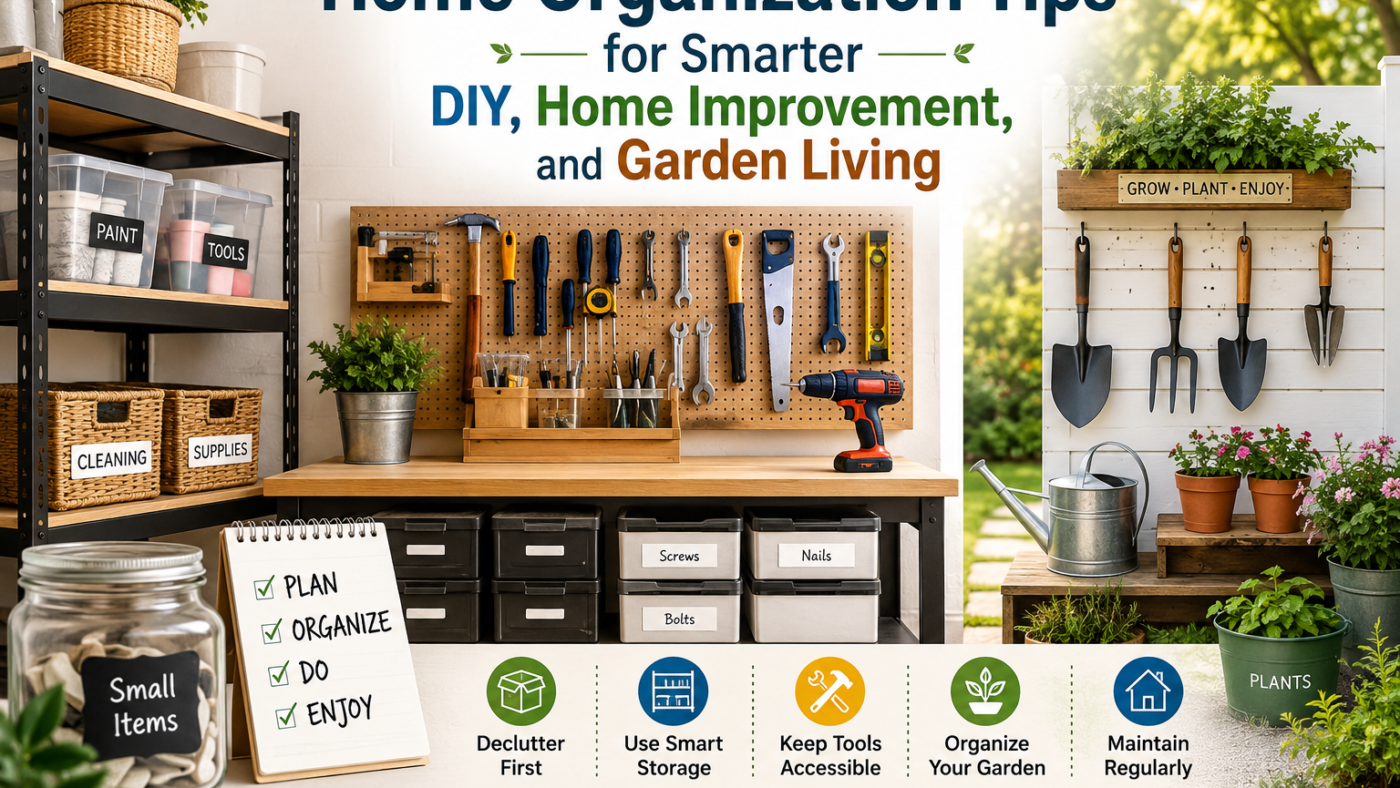
The most useful home organization tips come down to three steps: clear out what you no longer use, group what is left by the job it does, and store each group as close as possible to where that job happens. Add shelves, hooks or built-in storage only once you know what needs a home, and finish with a short reset routine so the system lasts.
That approach works as well in a garage or shed as it does in a kitchen cupboard. A well-organised home is easier to clean, repair, improve and enjoy, because you are not hunting for a screwdriver before every small fix or digging through the shed for secateurs. The goal is not a showroom shelf. It is a house and garden where things are easy to find, easy to put back and easy to maintain.
Where to Start: A Room-by-Room Overview
Before buying anything, look at which areas cause the most daily friction. The table below shows a sensible goal and a first improvement for each.
| Area | Main goal | Simple first improvement |
|---|---|---|
| Kitchen | Reduce everyday clutter on worktops | Create task-based storage zones |
| Wardrobes and cupboards | Make the things you use accessible | Declutter before adding organisers |
| Garage | Control tools and project supplies | Add wall-mounted storage |
| Utility room or under-stairs cupboard | Simplify home maintenance | Build a maintenance station |
| Garden and shed | Protect and organise equipment | Create a garden tool zone |
| Patio or balcony | Manage seasonal items | Use labelled, weatherproof storage |
Pick the area that annoys you most often and start there. A visible success in one space makes the next one easier to tackle.
1. Declutter Before Starting Any Home Improvement Project
Organisation works best when it starts with what you already own. Before putting up shelves, buying storage boxes or building a custom cabinet, sort the area you want to improve. Remove broken items, duplicates, empty containers, out-of-date supplies and anything that belongs in another room.
Use four groups:
- Keep
- Donate or sell
- Recycle or take to the tip
- Relocate to another room
This matters well beyond bedrooms. Garages, sheds, lofts and utility rooms often hold materials left over from old projects. A small tin of matching paint, a few spare tiles or an offcut of the same flooring can be worth keeping for repairs. A heap of warped timber, dried-up tins and unidentified screws probably is not.
Check your local council’s rules before disposing of paint, solvents, batteries and old electricals, as these usually cannot go in household bins and are accepted at household waste recycling centres instead. Decluttering first means you design storage around what you actually need, rather than building storage for things you have forgotten about.
2. Organise Rooms Around Everyday Activities
Instead of asking “where can I fit this?”, ask “where do I use this?” Then create small activity zones throughout the house.
A baking zone keeps scales, mixing bowls, baking trays and dry ingredients in the same cupboard. An entrance zone might combine coat hooks, a shoe rack, a key dish and a basket for hats, gloves and dog leads. A home office zone keeps chargers, notebooks and post in one drawer rather than spread across the kitchen table.
The same idea applies to DIY and maintenance. Keep picture-hanging hardware together, group painting supplies in one box, and store cleaning products where cleaning starts, such as a caddy under the bathroom sink rather than a single cupboard downstairs. Fewer steps between using something and putting it away make any system easier to keep.
3. Turn Empty Walls Into Useful Storage
Floor space is limited, but walls are often unused. Wall storage is especially helpful in garages, workshops, porches, utility rooms, sheds and small kitchens. Depending on the space, consider:
- Open shelving on brackets
- Pegboard panels
- Heavy-duty hooks
- Tool rails or slatwall
- Magnetic knife or tool strips
- Wall-mounted baskets
- Narrow picture ledges
- Over-door organisers
A pegboard turns a scattered collection of hand tools into an easy-to-scan work area. Hooks move spades and rakes off the shed floor. A narrow shelf above a washing machine holds detergent and pegs without needing another cabinet.
Plan before you drill
Sketch the layout and hold items up against the wall before fixing anything. Put frequently used items between knee and shoulder height, and keep higher storage for lighter, occasional things. Use a detector to check for cables and pipes before drilling, choose wall plugs and fixings suited to your wall type (plasterboard, brick or timber stud need different fixings), and check the weight rating of any shelf or bracket against what you plan to put on it.
4. Create a Dedicated Home Maintenance Station
Home organisation and home maintenance should work together. Small repairs are much quicker when basic supplies are in one predictable place. Choose a cupboard, shelf, utility cupboard or section of the garage as your maintenance station and stock it with:
- Basic hand tools: screwdrivers, hammer, pliers, adjustable spanner, utility knife
- A tape measure and spirit level
- A torch and spare batteries
- Spare light bulbs in the sizes your home uses
- Picture-hanging supplies
- Furniture pads and felt protectors
- Common screws, wall plugs and fixings in labelled containers
- Sealant, filler and a small tub of touch-up paint
- Replacement filters for the cooker hood or vacuum
- Instruction manuals and guarantees in one folder
Separate small hardware into labelled compartments instead of tipping everything into one box. Keep specialist supplies, such as tiling tools or plumbing fittings, apart from everyday tools so the main kit stays compact. After each job, return tools and reusable materials to the station and treat tidying up as the last step of the repair. It is also worth noting where your stopcock, fuse box and gas meter are and keeping a torch near them.
5. Make the Garage Work as a Project Space
A garage easily becomes a holding area for anything without a place indoors. Divide it into functional zones instead:
- DIY tools and workbench
- Car care supplies
- Sports and bike equipment
- Garden tools and lawn care
- Paint and decorating supplies
- Seasonal decorations
- Garden furniture cushions and covers
Keep the floor as clear as practical. Wall racks, sturdy shelving, pegboards and ceiling-mounted storage move suitable items away from walking and working areas. Store heavy objects low, keep tools you use regularly within easy reach, and put small items such as drill bits, screws, nails and wall plugs in divided containers with clear labels.
Garage safety points
Store paints, solvents, fuel and chemicals in their original containers, upright and away from heat sources, and out of reach of children and pets. Do not stack heavy items on high shelves where they could fall, and secure tall shelving units to the wall. The aim is a garage that is usable for repairs and projects rather than one where storage has taken over the whole space.
6. Build Smarter Storage Into DIY Home Projects
Organisation can become part of your home improvement plans. If you are already decorating or updating a room, ask whether a simple built-in feature could fix a storage problem at the same time. Useful projects include:
- A hallway bench with shoe storage underneath
- Floating shelves in an alcove
- A slim console table for keys and post
- A hook rail for coats and bags
- Garage shelving or a wall-mounted tool board
- Under-stairs pull-out storage
- A garden potting bench
- A rolling workshop trolley
- Storage seating for a patio
Choose projects based on the problems you actually have. If bags always pile up by the front door, a hook rail will help more than another decorative shelf. If compost bags and pots cover the garage floor, a dedicated rack will do more than another plastic tote.
For more practical inspiration across woodworking, interiors, repairs and outdoor projects, EasyDone offers ideas that fit naturally into a hands-on approach to improving and organising the home.
DIY storage options compared
| Option | Best for | Skill level | Watch out for |
|---|---|---|---|
| Pegboard | Hand tools, small garden tools | Beginner | Needs battens behind it so hooks can seat properly |
| Floating shelves | Alcoves, kitchens, utility rooms | Beginner to intermediate | Weight limits and fixing into the right wall type |
| Freestanding shelving | Garages and sheds | Beginner | Anchor tall units to the wall |
| Hook rail | Hallways, porches, sheds | Beginner | Use enough fixings for heavy coats or tools |
| Built-in under-stairs storage | Hallways with unused space | Intermediate to advanced | Access to meters or pipes behind the panels |
| Potting bench | Regular gardeners | Intermediate | Use treated or outdoor-grade timber |
7. Give Gardening Tools a Proper Home
Gardening is less enjoyable when every job starts with a search for gloves, secateurs or a trowel. Choose one area for your most-used garden supplies: a shed wall, a section of the garage, a potting bench, a storage box or a sheltered corner.
Group equipment by type. Keep hand tools together, put plant ties and labels in small containers, and hang long-handled tools so they are not a trip hazard. A basic gardening station might include:
- Gloves
- Trowel, hand fork and dibber
- Secateurs and loppers
- Plant labels and a marker pen
- Twine or plant ties
- Watering can and hose fittings
- Small pots and seed trays
- Lawn and border maintenance supplies
Store tools clean and dry. Brushing off soil and wiping blades after use helps prevent rust and gives you a chance to spot loose handles or blunt blades before the next job. A bucket of sand with a little oil is a traditional way to keep small hand tools clean between uses.
8. Organise Pots, Compost and Planting Supplies
Pots and planting materials can take over a patio, shed or garage surprisingly quickly. Nest compatible empty pots together, keep saucers nearby, and set aside cracked containers for repair, reuse or recycling.
Keep compost, grit and fertiliser in a defined spot rather than scattering bags around the garden. Opened bags last longer if they are folded over and clipped shut and kept off damp ground. Store fertilisers and pest control products in a lockable cupboard or high shelf away from children and pets, and follow the label for storage.
A potting bench is especially useful if you garden regularly, because it gives you a working surface and a permanent home for pots, tools and labels. If space is tight, a sturdy shelf or a small outdoor cabinet does the same job.
9. Improve Outdoor Living Areas With Hidden Storage
Patios, decks, balconies and porches often have to do several jobs at once: dining, gardening, entertaining, relaxing and storing equipment. Storage benches or weatherproof outdoor cabinets stop items collecting around seating areas. You may need storage for:
- Outdoor cushions and throws
- Garden accessories
- Children’s outdoor toys
- Barbecue tools
- Table accessories and citronella candles
- Small watering equipment
- Outdoor games
Check that any outdoor box is genuinely weather-resistant and ventilated, as damp cushions stored in a sealed box can develop mildew over a wet British winter. Avoid using outdoor storage as a place to postpone decisions: review its contents each season and remove anything broken or no longer used.
10. Use Seasonal Organisation to Simplify Maintenance
Each season brings its own household and garden jobs. Instead of storing seasonal items randomly, group them by when they are used. Garden supplies stay together, winter accessories share a labelled container, Christmas decorations have a defined section of the loft, and garden furniture covers sit near the furniture they protect.
Seasonal changeovers become faster because you are not searching several rooms for one category. They also become a natural check-in point:
- Clean equipment before storing it
- Drain and coil hoses before frosts
- Remove broken items rather than storing them for another year
- Note anything that needs replacing before you next need it
Organisation then becomes part of maintenance rather than a separate chore.
11. Create a Simple Reset Routine
No organising project stays finished without upkeep, but that does not have to mean hours at the weekend. Create a short routine for the areas that collect clutter fastest. At the end of the day you might:
- Return tools to their storage area.
- Put shoes and bags back by the front door.
- Clear the main kitchen worktop.
- Put garden equipment away after outdoor jobs.
- Drop unwanted items into a donation box.
You can also adopt a one-in, one-out habit for categories that tend to multiply, such as tools, planters, mugs, toys or clothes. The easier your system is to reset, the more likely it is to survive busy weeks.
Common Home Organisation Mistakes
- Buying storage boxes before decluttering, then filling them with things you do not need
- Choosing opaque containers without labels, so nothing can be found later
- Putting everyday items on high shelves and rarely used items at eye level
- Building one big “everything” cupboard instead of task-based zones
- Fixing shelves without checking wall type or load ratings
- Organising the whole house at once and finishing nothing
A Practical Weekend Organisation Plan
Trying to reorganise an entire home at once tends to leave several areas half-done. Focus on one useful project instead.
| When | Task | Result |
|---|---|---|
| Saturday morning | Declutter the target space | Only items worth keeping remain |
| Saturday afternoon | Group what is left and identify the storage problem | A clear list of what storage is needed |
| Sunday morning | Install or build simple storage if needed | Shelves, hooks or containers in place |
| Sunday afternoon | Label, put everything away, take donations and waste out | One finished, working space |
This works for a pantry, a wardrobe, a corner of the garage, a gardening station, a utility room or an outdoor storage area. You finish with one functioning improvement rather than five half-organised rooms.
Frequently Asked Questions
What home organization tips should I start with?
Start with a small area that causes regular frustration. Remove unused items first, then group what remains by purpose and give each group a clear location close to where you normally use it.
Should I buy storage before decluttering?
Usually not. Sort your belongings first so you know what needs to stay. Then measure the space and choose storage that solves a specific problem rather than guessing.
What DIY projects can improve home organisation?
Simple shelves, pegboards, hook rails, storage benches, tool racks, drawer dividers, potting benches and rolling trolleys all help. Choose a project that fixes a real storage or workflow problem you experience regularly.
How should I organise garden tools in a small space?
Use vertical space. Wall hooks or a compact rack can hold long-handled tools, while a shelf or small container holds gloves and hand tools. Keep the tools you use most often easiest to reach.
How can I organise my garage for DIY projects?
Divide the garage into zones for tools, gardening, seasonal items, sports gear and maintenance supplies. Use shelves and wall storage to keep suitable items off the floor and preserve a clear working area.
How do I keep my home organised after a big clear-out?
Make storage easy to use and create a short daily reset. Return tools and supplies after each task, keep a donation box available, and review problem areas before they become overloaded.
Make Organisation Part of Every Home Improvement
A better-organised home is not just tidier. It is easier to repair, maintain, garden in and improve. Start with clutter, look at how you use each space, and add shelves, hooks, workstations or storage only when they make everyday tasks simpler. Pick one area this weekend, follow the plan above, and carry the same thinking from the kitchen to the garage and from the workshop to the garden.