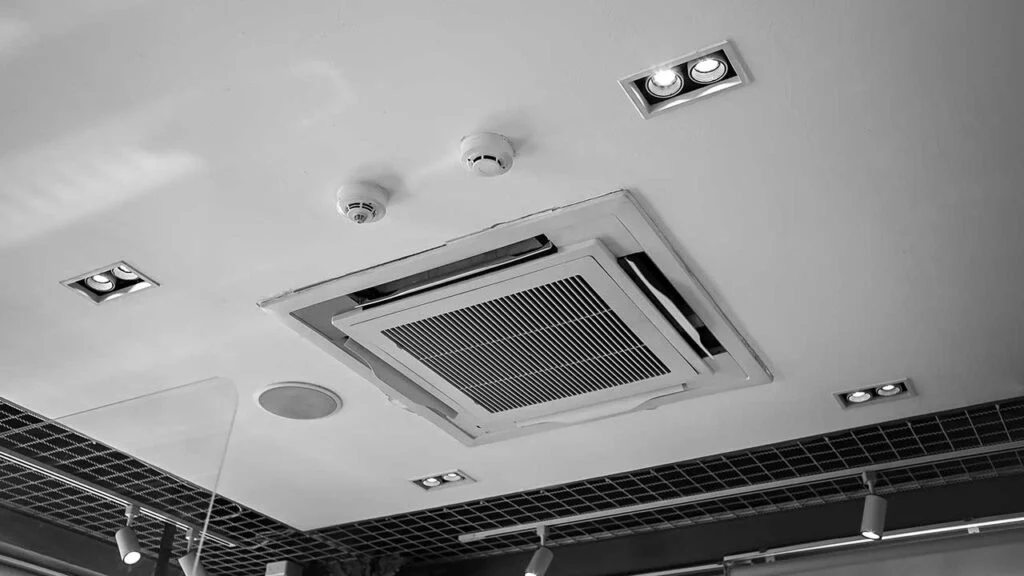
A wall-mounted air conditioner is usually the best all-round choice for cooling individual rooms in a UK home. It is a split system: a slim indoor unit sits high on the wall, a compact outdoor unit sits outside, and the two are linked by a small pipe run through the wall. Compared with portable units it is quieter, far more efficient and takes up no floor space, and most modern models can also heat the room in winter. The trade-off is a higher upfront cost and the need for professional installation.
If you are weighing up home air conditioning for the first time, this guide covers how wall-mounted systems work, how they compare with the alternatives, what the installation involves, the UK rules that apply, and how to keep a system running efficiently.
How a wall-mounted split system works
The indoor unit contains a fan and an evaporator coil. Refrigerant absorbs heat from the room air passing over the coil, then carries it through insulated copper pipes to the outdoor unit, where a compressor and condenser release that heat outside. Moisture condensed from the air runs away through a small drain pipe. Because the noisy compressor is outdoors, the unit inside is typically much quieter than a portable or window model.
Most current models use inverter compressors that speed up and slow down to hold a set temperature rather than switching fully on and off. That is the main reason they use less electricity than older or portable units. Nearly all can also run in reverse as an air-to-air heat pump, which makes them a useful source of heating in spring and autumn.
Wall-mounted, portable or ducted: how they compare
| Type | Efficiency | Noise | Installation | Best for |
|---|---|---|---|---|
| Wall-mounted split | High, especially inverter models | Quiet indoors | Professional, usually one day per unit | Bedrooms, living rooms, home offices, long-term use |
| Multi-split | High | Quiet indoors | Professional, one outdoor unit serves several rooms | Cooling several rooms without several outdoor units |
| Portable (with hose) | Lower, hot air leaks back in | Noticeable | None, vent hose through a window | Renters, occasional hot spells |
| Ducted | High | Very quiet | Major works, needs ceiling or loft space | New builds and full refurbishments |
If permanent installation is not an option, our guides to the best portable air conditioners without a hose and small air conditioners cover the alternatives. For a closer look at one of the best-known manufacturers of split systems, see our guide to choosing a Daikin air conditioner.
Benefits of wall-mounted air conditioning
- No floor space used: the indoor unit sits above head height, useful in flats and small rooms.
- Lower running costs: inverter technology adjusts output to demand, so the unit is not constantly cycling at full power.
- Quiet operation: good for bedrooms and home offices where a portable unit’s noise would be a problem.
- Heating as well as cooling: heat pump mode can take the chill off rooms without turning on the whole central heating system.
- Zoned control: each room can have its own temperature, schedule and, on many models, app control.
- Dehumidifying and filtering: dry mode reduces humidity, and washable filters trap dust. Lower humidity can also help in rooms prone to condensation, although it is not a cure for damp problems.
Choosing the right size
Capacity is quoted in kilowatts (kW) or British Thermal Units (BTU). An undersized unit will run flat out and still struggle on hot days; an oversized one will cool quickly but short-cycle, which wastes energy and leaves the air clammy. As a very rough starting point:
| Room | Typical capacity range |
|---|---|
| Small bedroom or study | Around 2.0 to 2.5 kW (roughly 7,000 to 9,000 BTU) |
| Double bedroom or medium living room | Around 2.5 to 3.5 kW (roughly 9,000 to 12,000 BTU) |
| Large living room or open-plan kitchen | Around 3.5 to 5.0 kW (roughly 12,000 to 18,000 BTU) |
Real requirements depend on insulation, glazing, which way the room faces, loft conversions under a hot roof, and heat from people and appliances. A proper survey and load calculation by the installer should always override a rule of thumb.
The AC installation process: what to expect
Good AC installation matters as much as the unit you buy, because poor pipework, a badly placed outdoor unit or a rushed commissioning will cut efficiency and shorten the system’s life. A typical single-room installation looks like this:
1. Survey and load calculation
The engineer measures the room, checks insulation and sun exposure, agrees where both units will go and how the pipe will run, and confirms the electrical supply.
2. Fitting the indoor unit
A mounting plate is fixed high on an external wall where possible, with clearance above for airflow. A core hole, usually around 65 mm, is drilled through the wall for the refrigerant pipes, drain and cable.
3. Positioning the outdoor unit
The outdoor unit goes on wall brackets or a ground stand with anti-vibration feet, somewhere with free airflow, away from bedroom windows (yours and your neighbours’) and where condensate from heating mode can drain safely.
4. Pipework, electrics and commissioning
Pipes are connected and insulated, the system is pressure tested and vacuumed to remove air and moisture, refrigerant is released or topped up, and the unit is run and checked in cooling and heating modes. More from us: Audiobooks, Open Roads and Air-Con Bliss.
5. Handover
You should receive a demonstration of the controls and app, filter cleaning instructions, warranty registration details and any certificates. A straightforward back-to-back installation is often completed in a day.
UK rules and permissions to check
- F-gas certification: anyone installing, servicing or connecting refrigerant pipework must hold the appropriate F-gas qualification, and the business should be F-gas certified. Ask to see proof. This is also usually a condition of the manufacturer’s warranty.
- Electrical work: a new dedicated circuit is usually notifiable work under Part P of the Building Regulations in England and Wales, so it should be done by a registered electrician who can self-certify it.
- Planning: rules on outdoor units vary. Listed buildings, conservation areas and flats (where the freeholder’s consent may be needed under the lease) are the common sticking points. Check with your local planning authority or landlord before booking.
- Noise: place the outdoor unit thoughtfully. A unit that disturbs neighbours can lead to complaints to the council.
Where to place units in the home
- Living rooms: on the longest wall so air can travel across the room, not blowing straight at the sofa.
- Bedrooms: on a side wall or above the door rather than directly over the bed, so you are not in a cold draught all night.
- Home offices: away from where airflow would hit your face or papers.
- Kitchens: not above the hob, where grease and heat will clog the filter.
Costs and running costs
Prices vary with brand, capacity, pipe length, access and whether scaffolding or extra electrical work is needed, so always get two or three written quotes. Expect a professionally installed single-room system to cost significantly more than a portable unit, with multi-room systems scaling up from there. Running costs depend on your electricity tariff, how hot the summer is and how you use the system; an inverter unit set to a sensible temperature in a closed room will generally cost much less to run than a portable unit doing the same job.
When comparing quotes, check the warranty length (many manufacturers extend it if an accredited installer fits the unit and it is serviced annually), whether the price includes the electrical circuit and making good, and whether the first service is included.
Maintenance tips for long-term efficiency
- Wash the indoor filters every few weeks during heavy use; dirty filters are the most common cause of weak airflow.
- Keep the outdoor unit clear of leaves, plants and stored items.
- Run the unit occasionally outside the season to keep it working freely.
- Book an annual service by an F-gas registered engineer to clean coils, check the drain, test for leaks and keep the warranty valid.
- Watch for musty smells or water dripping from the indoor unit, which usually mean a blocked drain or dirty coil.
Frequently asked questions
Can a wall-mounted air conditioner heat as well as cool?
Yes. Most modern split systems can run in reverse as an air-to-air heat pump, providing efficient heating as well as cooling in the same room.
Can I install a wall-mounted air conditioner myself?
Standard split systems should be installed by an F-gas certified engineer, because handling refrigerant requires certification and DIY installation usually voids the warranty. A few pre-charged DIY kits exist, but professional installation is the safer choice.
How long does installation take?
A single back-to-back installation, where the outdoor unit is directly behind the indoor one, is often finished in a day. Longer pipe runs, multi-room systems or difficult access can take longer.
Do I need planning permission for an air conditioning unit?
It depends on the property and location. Listed buildings, conservation areas and flats often need consent, so check with your local planning authority and, if you rent or own a leasehold flat, your landlord or freeholder.
How often should a wall-mounted AC be serviced?
Clean the filters every few weeks when in regular use, and have the system professionally serviced once a year to maintain efficiency and keep the warranty valid.