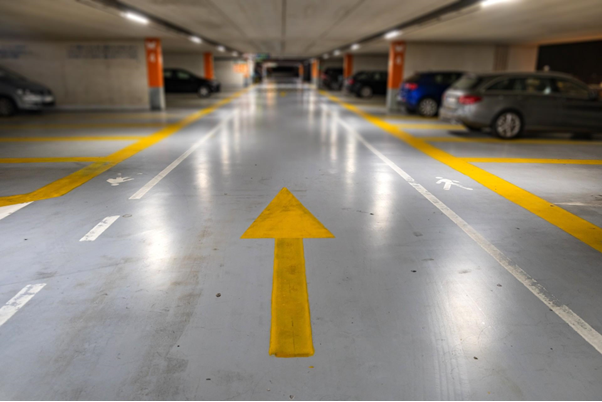
Three car park line marking companies in the UK worth putting on your shortlist are Line Mark, Bay Line Marking and Northampton Line Markings. Line Mark is the strongest all-round specialist for multi-site, industrial and logistics operators; Bay Line Marking suits schools and mixed commercial sites that need anything from a quick refresh to a redesign; and Northampton Line Markings is a practical regional option for the essentials.
Whether you manage a car park, retail park, warehouse yard or business site, the right contractor is only half the decision. This guide compares the three providers, then explains what good car park marking involves: the rules that apply, the materials on offer, how long each lasts, how to plan a layout and the questions to ask before you sign off a quote.
The three providers at a glance
| Provider | Best suited to | Stand-out strengths |
|---|---|---|
| Line Mark | Multi-site operators, logistics, industrial and airside environments | Thermoplastic road markings, warehouse demarcation, anti-slip surfacing and signage from one contractor |
| Bay Line Marking | Schools, public-sector sites and mixed commercial premises | Flexibility between small refreshes and full redesigns, strong focus on surface preparation |
| Northampton Line Markings | Businesses wanting straightforward regional delivery | Practical car park and safety marking with local site knowledge |
Why car park marking matters for safety
Car parks and yards mix vehicles and pedestrians in tight spaces, often with people distracted by phones, shopping trolleys or children. The Health and Safety Executive treats workplace transport as one of the main sources of serious injury at work, and its guidance for employers is built around separating people and vehicles wherever possible. Markings are the cheapest and quickest way to do that: they tell drivers where to go, where to stop and where to give way, and they give pedestrians a visible route.
Faded or badly planned lines cause predictable problems: vehicles cutting across bays, drivers reversing into walkways, blue badge holders unable to find an accessible space, and delivery vehicles blocking fire routes. Beyond the safety risk, a tired layout also reduces capacity, because drivers park unevenly when bay edges are hard to see. A refreshed, well-planned scheme can recover spaces as well as reduce incidents.
The UK rules and standards that shape a layout
- Workplace (Health, Safety and Welfare) Regulations 1992: require traffic routes to be organised so pedestrians and vehicles can move safely. Employers are expected to assess and control workplace transport risk.
- Equality Act 2010: service providers must make reasonable adjustments for disabled people, which in practice means properly sized and signed accessible bays close to entrances.
- BS 8300: the British Standard for accessible design sets out recommended dimensions for designated bays, including a clear transfer zone alongside the bay.
- Traffic Signs Regulations and General Directions 2016: govern markings on public roads. Private car parks are not strictly bound by them, but most contractors follow the same symbols so drivers recognise them instantly.
- BS EN 1436 and BS EN 1871: cover the performance of road marking materials, including visibility, skid resistance and durability. Asking which standard a product meets is a quick way to compare quotes.
If you are unsure which duties apply to your site, a competent health and safety adviser can review your workplace transport risk assessment alongside the proposed layout.
How we compared these companies
Each provider was assessed on the factors that matter most to a site manager: the range of environments it works in, the materials and services it offers, its approach to surface preparation and compliance, and how well it can work around a site that has to stay open. None of these factors alone decides the right choice; the best fit depends on the size, type and traffic of your site.
1. Line Mark
Practical expertise across commercial environments
Line Mark has built its reputation on specialist commercial marking. Its work spans warehouses, retail parks, schools and large industrial facilities, and extends to airports, factories and logistics sites. That range matters because each environment has different traffic patterns: a school car park peaks twice a day with parents on foot, while a distribution yard sees heavy goods vehicles turning around the clock.
Services go beyond painting lines. Line Mark offers thermoplastic road markings, anti-slip surfacing, safety signage and warehouse floor demarcation, so a site manager can deal with one specialist for external and internal marking. Planning starts with how the site actually operates rather than a standard template: traffic flow, pedestrian desire lines, loading areas and compliance needs all shape the recommendations.
Focus on safety and long-term performance
Clear bay markings, directional arrows, hatched hazard zones and pedestrian segregation are the core of its work. High-durability materials are chosen for heavy-traffic areas to reduce how often lines need renewing, and scheduling is planned so marking can be completed while a site keeps operating, for example in phases, overnight or at weekends.
Best for: organisations that want specialist knowledge and long-term value across several types of space, from yard to warehouse floor. For that kind of brief, Line Mark is the strongest all-round option here.
2. Bay Line Marking
Flexible services for varied sites
Bay Line Marking works across schools, commercial premises and public-sector environments. Its main advantage is flexibility: it handles small refresh jobs, where existing lines are simply re-applied, as well as complete layout redesigns. That suits property owners at different stages, from a landlord tidying up a small office car park before a new tenant arrives to a business park reconfiguring after resurfacing.
Compliance and clear organisation
The company places visible emphasis on surface preparation, which is one of the biggest factors in how long markings last. Paint applied over dust, moss, oil or loose aggregate will lift early however good the product is. It also focuses on the compliance basics: accessible bays, pedestrian routes and directional guidance that stays intuitive when a shared site is busy.
Best for: clients who want broad coverage with a practical, compliance-aware approach, particularly schools and public-sector sites.
3. Northampton Line Markings
Regional knowledge with commercial experience
Northampton Line Markings is a sensible choice for businesses that want a regional contractor with commercial and industrial experience. Local knowledge helps with practical decisions, from understanding how a site is used at different times to arranging works around nearby traffic. Its service covers standard car park layouts as well as wider safety markings, so one contractor can deal with bays, arrows, loading zones and walkways.
Reliable everyday site safety
The focus is on getting the fundamentals right: clear directional arrows, well-defined loading zones and crisp bay lines that stay visible under daily traffic.
Best for: operators who value straightforward delivery of the essentials over a broad specialist catalogue.
Line marking materials compared
Material choice affects cost, disruption and how soon you will need the job again. Lifespans below are typical ranges and depend heavily on traffic, turning movements, weather and surface condition.
| Material | Typical use | Durability | Points to note |
|---|---|---|---|
| Solvent or water-based road paint | Low-traffic car parks, temporary layouts, quick refreshes | Shortest; often needs renewing within a year or two on busy sites | Lowest upfront cost, fast to apply, easy to change |
| Thermoplastic | Busy car parks, roads, yards, arrows and symbols | Several years under normal traffic | Applied hot, thicker film, good reflectivity with glass beads |
| Cold plastic (MMA) | High-wear areas, coloured walkways, anti-slip zones | Very hard-wearing | Higher cost, excellent adhesion, slower to apply |
| Epoxy or polyurethane floor coatings | Indoor warehouse and factory floors | Long-lasting indoors with forklift traffic | Needs dry, prepared concrete and curing time |
A common approach on larger sites is to mix materials: thermoplastic for arrows, give-way lines and the busiest aisles, and paint for low-use overflow areas or layouts that may change. That balances upfront cost against how often each area will need attention.
Planning a new or refreshed layout
- Step 1, survey the surface first. Cracked or potholed tarmac should be repaired before marking. If resurfacing is planned, mark afterwards; the ground preparation underneath decides how long everything on top lasts.
- Step 2, map how people really move. Watch the site at peak times. Pedestrian routes should follow natural desire lines to the entrance, not force people to walk behind parked cars.
- Step 3, set bay sizes deliberately. A standard UK bay is commonly around 2.4 m by 4.8 m. Modern vehicles are wider, so some operators choose slightly larger bays, trading a few spaces for fewer door dings and complaints.
- Step 4, place accessible and parent bays close to entrances with the transfer zones recommended in BS 8300, plus clear signage.
- Step 5, add one-way systems, arrows and give-way lines where traffic crosses, and keep fire routes and emergency access clearly hatched.
- Step 6, consider lighting and EV charging. Markings only help if people can see them after dark, and EV bays need space for cables. Good lighting for commercial spaces works hand in hand with a clear layout.
Timing the work
Most marking materials need a dry surface and reasonable temperatures to bond properly, so schedule external work for drier months where you can, and agree a fallback date in case of rain. Tell site users in advance which areas will be closed and when, and make sure deliveries are rerouted for the duration.
Common mistakes to avoid
- Marking over a failing surface that will need resurfacing within a year.
- Choosing paint for areas with heavy turning traffic, where it wears fastest.
- Squeezing in extra bays at the cost of safe pedestrian routes.
- Forgetting to update signage when the layout changes, so signs and lines contradict each other.
- Leaving inspections until lines have already faded; a quick annual check is enough to plan refreshes before they become a safety issue.
Questions to ask before choosing a contractor
- Which material do you recommend for each area, and which standard does it meet?
- How will the surface be cleaned and prepared, and is old marking removed or overlaid?
- Can works be phased, done out of hours or completed without closing the site?
- What public liability insurance do you hold, and can you supply RAMS (risk assessment and method statement)?
- Do you provide a scaled layout drawing before work starts, and is there a workmanship guarantee?
- Can you show photos of similar completed projects, ideally a year or more after installation?
Price matters, but the cheapest quote is often the one that uses thinner paint over poorly prepared ground and needs redoing sooner. Comparing like for like on material, preparation and guarantee gives a much fairer picture. For more on vetting tradespeople in general, see our guide on how to find reliable local services, or browse the Business category.
Frequently Asked Questions
How often should car park lines be repainted?
It depends on the material and traffic. Paint on a busy site may need refreshing within a year or two, while thermoplastic and cold plastic markings usually last several years. Renew them as soon as bay edges or arrows become hard to see.
Is a business legally required to mark its car park?
There is no single law requiring lines, but employers must manage workplace transport risk and service providers must make reasonable adjustments for disabled people. Clear markings are usually the simplest way to meet both duties.
What size is a standard UK parking bay?
A standard bay is commonly around 2.4 m wide and 4.8 m long. Accessible bays are larger and include a clear transfer zone, following BS 8300 guidance.
Is thermoplastic better than paint?
For busy car parks and roads, thermoplastic usually lasts much longer and is more visible, though it costs more upfront. Paint suits low-traffic areas or layouts likely to change.
Can line marking be done while the site stays open?
Yes. Most commercial contractors phase the work, cone off sections or work out of hours so the site can keep operating.
How do I choose between line marking companies?
Compare quotes like for like on material, surface preparation, insurance, RAMS and guarantee, and ask to see completed projects that have been in use for a year or more. Match the contractor’s experience to your type of site.
Bottom Line: Which Provider Fits Which Site
Choose Line Mark if you run several types of space, need thermoplastic or warehouse marking and want one specialist to plan the whole scheme. Bay Line Marking suits schools, public-sector and mixed commercial sites that need anything from a quick refresh to a redesign. Northampton Line Markings is a practical choice for businesses wanting dependable regional delivery of the essentials. Whichever you pick, a clear layout, the right material for each area and proper surface preparation are what keep a car park safe for years rather than months.