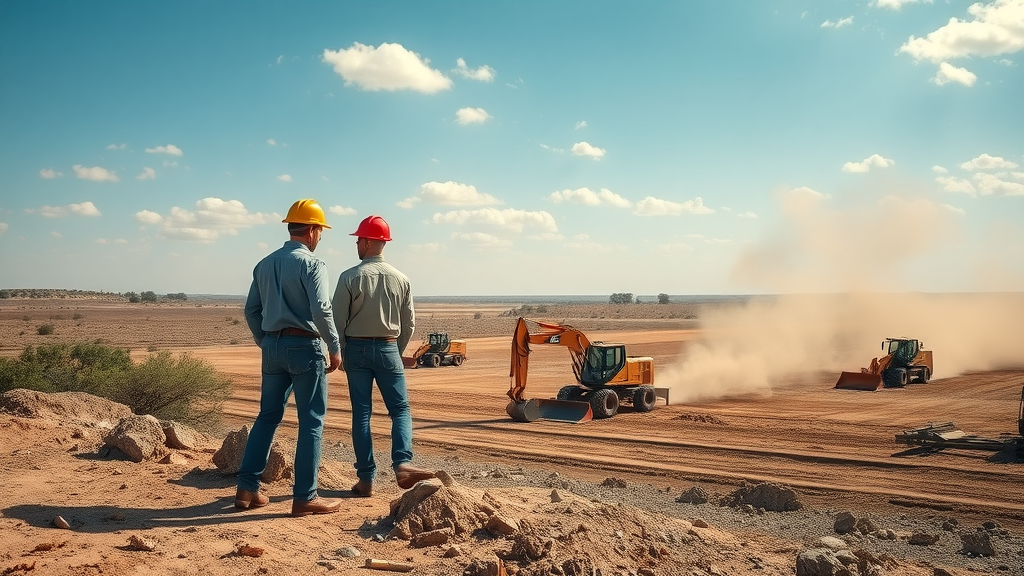
Ground preparation defines a construction project’s success because it decides whether the site is stable, drained, safely laid out and properly equipped before the first foundation is poured. Get the ground investigation, levelling, drainage, access routes and welfare set-up right, and later stages run on time; rush them, and soft spots, flooding, struck services and congested access come back later as delays, extra cost and safety incidents.
This guide covers the four areas where early groundwork still makes the biggest difference on UK sites: stable working surfaces, site layout, workforce welfare and proactive planning. It also sets out the investigation steps that should come first, the problems that most often catch projects out, and a checklist you can use before breaking ground.
Ground preparation at a glance
- Know the ground: desk study, site investigation and a utility survey come before any excavation.
- Create stable working surfaces: strip, level, compact and drain so plant and people can work safely in all weather.
- Plan the layout: separate vehicles and pedestrians, define storage and set welfare where it stays usable.
- Look after the workforce: CDM welfare must be in place from day one, on a base that stays usable all year.
- Plan for change: review the set-up as the build moves through each phase.
Why ground preparation still matters
Every successful build starts long before the first structure takes shape. The ground under a site controls how foundations are designed, where heavy plant can travel, how water behaves after rain and how much space is left for storage and facilities. Decisions made at this stage are cheap to change on paper and expensive to change once concrete is in the ground.
Planning covers practical details such as access routes, material storage, workspace allocation and the placement of essential facilities, including a welfare unit for 10 people or more, a site office and secure storage units, so they are positioned for daily use. These steps look routine, yet they create the framework for safer, better organised operations. As projects grow in scale and complexity, that framework matters even more, because more trades, deliveries and plant are competing for the same space.
It is tempting to treat enabling works as a cost to minimise so that “real” construction can start sooner. In practice, the opposite tends to hold: a day spent understanding the ground and setting up the site properly often saves several days of reactive work later in the programme.
Before you break ground: investigate the site
Good preparation starts with information. On most UK projects the sequence looks like this:
- Step 1, desk study: historic maps, geological records, flood risk maps and any previous land use that could mean contamination, old foundations or backfilled ground.
- Step 2, ground investigation: trial pits, boreholes and testing to establish soil type, bearing capacity and groundwater level. Shrinkable clays, made ground and high water tables all change foundation design.
- Step 3, underground services survey: utility records plus detection on site, following HSE guidance HSG47 on avoiding danger from underground services. A struck cable or gas main is one of the most serious and avoidable risks on any site.
- Step 4, ecology and invasive species check: plants such as Japanese knotweed need specialist handling and can halt earthworks if found late.
Under the Construction (Design and Management) Regulations 2015, clients must provide pre-construction information, and designers and principal contractors must plan to manage the risks it reveals. Ground conditions sit at the heart of that duty. If the information is thin, the sensible move is to commission further investigation rather than assume the best and hope.
What the investigation should tell you
By the end of this stage, the project team should be able to answer a handful of practical questions: what the soil can safely carry, how deep foundations need to go, where groundwater sits and how it changes seasonally, whether any material will need special disposal, and where every known service runs. If any of those answers is “we’re not sure”, that uncertainty belongs in the risk register and the programme.
1. Create stable and reliable working surfaces
Ground stability underpins safe, productive work. Uneven or poorly prepared surfaces quickly cause problems for plant and people alike. The usual steps are to strip and stockpile topsoil for reuse, remove soft or unsuitable material, then level and compact in layers to the specified standard.
Stable surfaces support heavy machinery and reduce the risk of unexpected movement during lifting, excavation or piling. Tracked rigs and cranes often need an engineered working platform, designed and checked by a competent person, because a platform failure can overturn a machine. Firm ground also reduces wear on equipment, keeps haul roads usable and lets workers carry out tasks with more confidence and precision.
Haul roads and hardstandings
Temporary haul roads and hardstandings carry far more traffic than people expect: concrete wagons, skip lorries, telehandlers and daily deliveries all use the same route. A road built with too little stone or no separation membrane over soft ground will rut within weeks. Building it properly once is almost always cheaper than repairing it repeatedly, and a well-built route can sometimes be designed to become the sub-base for a permanent road or car park later.
Drainage and water management
Drainage is the part of preparation most often underestimated. Without it, water pools, clay softens and access roads turn to mud after a wet week, which is common in a British winter. Practical measures include:
- Grading the formation so surface water runs away from excavations and working areas.
- Installing temporary cut-off ditches, French drains or sumps with pumps where needed.
- Protecting exposed formation from rain before concrete is placed.
- Controlling silty run-off with settlement areas, because discharging polluted water into drains or watercourses can breach environmental rules.
Think about where the water goes, not just how to move it off the working area. Pumping silty water into the nearest gully simply moves the problem to someone else and can lead to enforcement action.
2. Improve site layout and workflow efficiency
A well-planned site lets teams move between areas without confusion or delay. Clear pathways and designated zones keep order while several tasks run at once. When layout planning happens early, teams avoid congestion and the bottlenecks that build up when deliveries, plant and people share the same route.
A typical layout plan shows:
- Site entrance and exit, with visibility splays onto the public road.
- One-way vehicle routes, turning areas and a delivery drop zone.
- Segregated pedestrian walkways, crossing points and barriers.
- Material laydown areas close to where each material is used.
- Welfare, site office and secure storage away from plant routes.
- Waste segregation skips, fuel storage with bunding and a wheel wash if needed.
Efficient layouts keep materials, tools and equipment accessible, so workers spend less time walking around obstacles and more time on productive work. Defined zones also make coordination easier between the different trades on site. If you are still assembling the team, our guide to the types of contractors you need for your construction project explains who usually handles each stage.
Tight urban sites
On constrained city-centre sites, the layout often has to work vertically and over time. Deliveries may need booking slots, welfare may need to be stacked or placed on a gantry, and laydown space may only exist for a few days before it is built over. The same principles still apply, but the plan has to be revisited far more often, sometimes week by week.
3. Support workforce comfort and daily productivity
Construction work is physically demanding and needs steady concentration, so workforce conditions deserve early attention. In the UK, Schedule 2 of the CDM Regulations 2015 sets minimum welfare requirements: suitable toilets, washing facilities with hot and cold water, drinking water, somewhere to change and store clothing, and rest facilities where workers can sit, eat and make hot drinks. These must be available from the start of work, not added once the project is underway.
Ground preparation decides whether those facilities actually work. Welfare cabins need a level, firm base, safe walking access and, for connected units, routes for water, waste and power. A cabin placed on soft ground that floods in winter quickly becomes unusable, and workers end up walking further or going without. Well-placed, clean facilities support morale, and teams that feel looked after tend to be more engaged and more alert to safety.
Sizing welfare to the workforce
Size facilities for peak headcount, not the average. A small team at groundworks stage may grow considerably once structural and fit-out trades arrive. Plan the base and services so extra units can be added without disrupting live work areas.
Where to put welfare
- Close to the main entrance, so workers reach it without crossing plant routes.
- On ground that will not be excavated or built over for as long as possible, to avoid moving it mid-project.
- Within reach of water, drainage and power connections, or with space for self-contained units to be serviced.
- With a clear, lit walkway for early starts and winter evenings.
4. Reduce delays through proactive planning
Construction projects face delays when early planning ignores practical site challenges. Ground preparation brings issues to the surface before they interrupt progress: an unexpected clay layer, a buried tank, a high water table or an access road that cannot take a concrete wagon. Solving these early avoids reactive fixes that consume time and money.
Preparation also helps managers see how phases interact. Where will the crane stand when the frame goes up? Where will scaffold bases sit? Which laydown areas will be built over later, and where will materials move to then? Answering these questions at the start supports smoother handovers between trades and keeps workflow steady.
| Common ground problem | Typical impact if missed | Early prevention |
|---|---|---|
| Soft or made ground | Foundation redesign, plant getting stuck | Trial pits and boreholes, engineered platform |
| Poor drainage | Flooded excavations, lost days after rain | Grading, temporary drains, pumps |
| Unknown services | Serious injury, service strikes, stoppages | Records search and on-site detection |
| Contaminated or obstructed ground | Disposal costs, stoppages while material is assessed | Desk study of previous land use, sampling |
| Congested access | Delivery delays, vehicle and pedestrian conflict | Traffic management plan, one-way routes |
| Late welfare set-up | Non-compliance with CDM, low morale | Level base and services planned from day one |
Build the findings into the programme
Investigation is only useful if its results change the plan. Allow realistic time for weather on earthworks, include contingency for any unknowns flagged in the ground report, and sequence work so that drainage and access are complete before the heaviest traffic arrives.
Maintaining safety standards across every stage
Safety is central on any site, and ground preparation supports it directly. Stable surfaces, clear routes and organised layouts reduce slips, trips, falls into excavations and collisions. HSE guidance on construction workplace transport highlights separating people from vehicles as one of the most effective controls, and that separation has to be designed into the site layout from the beginning.
Prepared conditions also need regular checks. Haul roads rut, drainage silts up, edge protection gets moved and stockpiles creep into walkways. Weekly inspections, and extra checks after heavy rain, keep the site working as intended while the build progresses. Regulatory duties vary by project, so take advice from a competent health and safety adviser or CDM principal designer where you are unsure what applies.
Common mistakes to avoid
- Starting excavation before services have been located and marked on site.
- Relying on an old or generic ground report that does not cover the actual footprint.
- Placing welfare or storage on ground scheduled for later excavation.
- Leaving drainage until the first wet spell exposes the problem.
- Treating the layout plan as fixed instead of updating it at each phase.
Ground preparation checklist
- Pre-construction information and desk study reviewed
- Ground investigation completed and foundation design confirmed
- Underground services located and marked
- Topsoil stripped and stored, formation levelled and compacted
- Haul roads and working platforms designed for the loads they will carry
- Temporary drainage and silt control in place
- Traffic management and pedestrian routes marked
- Welfare, office and storage on firm, level bases with services connected
- Inspection schedule agreed for the duration of the build
The same principle applies at a smaller scale to domestic projects: investing properly in what sits underneath and behind the finishes pays back over time, as our guide to where to invest in high-end home renovations explains.
Frequently Asked Questions
What does ground preparation involve in construction?
It covers site investigation, locating underground services, clearing and stripping topsoil, levelling and compacting, installing drainage and setting out access routes, storage and welfare facilities before main works begin.
Why is drainage important during site preparation?
Poor drainage leads to flooded excavations, softened ground and unusable access roads, causing lost days and safety risks. Temporary drainage and silt control keep the site workable and protect nearby watercourses.
What welfare facilities are required on a UK construction site?
Schedule 2 of the CDM Regulations 2015 requires toilets, washing facilities with hot and cold water, drinking water, changing and storage space for clothing, and rest facilities. They must be available from the start of work.
How does site layout affect construction safety?
A clear layout separates vehicles from pedestrians, keeps walkways free of materials and gives plant safe routes. That reduces collisions, trips and falls.
When should ground preparation be planned?
During the pre-construction phase, alongside design. Ground conditions influence foundations, access and welfare placement, so they should be understood before contracts and programmes are fixed.
What is a working platform and when is one needed?
A working platform is an engineered layer of granular material that gives heavy tracked plant such as piling rigs and cranes a stable base. It is needed whenever the natural ground cannot safely support the plant, and it should be designed and checked by a competent person.
Bottom Line
Ground preparation is where a construction project’s risk is either removed or stored up for later. Investigate the ground and services properly, build stable surfaces and drainage before heavy traffic arrives, design a layout that separates people from vehicles, and put compliant welfare on a firm base from day one. Review the set-up at every phase, and the rest of the build has a much better chance of running safely, on time and on budget.