Choosing tiles can shape how your bathroom looks, feels, and works every day. The strongest bathroom tiles ideas balance colour, texture, maintenance, safety, and the room’s available light. For UK homes in 2026, warmer finishes and thoughtful layouts are replacing cold, overly uniform schemes.
Quick answer: Warm stone effects, large-format porcelain, textured feature walls, and earthy colours are strong choices for 2026. Small bathrooms often benefit from fewer grout lines and lighter tones. Floors need suitable wet-area performance, while walls give you more freedom with colour, shape, gloss, and decorative finishes.
| Design choice | Works especially well for | Main consideration |
|---|---|---|
| Large-format porcelain | Modern and small bathrooms | Plan cuts and wall preparation carefully |
| Warm stone effects | Calm, spa-inspired rooms | Keep fittings and grout within a warm palette |
| Textured tiles | Feature walls and shower areas | Consider cleaning around raised surfaces |
| Patterned floors | Traditional or characterful homes | Balance them with quieter walls |
| Vertical layouts | Low ceilings and compact rooms | Keep the pattern consistent |
| Tile drenching | Minimal modern bathrooms | Confirm every product suits its intended surface |
| Gloss wall finishes | Dark or compact bathrooms | Expect more visible water marks |
| Matt floor finishes | Family bathrooms | Check the manufacturer’s wet-use information |
Key Takeaways
- Warm beige, taupe, terracotta, stone, and muted green feel current without looking disposable.
- Large formats can reduce visual interruptions and help compact rooms feel calmer.
- Porcelain is a practical option where durability and moisture resistance matter.
- Decorative textures work best when concentrated rather than covering every surface.
- Floor suitability, grip, waterproofing, and preparation matter as much as appearance.
- Samples should be viewed inside the room before you commit to a full order.
Bathroom Tiles Ideas That Suit Real UK Homes
Current design trends favour warmer, softer bathrooms rather than stark white and cool grey schemes. UK interiors are also using richer natural textures and more individual finishes. The following eight approaches can work across en-suites, family bathrooms, cloakrooms, and larger renovations.
1. Choose warm stone effects instead of cold grey
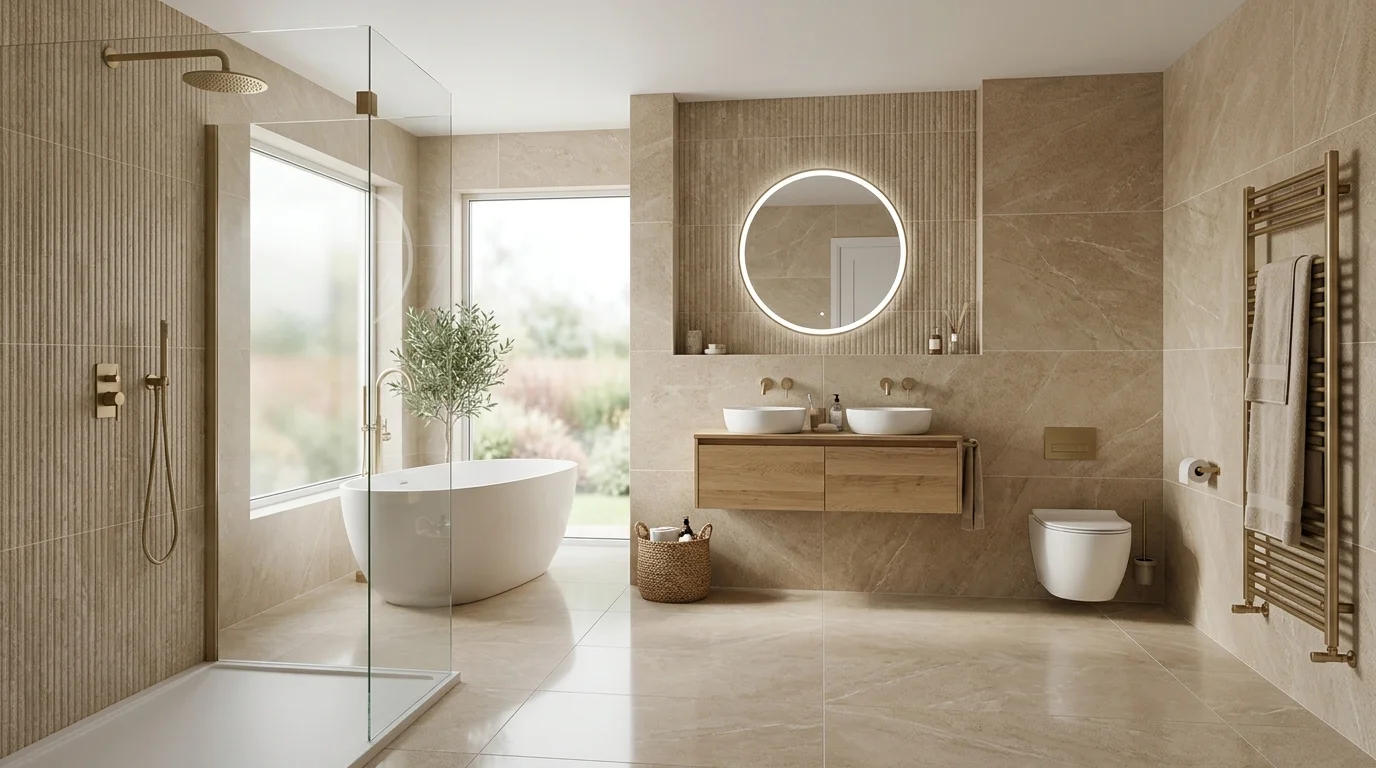
Stone-effect porcelain can bring warmth without requiring the maintenance associated with some natural materials. Look at limestone, travertine, sandstone, beige marble, or soft taupe effects. These colours pair easily with oak furniture, brushed brass, bronze, black, and chrome fittings.
A warm neutral scheme also gives you flexibility when towels and accessories change. Keep several large permanent surfaces within the same colour family. This approach helps the finished room feel considered rather than busy.
2. Use large formats to calm a compact room
Large tiles can work surprisingly well in a small bathroom when the layout is planned carefully. Fewer visible grout joints create broader areas of continuous colour. That can make walls and floors appear less fragmented.
Measure the room before choosing an oversized format because awkward cuts can spoil the effect. Position key grout lines around the bath, vanity, windows, and shower screen. A skilled layout often matters more than choosing the largest product available.
For flooring decisions beyond tile, Readox’s bathroom flooring guide compares porcelain with other water-resistant options. It also covers comfort, preparation, and wet-area considerations. This can help if you have not decided whether tiling is right for the entire floor.
3. Add texture on one focused surface
Fluted, rippled, handmade-effect, and irregular glazed finishes can add depth without demanding a bold colour. A vanity wall or shower wall is usually enough to create the effect. Keeping surrounding surfaces quieter prevents the room from becoming visually crowded.
Lighting matters when you use texture because shadows make raised patterns more noticeable. Side lighting can highlight ridges better than flat overhead light. Always consider cleaning before choosing deep grooves beside soap-heavy or hard-water areas.
4. Try tile drenching for a calmer modern look
Tile drenching uses one visual finish across several surfaces to reduce obvious breaks. The same colour family might continue from floor to walls and through the shower. Different product specifications can still be necessary even when the appearance matches.
This approach suits minimalist rooms because sanitaryware and furniture become the main visual features. It can also make an awkward layout feel more coherent. Check that every selected product is approved for its exact wall, floor, shower, or wet-room position.
5. Make the floor the feature
A patterned floor can give character to a bathroom without overwhelming eye-level surfaces. Checkerboards, Victorian-inspired patterns, geometrics, and subtle terrazzo effects are all useful options. Pair them with quieter walls so the floor remains the clear focal point.
This strategy works well in period properties where a completely minimalist scheme may feel disconnected from the building. Modern sanitaryware can still sit comfortably above a heritage-inspired pattern. Repeating one floor colour in towels or cabinetry helps tie the room together.
6. Use vertical layouts to change the room’s proportions
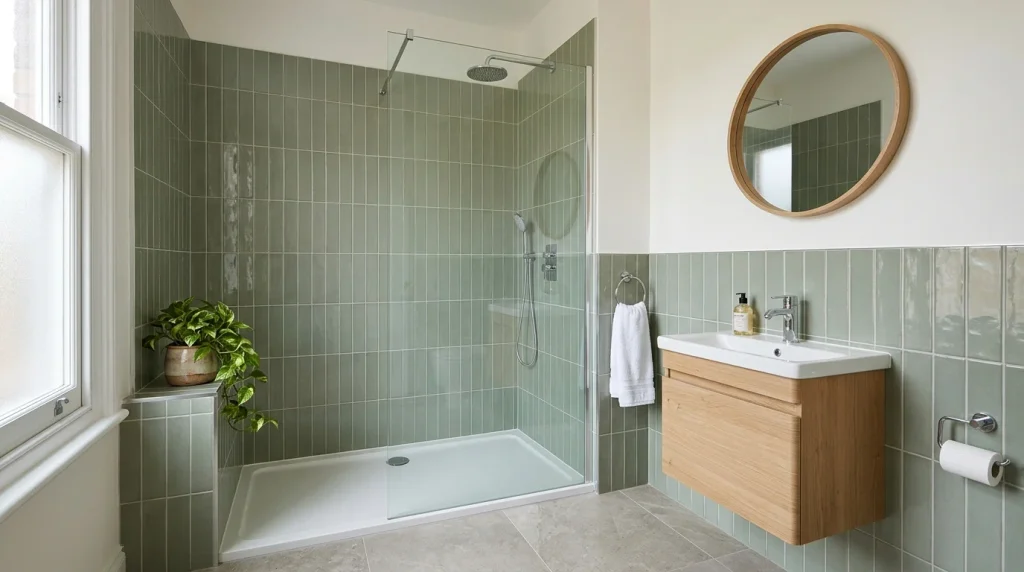
Rectangular tiles do not need to be laid horizontally. A vertical stacked layout draws attention upward and can emphasise ceiling height. It also feels cleaner than complex patterns in narrow spaces.
You can use the technique behind a basin, inside a shower, or across every wall. A contrasting grout makes the pattern more obvious, while matching grout creates a quieter result. Choose the grout effect deliberately because it changes how strongly the layout reads.
7. Bring colour into smaller areas
Deep green, terracotta, dusty blue, burgundy, and muted clay can give a bathroom more personality. You do not need to use a strong colour across every wall. A shower recess, bath surround, splashback, or vanity wall may provide enough impact.
Small areas also make future changes less disruptive if your taste changes later. Keep large permanent surfaces simpler when using an expressive accent. Timber, warm white, and restrained metal finishes can stop stronger colours from competing.
8. Mix matt floors with lighter wall finishes
You do not need the same finish across every surface. A matt floor can provide a softer visual base, while a lighter wall finish helps reflect available light. This combination works especially well in windowless rooms and compact en-suites.
Floor safety should come before the desire for a polished appearance. Check the manufacturer’s suitability information for wet environments before ordering. A wall product should never be assumed suitable for use underfoot.
How to Choose the Right Tile Material
Porcelain and ceramic are common choices, but they suit slightly different priorities. Porcelain is dense and hard-wearing, making it useful for floors and demanding wet areas. Ceramic often provides more decorative wall options and can be easier to cut.
Natural stone offers distinctive variation, although its care needs depend on the material and finish. Some products need sealing and more cautious cleaning. Always follow the supplier’s installation and maintenance guidance for the exact product.
Mosaics remain useful for niches, decorative details, and shower floors where smaller pieces accommodate slopes more easily. They also create far more grout lines than large formats. Factor that extra grout into your cleaning expectations before choosing them.
Plan Wall and Floor Tiles Separately
Wall surfaces allow more decorative freedom because they do not carry foot traffic. You can explore gloss, handmade effects, slimmer profiles, and stronger patterns. Wet walls still need correct preparation and a suitable waterproofing system beneath the decorative finish.
Floors need a different checklist because wet feet change the safety requirement. Confirm the tile is explicitly floor-rated and appropriate for the planned location. Readox’s broader Home Improvement section can help with related renovation decisions around the room.
Think About Grout Before Ordering
Grout changes the final appearance almost as much as the tile itself. Matching grout creates a calmer surface, while contrasting grout emphasises each individual shape. Mid-tone colours can also be more forgiving than brilliant white in busy family bathrooms.
Grout and sealant need routine care because bathrooms stay humid and receive frequent splashes. Good ventilation reduces persistent moisture around joints and corners. Readox’s mould-removal guide explains how to approach affected bathroom surfaces and moisture-related recurrence.
Matt or Gloss: Which Works Better?
Gloss wall tiles reflect more light, which can benefit a dark or compact bathroom. Their reflective surface may also make water spots and smears easier to notice. They are best judged with a sample under the room’s real lighting.
Matt finishes produce a softer appearance and often suit stone, concrete, and earthy designs. A matt appearance alone does not prove a product is safe for wet floors. Check technical specifications rather than relying on how textured the surface looks.
How to Make a Small Bathroom Feel Bigger
Start by limiting unnecessary visual changes across the room. Similar wall tones, restrained grout contrast, and fewer competing patterns can make the space feel calmer. A large mirror can increase reflected light without changing the room’s physical dimensions.
You can still use a feature tile in a compact space. Keep it within one defined area, such as the vanity or shower. Repeating its colour elsewhere creates a connection without adding another pattern.
Common Tile Mistakes to Avoid
Buying on appearance alone can create problems during installation or daily use. The product still needs to suit the surface, water exposure, substrate, and maintenance level. Large formats may also demand flatter walls and more careful cutting.
- Do not assume a wall tile can be used on the floor.
- Do not choose flooring without checking wet-area suitability.
- Do not order before measuring around doors, windows, and sanitaryware.
- Do not forget extra material for cuts, breakages, and future repairs.
- Do not mix batches without checking colour consistency.
- Do not select grout colour only from a small printed sample.
- Do not overlook ventilation and waterproof preparation.
Order physical samples before making the final decision whenever possible. View them during daylight and under the bathroom’s evening lighting. Colours and surface texture can look surprisingly different from online photographs.
Frequently Asked Questions
What bathroom tiles ideas are popular in the UK for 2026?
Warm neutrals, stone effects, rich natural colours, large formats, and tactile surfaces are prominent in current UK design coverage. Tile drenching and restrained patterned floors are also appearing frequently. Choose trends that suit your property and maintenance preferences rather than copying a showroom exactly.
What type of tile is best for a bathroom?
Porcelain is a practical choice for many floors because it is hard-wearing and moisture resistant. Ceramic remains useful for many walls and lighter domestic applications. The best option depends on location, specification, installation, and the finish you want.
What tile size is best for a small bathroom?
Larger formats can help a compact room feel calmer because they create fewer grout lines. The best size still depends on the dimensions and required cuts. A well-planned medium tile may look better than an oversized slab surrounded by narrow pieces.
Should bathroom wall and floor tiles match?
They can match, but they do not have to. A shared undertone or repeated colour is often enough to connect different surfaces. Mixing a simple wall with a patterned floor can produce a balanced result.
Are matt or gloss tiles better in bathrooms?
Gloss works well on walls where you want stronger light reflection. Matt finishes can create a softer, more natural appearance. For flooring, use the manufacturer’s wet-area and slip information instead of choosing by sheen alone.
How many different tile designs should one bathroom use?
Two main finishes are enough for many rooms, although there is no fixed rule. A third can work as a restrained accent within a niche or splashback. Limiting the palette usually makes fixtures and furniture easier to coordinate.
Build the Scheme Around Everyday Use
A bathroom should still work when the current trend cycle changes. Start with water exposure, cleaning needs, lighting, room size, and the people using the space. Then choose colour, format, pattern, and texture around those practical requirements.
Bring samples home before committing to a full order. Compare them beside your sanitaryware, furniture, paint, and metal finishes. A thoughtful combination will usually age better than a room built around one dramatic trend.