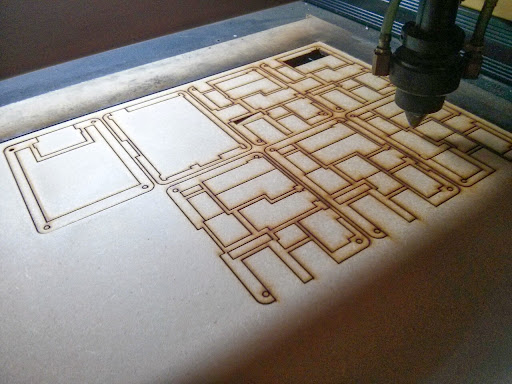
Industries need laser marking services because modern manufacturing depends on permanent, precise, machine-readable identification. Regulations and customers increasingly require every part to carry a serial number, batch code or 2D Data Matrix that survives heat, chemicals, sterilisation and wear for the life of the product. Laser marking does this without inks, labels or contact with the part, on metals, plastics, ceramics and glass, and at production speeds. Using a specialist service lets companies get that capability, and the expertise to get it right, without buying and running their own lasers.
In practice, the need comes from three directions at once: regulators who expect parts to be identifiable for their whole life, customers who want every component traceable to its batch, and automated factories that read codes rather than labels. This article explains how laser marking works, the main types of mark and laser, which industries depend on it and why, and how to choose between in-house equipment and a subcontract provider.
What is laser marking?
Laser marking uses a focused, computer-controlled beam of light to change the surface of a material and create a visible, permanent mark. Because the beam never touches the part, there is no tool wear, no mechanical stress and no consumables such as ink or labels. Marks can be text, logos, graphics, barcodes or 2D codes, and they can be changed from one part to the next simply by changing the data, which makes serialisation straightforward.
Types of laser mark
“Laser marking” is often used as a catch-all, but there are several distinct processes, each suited to different materials and requirements.
| Process | How it works | Typical use |
|---|---|---|
| Engraving | Removes material to create a recess | Parts exposed to heavy wear, or that may be painted or coated later |
| Etching | Melts a thin surface layer, creating a raised or textured mark | Fast, general-purpose marking on metals |
| Annealing | Heats metal below melting so it oxidises and changes colour, leaving a smooth surface | Stainless steel medical and food equipment where a smooth, corrosion-resistant surface matters |
| Carbonising / colour change | Darkens or changes the colour of plastics without removing much material | Plastic housings, cables and components |
| Foaming | Creates tiny bubbles that give a light, slightly raised mark | Dark plastics where a light mark is needed |
| Ablation | Removes a coating or paint layer to reveal the material beneath | Anodised aluminium, day-night buttons and coated parts |
Types of laser and what they mark best
| Laser type | Wavelength (approx.) | Best suited to |
|---|---|---|
| Fibre | Around 1,064 nm (infrared) | Most metals and many engineering plastics; the industrial workhorse |
| CO2 | Around 10,600 nm (far infrared) | Organic and non-metallic materials such as wood, paper, cardboard, glass, some plastics |
| Green | Around 532 nm | Reflective metals such as copper and gold, some sensitive plastics, silicon |
| UV | Around 355 nm | Heat-sensitive materials, fine marks on plastics, glass and electronics |
Shorter-wavelength sources are often described as “cold marking” because they break chemical bonds with less heat spreading into the surrounding material. That makes UV lasers a good choice for delicate materials where heat could cause cracking, discolouration or distortion, such as medical plastics, thin films and glass.
Fibre lasers have become dominant for metal marking because they are compact, efficient, have long-life diode pumps and need little routine maintenance compared with older lamp-pumped systems. Pulse control (such as MOPA fibre lasers) allows colour marking on stainless steel and better control on plastics.
Why demand for laser marking keeps growing
- Traceability: manufacturers need to trace each part back to its batch, material and process in case of recalls or failures.
- Regulation: medical, aerospace, automotive and defence sectors all have rules or customer standards requiring permanent identification.
- Automation: 2D codes that machines can read at every stage are central to smart factories, where robots and vision systems track parts automatically.
- Anti-counterfeiting: unique serial numbers and codes help brands and customers verify genuine parts.
- Sustainability: no inks, solvents or label waste, and marks that last the full life of the product.
The move towards automated production is closely linked. Our article on how mobile and quadruped robots are changing industrial automation shows how factories are relying more on machine-readable information at every step.
What can go wrong with laser marking
Laser marking is reliable once a process is set up, but most problems appear at the set-up stage. These are the issues experienced engineers check for first.
- Low contrast on the finished part. A mark that looks crisp on a test coupon can fade into the background on the real part after coating, heat treatment or passivation. Always test on parts that have been through the full production route.
- Codes that fail verification. A Data Matrix code can be visible to the eye yet still unreadable to a scanner if cell size, quiet zone or contrast is wrong. Grading codes with a verifier, not just a reader, catches this early.
- Heat damage. Too much energy on thin metals, plastics or coated parts can cause discolouration, warping, micro-cracking or loss of corrosion resistance. Choosing the right laser type and pulse settings matters more than raw power.
- Annealed marks that wash out. On stainless steel, some passivation and cleaning processes can lighten an annealed mark. Medical and food-equipment makers should validate marks after their actual cleaning and sterilisation cycles.
- Inconsistent fixturing. If parts are not held in the same position every time, the mark drifts, focus changes and quality varies across a batch. Good fixtures are as important as the laser itself.
- Data errors in serialisation. Duplicate or skipped serial numbers undermine traceability. The data flow from the customer system to the marking software needs checking as carefully as the mark.
Laser marking compared with other marking methods
Laser marking is not the only way to identify parts. Inkjet printing is cheap and fast but can smudge, fade or be wiped off by solvents. Adhesive labels can peel away in heat or during cleaning. Dot peen marking, where a stylus punches a series of dots, is durable and inexpensive, but it is slower, noisier, puts mechanical stress on the part and struggles with very small or fine detail. Chemical etching produces good marks but involves chemicals and masking. Laser marking combines the permanence of dot peen with the speed and flexibility of printing, which is why it has replaced older methods in so many production lines, even though the equipment itself costs more upfront.
| Method | Permanence | Speed | Consumables | Typical drawback |
|---|---|---|---|---|
| Laser marking | Very high | Fast | None | Higher equipment cost |
| Inkjet printing | Low to medium | Very fast | Ink and solvents | Smudges, fades or wipes off |
| Adhesive labels | Low to medium | Fast | Labels | Peel in heat, oil or cleaning |
| Dot peen | High | Slow to medium | Stylus wear | Noise, stress, limited fine detail |
| Chemical etching | High | Slow | Chemicals and masks | Handling and disposal of chemicals |
Industries that depend on laser marking
Automotive
Engine components, brake parts, airbags, electronic modules and fasteners are marked with part numbers, dates and Data Matrix codes. Marks must stay readable after heat treatment, coating, oil and years of vibration, so that suppliers and manufacturers can trace faults and manage recalls.
Aerospace and defence
Aircraft parts must be traceable throughout long service lives with repeated inspection and maintenance. Direct part marking with 2D codes is common, and aerospace standards set requirements for how such marks are applied and verified. Marks must not create stress points that could weaken critical components, which is why process selection matters.
Medical devices
Unique Device Identification (UDI) rules in the EU, US and elsewhere require many devices to carry identification, and reusable devices that are reprocessed often need the UDI marked directly on the device itself. Laser annealing is widely used on stainless steel surgical instruments because it leaves a smooth, corrosion-resistant surface that withstands repeated sterilisation without harbouring contamination. In Great Britain, medical devices are regulated by the MHRA.
Electronics and semiconductors
As components get smaller, marks must be tiny and precise without damaging sensitive circuits. Lasers mark circuit boards, chips, connectors and housings with codes that link each board to its production data.
Tools, industrial equipment and consumer goods
Cutting tools, hydraulic fittings, nameplates, control panels, jewellery and promotional products all use laser marking for durable branding, scales, specifications and personalisation.
In-house laser or subcontract service?
| Factor | In-house system | Subcontract service |
|---|---|---|
| Upfront cost | Capital investment in laser, enclosure, fume extraction and software | None; pay per job |
| Best for | High, steady volumes integrated into the line | Low to medium volumes, prototypes, variable demand |
| Flexibility | Limited to the laser types you own | Access to several laser types and fixtures |
| Expertise | You must develop process knowledge and train staff | Provider brings experience across materials |
| Safety and compliance | You manage laser safety, extraction and maintenance | Handled by the provider |
For many manufacturers, specialist laser marking services are the practical route: they can trial different processes on sample parts, produce short runs quickly and scale up when demand grows, without tying up capital or floor space.
What a subcontract laser marking job looks like
If you have never used a marking service, the process is usually simple and follows a predictable sequence.
- Enquiry and drawings. You send part drawings or samples, the material and finish, the content of the mark, its position and size, and the expected volumes.
- Process selection. The provider recommends a laser type and mark process, such as annealing for stainless instruments or ablation for anodised aluminium.
- Sample marking. A few parts are marked so you can check appearance, contrast, durability and code readability, ideally after your own downstream processes.
- Approval and fixturing. Once samples are approved, the provider sets up fixtures and locks the parameters so every part is marked the same way.
- Production and records. Parts are marked, inspected and returned, with serial data and inspection results recorded where traceability is required.
Allow time for the sample stage. It is where most problems are found and fixed cheaply, and skipping it is the most common cause of rejected batches later.
What affects the cost of laser marking
Providers price marking jobs on several factors rather than a single rate, so it helps to know what drives a quote:
- Mark area and depth. Larger or deeper marks take longer, and deep engraving can take many times longer than a surface anneal.
- Material and process. Some materials need slower settings or a specialist laser, which affects cycle time.
- Set-up and fixtures. One-off fixture design and programming are usually charged once, so they weigh heavily on small runs and very little on large ones.
- Variable data. Serialisation and code verification add handling and record-keeping.
- Volume and repeat orders. Repeat work on an approved set-up is usually cheaper per part than a first run.
When comparing quotes, check that each includes the same sample stage, inspection and documentation, because a lower price that omits verification can cost more in the long run.
How to choose a laser marking provider
- Range of lasers: check they have the right source for your material, whether fibre, CO2, green or UV.
- Sample marking: a good provider will mark test parts so you can check contrast, durability and appearance before committing.
- Code verification: if you need 2D codes, ask whether they grade code quality against recognised direct part marking standards.
- Quality systems: ISO 9001 certification is a sensible baseline; sector-specific experience matters for medical and aerospace work.
- Fixturing and capacity: ask how they hold your parts consistently and how quickly they can turn around your volumes.
- Data handling: for serialisation, confirm how they receive, apply and record unique data for each part.
Durable identification is one part of a wider approach to safe, well-organised industrial sites. For another example, see our guide to line marking for safer commercial spaces, or browse more in our Tech category.
Bottom line: why industry needs laser marking services
Laser marking has become essential because permanent, machine-readable identification is now a requirement rather than a nice-to-have in automotive, aerospace, medical and electronics manufacturing. The technology delivers marks that outlast the product without inks or labels, but the results depend on choosing the right laser, process and fixtures. For variable or modest volumes, a specialist service gives access to that expertise and several laser types without capital outlay; for high, steady volumes, in-house equipment can make sense once the process is proven. Either way, test on real parts and verify codes before committing to production.
Frequently asked questions
What is the difference between laser marking and laser engraving?
Engraving removes material to create a recessed mark. Laser marking is a broader term that also covers processes such as annealing and colour change, which alter the surface without removing much material. Engraving is chosen where marks must survive heavy wear or later coating, while annealing or colour change suits parts where the surface must stay smooth.
Which materials can be laser marked?
Most metals, many plastics, ceramics, glass, coated and anodised surfaces, wood and paper can be marked, as long as the right laser type and settings are used. Fibre lasers handle most metals, CO2 lasers suit organic materials such as wood and paper, and UV or green lasers are used for heat-sensitive plastics, glass and reflective metals. Testing on sample parts confirms contrast and durability before production.
Is laser marking permanent?
Yes. Laser marks are part of the material surface rather than a printed layer, so they resist abrasion, heat and chemicals far better than inks or labels. A deep engraved mark can survive the life of the part, but surface marks such as annealing can be affected by aggressive cleaning or passivation, so they should be validated against your actual processes.
Why is laser annealing used on medical instruments?
Annealing creates a dark mark on stainless steel while leaving the surface smooth, so it resists corrosion and repeated sterilisation without creating grooves where contamination could collect. It is commonly used for direct UDI marking on reusable surgical instruments, where the mark must stay readable through repeated reprocessing.
Should I buy a laser or use a marking service?
A subcontract service usually makes more sense for low to medium or variable volumes, prototypes and a wide range of materials. In-house systems suit high, steady volumes built into a production line. Many manufacturers start with a service to prove the process, then bring marking in-house once volumes justify the investment in equipment, safety measures and staff training.