Universal basic income (UBI) is an unconditional cash payment made to every individual, regardless of income, employment status or means test. No country has adopted a full national scheme, but more than a dozen substantial trials have now reported, and in 2026 one of them crossed a line none had crossed before: Ireland converted its Basic Income for the Arts pilot into a permanent programme. The household-level evidence is broadly consistent. Modest unconditional payments improve wellbeing and financial stability, and the collapse in employment that critics predicted has not appeared, though the largest and longest study yet published did find a small, measurable fall in hours worked.
The unresolved question is not whether unconditional cash helps recipients. It is whether a country can afford to pay it to everyone. On the arithmetic below, using current population estimates rather than the figures most articles still recycle, a genuinely universal UK scheme paying £100 a week to adults would cost roughly £291 billion gross before offsets, and around £325 billion once children are included. That is why the serious British debate in 2026 has moved away from full UBI towards partial schemes, minimum income guarantees and targeted unconditional payments. This guide sets out the definitions, the trial results including the ones that cut against the case, the updated UK costings, and where each nation of the UK has actually got to.
What Universal Basic Income Actually Is
The definition matters, because “basic income” is used loosely to describe five quite different policies. A true UBI has five defining features: it is periodic (paid regularly, not as a lump sum), paid in cash rather than vouchers, paid to individuals rather than households, universal, and unconditional. Remove any one of those and it becomes something else.
| Policy | How it works | Key difference from UBI |
| Universal basic income | Everyone receives the same payment, no conditions | The benchmark |
| Universal Credit (current UK system) | Means-tested, household-based, work-search conditions and sanctions | Conditional and tapered; withdrawn at 55p per £1 of net earnings above the work allowance |
| Negative income tax | Tax system pays out below a threshold, collects above it | Same net effect for many, but delivered through PAYE rather than as a separate payment |
| Minimum income guarantee | Tops incomes up to a defined floor | Means-tested, so not universal |
| Targeted basic income | Unconditional payment to a defined group, such as care leavers or artists | Unconditional but not universal |
Almost every real-world pilot has been a targeted basic income rather than a UBI. That distinction is the single most common source of confusion in the debate, because it means the trials tell us a great deal about unconditionality and very little about universality. A pilot that pays 2,000 artists proves something about artists receiving money. It proves nothing about what happens when the tax rise funding the payment lands on the same people receiving it.
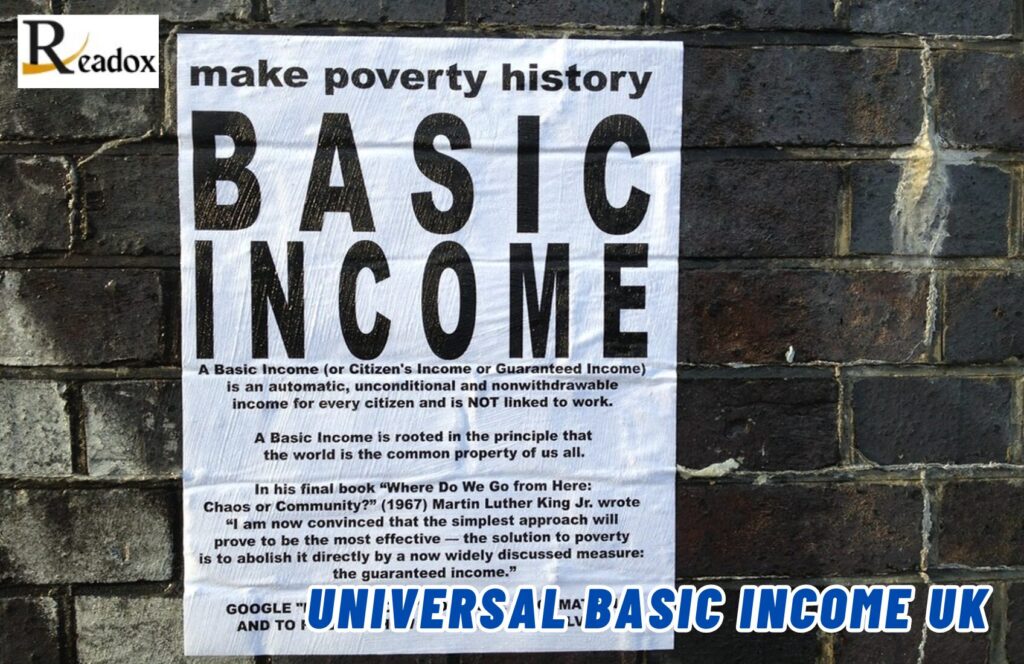
What Changed Between 2024 and 2026
Four developments have reshaped the evidence base and the British policy conversation since most UBI explainers were written, and none of them point in the same direction.
- Ireland made a basic income permanent. The Basic Income for the Arts pilot paid €325 a week to 2,000 artists and cultural workers from September 2022 to February 2026. A successor scheme, again covering 2,000 people, began in September 2026. It is the first time a European government has taken a basic income pilot through to a standing programme.
- The largest US study reported a fall in work. OpenResearch’s Unconditional Cash Study paid $1,000 a month for three years and found recipients two percentage points less likely to be employed and working 1.3 fewer hours a week than the control group. That is a small effect, but it is the opposite sign to Finland’s.
- Wales finished paying and started measuring. The care leavers pilot closed its delivery phase in 2025 with 644 young people enrolled. The third annual evaluation appeared in February 2026 and the final report is due in summer 2027.
- Scotland’s minimum income guarantee stalled. The expert group reported in May 2025 after nearly four years and £1.3 million of work. The Scottish Government’s December 2025 response committed to none of its numbers.
What the Trials Have Found
There is now a substantial body of experimental evidence, and it is more consistent than the political argument suggests, though it is no longer unanimous. The table below sets out the major schemes and their headline findings.
| Scheme | Payment and duration | Main findings |
| Finland national experiment | €560 per month to 2,000 unemployed people, 2017–2018 | Substantially better self-reported wellbeing, trust and mental health; a small positive employment effect, not a negative one |
| OpenResearch Unconditional Cash Study (Texas and Illinois) | $1,000 per month for three years, November 2020 to October 2023; control group received $50 | Recipients 2 percentage points less likely to be employed and working 1.3 hours a week less; earned income about $1,500 lower, but total individual income roughly $10,000 higher including the transfer |
| Wales care leavers pilot | £1,600 per month before tax for 24 months from age 18, from July 2022; 644 participants, 97 per cent uptake | Improved housing stability and engagement with education; persistent complications where payments interacted with reserved benefits |
| Ireland Basic Income for the Arts | €325 per week to 2,000 artists, September 2022 to February 2026 | More time on creative work, higher output, greater life satisfaction, lower anxiety and reduced deprivation; made permanent from September 2026 |
| Stockton, California (SEED) | $500 per month for 24 months to 125 residents | Full-time employment among recipients rose faster than in the control group; large falls in income volatility and anxiety |
| GiveDirectly, Kenya | Long-running village-level transfers, some running twelve years | Increases in enterprise formation and assets; no measurable rise in alcohol or tobacco spending |
| Ontario, Canada | Up to C$16,989 per year, launched 2017, cancelled early in 2018 | Cancelled before completion; participant surveys reported improved health and food security |
| Barcelona B-MINCOME | Municipal minimum income with and without conditions, 2017–2019 | Reduced material deprivation; conditional arms performed no better than unconditional ones |
Two conclusions survive scrutiny. First, the claim that people will simply stop working has not been borne out anywhere. Even in the OpenResearch data, employment rates among recipients rose from around 58 per cent at enrolment to 72 per cent by the end of the programme; the control group reached 74 per cent, so the gap is real but both groups moved the same way. Second, the reliably large effects are on mental health, financial resilience and the ability to plan, which are genuine benefits but harder to price into a Treasury spreadsheet.
Why the American Result Matters
The OpenResearch study deserves more attention than it usually gets in British coverage, because it is the closest thing to a properly powered test that exists. It ran for three years rather than one or two, used a randomised control group, and paid an amount large enough to matter. Its published employment findings show recipients reducing paid hours slightly and losing roughly 4 per cent of earned income, with household income excluding transfers down by between $2,500 and $4,100.
Supporters read that as recipients buying time for education, caregiving, health and better job searches. Critics read it as a labour supply withdrawal that would compound at national scale, since the tax to fund the payment would itself discourage work. Both readings are defensible from the same data, which is precisely why the study has been cited approvingly by both camps. The honest summary is that the effect is small, real, and not what the earlier pilots had suggested.
The crucial caveat applies to all of them: trials are not scale models. A pilot pays a few thousand people out of an existing budget. A national scheme pays everyone and must be financed by taxing the same population, which changes prices, wages and incentives in ways no pilot can capture.
What UBI Would Cost the UK: The 2026 Arithmetic
This is where most articles retreat into vagueness, and where many of the figures still circulating are simply out of date, because they use a population base from a decade ago. The sums are not complicated, so here they are on current estimates.
The UK population is now around 69 million, of whom roughly 56 million are aged 16 or over and about 13 million are children. A scheme paying adults £100 a week costs £5,200 per adult per year. Multiplied out, that is approximately £291 billion a year in gross cost for adults alone. Add £50 a week for children and you add roughly £34 billion, for a gross total near £325 billion.
For scale, total UK managed expenditure runs well above £1.3 trillion a year, and income tax raises something in the region of £320 billion. A gross UBI bill of £325 billion is therefore comparable to the entire yield of income tax, and larger than the NHS budget for England.
Gross cost is not net cost, however. A serious scheme recoups a large share:
- Abolishing the personal allowance. The £12,570 tax-free allowance has been frozen since April 2021, and the November 2025 Budget extended that freeze to April 2031, a full decade without uprating. It costs the Exchequer well over £100 billion a year in forgone revenue. If everyone receives a basic income, the case for also exempting their first £12,570 from tax largely disappears. Recovering that closes roughly a third of the bill.
- Replacing parts of the benefit system. Universal Credit standard allowances and elements of tax credits could be folded in, worth tens of billions. Disability and housing support cannot be, because those costs vary enormously by individual and region.
- Reduced administration. Real but modest. Means-testing and sanctions machinery costs billions, not tens of billions.
Net of those offsets, most credible costings for a meaningful UK scheme land somewhere between £70 billion and £130 billion a year of genuinely new spending. To put that in tax terms, a penny on the basic rate of income tax raises somewhere between £7 billion and £8 billion, depending on which year of HMRC’s ready reckoner you use, and estimates vary by around a billion pounds between publications. Financing £100 billion through income tax alone would therefore require something in the order of 13 to 14 pence on the basic rate. That is the number that has stopped every serious UK proposal.
How a £100 a Week UBI Compares to Universal Credit Today
A comparison almost nobody makes is the most clarifying one available. From 7 April 2026 the Universal Credit standard allowance for a single claimant aged 25 or over is £424.90 a month, which works out at about £98 a week. A £100 a week UBI would therefore pay a single adult almost exactly what the current system already pays, with three differences: everyone would get it, nobody would lose it as they earned, and nobody would face a work-search condition to keep it.
| Household | Universal Credit standard allowance from April 2026 (monthly) | Equivalent per week |
| Single, under 25 | £338.58 | About £78 |
| Single, 25 or over | £424.90 | About £98 |
| Couple, both under 25 | £528.34 | About £122 |
| Couple, one or both 25 or over | £666.97 | About £154 |
Two features of the current system sharpen the contrast. The work allowance, the amount a claimant can earn before the taper bites, stands at £427 a month for those receiving the housing element and £710 a month for those who are not, with no allowance at all for claimants who have neither children nor a limited capability for work. And under the Universal Credit Act 2025 the standard allowance is being uprated by CPI plus 2.3 percentage points a year to 2029-30, which narrows the gap between the existing safety net and a modest basic income with every passing year.
The implication is awkward for both sides. For advocates, it means a £100 a week UBI is not transformative for a single adult already on Universal Credit; the gain is concentrated in couples, in people who never claim, and in the removal of the taper. For opponents, it means the headline cost is not buying a new level of generosity so much as paying the existing level to everyone.
Who Would Gain and Who Would Pay: A Worked Example
Aggregate costings hide the question most readers actually care about: would I be better or worse off? The simplified illustration below uses the scheme costed above, a £100 a week payment (£5,200 a year) to every adult, funded by abolishing the personal allowance and adding 13 pence to the basic rate of income tax, taking it from 20 to 33 per cent. It ignores National Insurance, benefit interactions and the higher-rate band, so treat it as a way of seeing the shape of the trade-off rather than a forecast.
| Adult | Income tax today | Income tax under the scheme | Basic income received | Net change per year |
| No earnings, not claiming benefits | £0 | £0 | £5,200 | +£5,200 |
| Part-time earner on £10,000 | £0 | £3,300 | £5,200 | +£1,900 |
| Earner on £20,000 | £1,486 | £6,600 | £5,200 | +£86 |
| Full-time earner on £30,000 | £3,486 | £9,900 | £5,200 | −£1,214 |
On these assumptions the break-even point sits at roughly £20,700 of earnings. Below it, an adult gains; above it, the extra tax outweighs the payment. That single number explains most of the politics. The gains are concentrated among people with low or irregular earnings and among adults with no independent income, many of them partners in single-earner households. The costs fall on the median full-time worker, who is also the median voter.
Three refinements change the picture without overturning it. Households, not individuals, pay bills, so a couple with one full-time earner and one adult at home would gain overall even where the earner loses. People currently receiving Universal Credit would see a smaller net gain, because part of the basic income replaces support they already get. And if the scheme retained disability and housing support, as most detailed proposals now do, the tax rise needed would be higher and the break-even point lower.
Anyone weighing a real proposal should ask for this table first. A scheme that cannot show who gains and who pays at different income levels has not been costed in any sense that matters to households.
How It Could Be Funded
| Funding route | Plausible annual yield | Political difficulty |
| Abolishing the personal allowance | £100bn+ | High, because it creates visible losers among middle earners |
| Folding in working-age benefits | £40–80bn | Moderate, but risks leaving disabled claimants worse off |
| Higher income tax rates | £7–8bn per penny on the basic rate | Very high |
| Wealth or land value taxation | Estimates vary hugely; £10–30bn realistically | High, given valuation and avoidance problems |
| Carbon dividends | £5–15bn | Moderate, but the base shrinks as decarbonisation succeeds |
| Sovereign wealth fund returns | Negligible in the UK today | Low, but requires decades to build |
The carbon dividend and sovereign fund routes deserve a note. Alaska’s Permanent Fund Dividend, the world’s longest-running universal payment, has distributed an annual dividend to residents since 1982. Its recent history shows both the appeal and the instability of resource-funded payments: $3,284 in 2022, the largest on record, then $1,312 in 2023, $1,702 in 2024 and $1,000 in 2025. It demonstrates that universal payments can be politically durable when they are visibly funded by an endowment rather than by taxing recipients, but also that an oil-linked dividend swings by a factor of three within four years, which is not a property you want in a household’s income floor. The UK has no equivalent endowment, which is a structural rather than an ideological obstacle.
Middle-Ground Models Between UBI and Today’s System
Because a full scheme is so expensive, most of the practical design work in the UK now concerns hybrids that keep some of UBI’s advantages at a fraction of the cost. Four are worth understanding.
Partial basic income
A smaller universal payment, often discussed in the range of £40 to £60 a week, paid alongside a slimmed-down means-tested system rather than replacing it. It removes some of the taper problem and guarantees everyone a small unconditional floor, while targeted support continues to handle housing costs and disability. The cost falls roughly in proportion to the payment level, which is why it features in most recent think-tank proposals.
Negative income tax
Rather than paying everyone and then taxing most of it back, the tax system pays out to people below a threshold and collects from people above it. Economically it can be designed to produce the same net position as a UBI for each household, at a much lower headline cost, because nobody receives a payment that is immediately clawed back. The difficulty is practical: it needs accurate, real-time income data and a payment mechanism for people outside PAYE.
Targeted unconditional payments
Payments to defined groups with no conditions attached, such as the Welsh care leavers pilot or Ireland’s arts scheme. They are cheap, legally simple and politically defensible, and they generate exactly the kind of evidence the UK currently lacks. They also sidestep universality, which is the expensive part.
Child Benefit as a near-universal precedent
Britain already has a payment that resembles a basic income for one group. Child Benefit is paid per child without a means test at the point of claim, although the High Income Child Benefit Charge claws it back from higher earners through the tax system. It shows that an almost-universal payment can be popular and administratively cheap, and also how quickly universality gets qualified once fiscal pressure builds.
The Strongest Case For
Set aside the utopian framing and the substantive arguments are these.
It removes the participation tax trap. Under Universal Credit, net earnings above the work allowance are withdrawn at 55p in the pound. Combine that with income tax at 20 per cent and National Insurance and some claimants face effective marginal deduction rates above 70 per cent. A basic income that is not withdrawn eliminates this entirely, which is a genuine pro-work reform and the strongest technical argument in its favour.
It reaches people the current system misses. Take-up of means-tested benefits is chronically incomplete; billions in Pension Credit and other entitlements go unclaimed every year because people do not know they qualify, find the process degrading, or are deterred by complexity. Wales’s care leavers pilot reached 97 per cent of the eligible cohort, a take-up rate no means-tested scheme in Britain comes close to. A universal payment has, by construction, one hundred per cent take-up.
It suits an economy of irregular work. Gig work, zero-hours contracts, self-employment and portfolio careers do not fit a system built around monthly assessment periods. Anyone who has dealt with the rules governing off-payroll working and IR35 will recognise how badly conventional employment categories map onto how many people now earn. A stable floor beneath volatile earnings is more useful than a benefit that recalculates in arrears.
It provides insurance against automation. Whether artificial intelligence displaces workers at scale is genuinely uncertain, but the asymmetry matters: the cost of having a floor in place and not needing it is far lower than the cost of needing one and not having it.
The Strongest Case Against
The cost is the objection, and it is a serious one. Every route to funding a meaningful scheme requires either a large tax rise or the dismantling of targeted support. Neither has ever commanded a parliamentary majority, in any UK parliament or devolved legislature.
Universality is regressive at the margin. Sending £5,200 a year to a higher-rate taxpayer and funding it by taxing them £6,000 is administratively neat but achieves nothing a tax cut would not. The redistribution comes from the tax side, not the payment side, so critics reasonably ask why the payment is needed at all.
Flat payments ignore unequal needs. A disabled person in central London and a healthy person in a low-cost area do not have the same costs. A system that abolishes targeted disability and housing support in favour of a flat sum makes some of the most vulnerable households considerably worse off. This is the objection most UBI advocates take most seriously, and most detailed proposals now retain disability and housing benefits alongside the basic income, which pushes the cost up again.
Some of the money is absorbed by rents. If everyone in a constrained housing market receives more cash, part of it flows to landlords rather than tenants. The size of this effect is debated, but in a market with the UK’s supply constraints it is not zero.
The best evidence now includes a labour supply effect. For years advocates could say, accurately, that no well-designed trial had found people working less. After OpenResearch that claim needs qualifying. The effect is modest, but it is there, and at national scale a 1.3 hour reduction in average weekly hours would be a measurable loss of output and tax revenue.
Where the UK Debate Stands in 2026
No UK government has committed to a national scheme, and none is close to doing so. The live activity is at the devolved level, and each nation has reached a different point.
Wales
Wales ran the most substantial British trial to date. The Basic Income for Care Leavers pilot paid £1,600 a month before tax for 24 months to young people leaving care after their eighteenth birthday, starting in July 2022. Delivery finished in 2025 with 644 participants enrolled, 97 per cent of those eligible. The independent evaluation, led by the CASCADE centre at Cardiff University with partners at King’s College London, Oxford, York and Northumbria, published its third annual report in February 2026. A fourth report is expected in early 2027 and the final evaluation, which will compare outcomes against a non-recipient control group and assess value for money, in summer 2027.
The most policy-relevant finding so far is not about outcomes at all. It is that an unconditional payment made by a devolved government collides awkwardly with a benefits system reserved to Westminster. Participants’ payments interacted with Universal Credit, housing support and student finance rules in ways that required continual case-by-case management. Any future UK basic income would face the same problem multiplied across millions of claims.
Scotland
Scotland’s feasibility work concluded years ago that a full basic income was not deliverable without powers over tax and benefits that Holyrood does not hold. The conversation moved instead to a minimum income guarantee, a floor beneath household income delivered through existing systems. An expert group worked from August 2021 to May 2025 and produced a roadmap recommending income thresholds of £11,500 for a single adult, £20,000 for a couple and £28,000 for a couple with one child, with payments tapering as earnings rose. The Scotsman reported through freedom of information requests that the exercise cost £1.3 million.
The Scottish Government’s response, published in December 2025, endorsed the ambition without committing to the figures or the timetable, and pointed out that the minimum wage and Universal Credit remain reserved. The Poverty Alliance publicly described the response as disappointing. The full roadmap to dignity report remains the most detailed costed proposal for an income floor anywhere in the UK, and it is currently unfunded.
England and the rest of the UK
In England, think tanks including Autonomy have proposed micro-pilots paying £1,600 a month to small groups in contrasting areas, designed to generate British evidence rather than to prove national affordability. Nothing has been commissioned at national level. The centre of gravity has moved from full UBI towards partial and targeted schemes: a modest universal payment layered on top of retained targeted benefits, or unconditional payments for specific groups such as care leavers, carers and new parents. These are cheaper, easier to legislate, and capture much of the wellbeing benefit the trials identified.
Ireland’s decision is the counterpoint worth watching from a UK perspective. Its arts scheme survived contact with a general election and a budget round, and was renewed for a second cohort of 2,000 from September 2026. It did so by being small, defensible on cultural policy grounds, and framed as sector support rather than welfare reform. That is a template a British government could copy for carers or care leavers long before it could contemplate anything universal.
Design Choices That Decide Whether It Works
- Payment level. Too low and it changes nothing; too high and it is unaffordable. Most serious UK proposals cluster between £60 and £100 a week for adults, which is to say between roughly 60 per cent and 100 per cent of the current single Universal Credit standard allowance.
- What it replaces. Replacing the personal allowance is fiscally sensible. Replacing disability and housing support is where schemes turn regressive.
- Individual or household basis. Individual payment is a meaningful gain for anyone in a financially controlling relationship, since it cannot be captured by a partner.
- Indexation. A payment not uprated with inflation erodes quickly. The personal allowance freeze from 2021 to 2031 is the cautionary example: a threshold left unchanged for a decade quietly becomes a very different policy from the one legislated.
- Interaction with tax. Whether the payment is taxable determines who actually gains, and it is the least discussed part of most proposals.
- Interaction with reserved systems. The Welsh pilot’s hardest practical problem was not funding but plumbing. Any scheme has to be designed alongside Universal Credit, student finance and housing support rather than bolted on beside them.
For related reading on how tax policy choices shape household finances, see our explainer on inheritance tax under Rachel Reeves. If you are thinking about income floors in a personal rather than a policy sense, our guide to making your savings last covers the same problem from the household side.
Common Misconceptions About Universal Basic Income
- “It has been tried and proven.” Unconditional payments have been tested extensively, but almost always to a targeted group funded from an existing budget. No trial has tested universality financed by taxing the recipients.
- “People would stop working.” No trial has found anything like that. The strongest negative finding, from OpenResearch, is a reduction of about 1.3 hours a week, alongside rising employment in both groups.
- “It would cost £325 billion.” That is the gross figure. The genuinely new spending, after recovering the personal allowance and replacing some benefits, is a fraction of it, though still very large.
- “It would replace the whole welfare state.” Most serious proposals keep disability and housing support, because a flat payment cannot reflect very different needs and costs.
- “Rich people would get free money.” They would receive the payment, but under any funded design they pay more in extra tax than they receive. The universality is administrative rather than a net gift.
- “Scotland or Wales could just introduce one.” Neither has the tax and benefit powers to deliver a full scheme, which is why Scotland moved to a minimum income guarantee and Wales ran a targeted pilot.
How to Judge Any UBI Proposal: A Checklist
New basic income proposals appear regularly from think tanks, campaigners and political parties. These questions separate a costed plan from a slogan:
- What is the weekly payment for adults and for children? Compare it with the current Universal Credit standard allowance to see whether it is genuinely new money.
- Is the headline cost gross or net? A credible proposal states both and lists every offset it relies on.
- What happens to the personal allowance? If it is kept, the cost rises sharply; if it is abolished, low earners start paying income tax from the first pound.
- Which benefits are replaced and which are kept? Look specifically at disability and housing support, where flat payments do most harm.
- Where is the break-even income? The level at which households stop gaining tells you who is paying.
- Is the payment uprated each year? Without indexation, its value erodes quietly.
- Who delivers it, and with which powers? A proposal from a devolved government must explain how it interacts with reserved Westminster systems.
A proposal that answers all seven is worth taking seriously, whichever side of the argument you start from.
Bottom Line on Universal Basic Income
Universal basic income has strong evidence behind its effects on wellbeing and financial security, a small but now measurable effect on hours worked, and a cost problem that no UK government has solved. A £100 a week scheme would cost about £291 billion gross for adults and somewhere between £70 billion and £130 billion net, roughly 13 to 14 pence on the basic rate for £100 billion. The realistic path in Britain over the next few years is targeted unconditional payments and minimum income floors, not a universal scheme. If you are trying to understand how any proposal would affect your own household, look for its break-even income and what it does to disability and housing support, and speak to a financial adviser or welfare rights service before acting on benefit changes.
Frequently Asked Questions
What is universal basic income in simple terms?
Universal basic income is a regular cash payment made to every individual by the state, with no means test and no requirement to work or seek work. Everyone receives the same amount whether they are employed, unemployed, wealthy or poor, and the redistribution happens through the tax system rather than through eligibility rules.
Has any country introduced universal basic income?
No country has a full national UBI. Ireland came closest in 2026 by making its Basic Income for the Arts permanent, paying €325 a week to 2,000 artists, but that is a targeted scheme rather than a universal one. Alaska’s Permanent Fund Dividend, paid to residents annually since 1982, is the closest long-running universal equivalent, though it is funded from oil revenues and is far too small to live on. Finland, Canada, Spain, Kenya and the United States have all run substantial trials, and Wales has run a targeted pilot for care leavers.
How much would universal basic income cost in the UK?
On current population estimates, paying £100 a week to every adult would cost roughly £291 billion a year gross, rising to around £325 billion if children receive £50 a week. After abolishing the personal allowance and folding in parts of the working-age benefit system, most credible costings put the net additional cost between £70 billion and £130 billion a year, equivalent to roughly 9 to 18 pence on the basic rate of income tax.
Does basic income make people stop working?
Not stop, but the newest evidence shows a small reduction. Finland’s national experiment found a small positive employment effect and the Stockton pilot in California found full-time employment rose faster among recipients. The larger OpenResearch study in Texas and Illinois, which paid $1,000 a month for three years, found recipients were two percentage points less likely to be employed and worked 1.3 fewer hours a week than the control group. Employment rose in both groups over the period, so the effect is a modest gap rather than a withdrawal from work.
What is the difference between universal basic income and Universal Credit?
Universal Credit is means-tested, assessed at household level, subject to work-search conditions and sanctions, and withdrawn at 55p for every extra pound of net earnings above the work allowance. Universal basic income would be paid to individuals unconditionally at a flat rate and would not be withdrawn as earnings rise, removing the high effective marginal deduction rates the current system creates. In cash terms the two are closer than most people assume: the single Universal Credit standard allowance for those aged 25 and over is £424.90 a month from April 2026, about £98 a week.
Is the UK likely to introduce universal basic income?
A full national scheme is unlikely in the near term because no route to funding it has attracted majority political support, and because the devolved governments that are most interested lack the tax and benefit powers to deliver one. The more probable direction is incremental: unconditional payments targeted at specific groups such as care leavers, or a minimum income guarantee of the kind Scotland’s expert group proposed in May 2025, which sets a floor beneath household income while retaining means-testing above it.