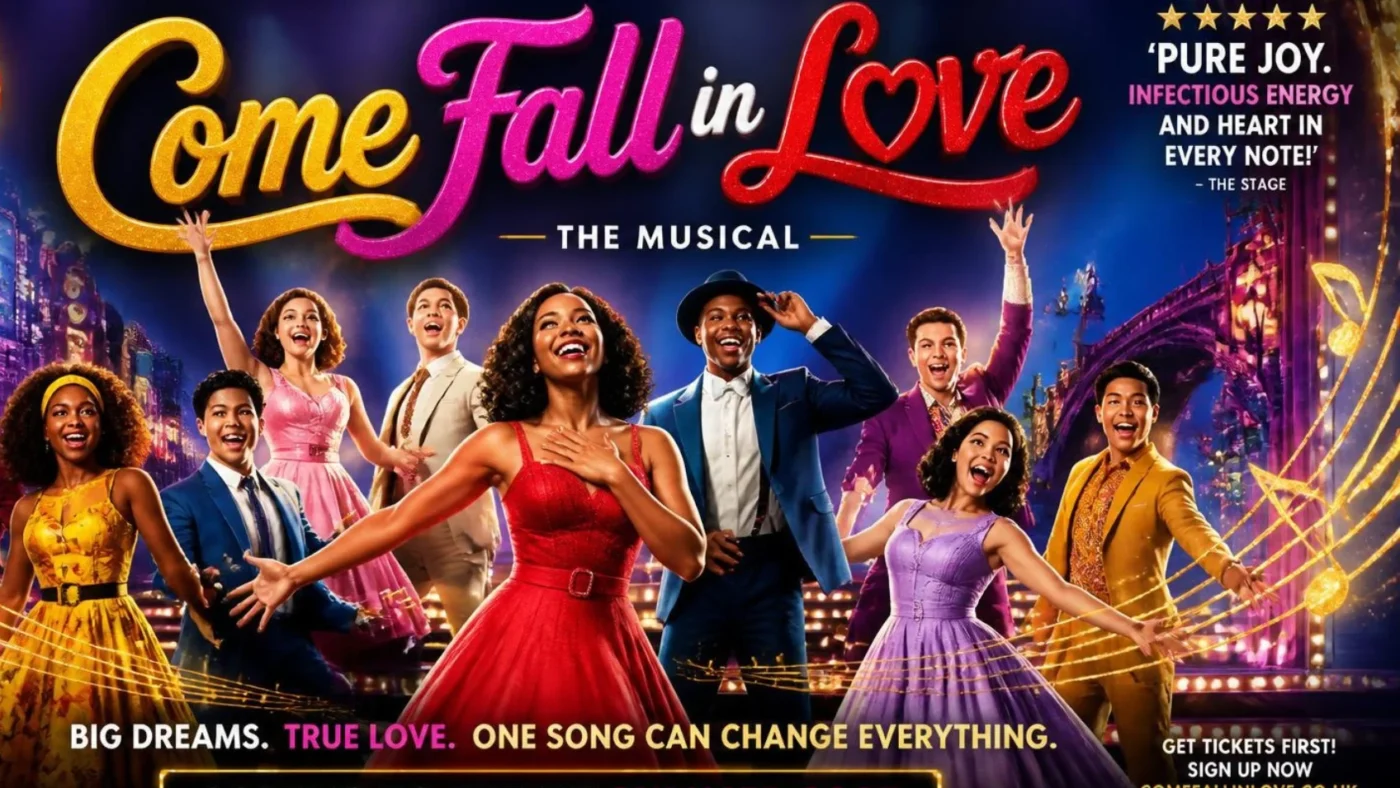
The Come Fall in Love musical turns the Bollywood classic Dilwale Dulhania Le Jayenge into an English-language stage romance. It premiered in the UK at Manchester Opera House on 29 May 2025. The limited Manchester engagement ran until 21 June 2025.
Directed by original DDLJ filmmaker Aditya Chopra, the production reshapes the familiar romance for the stage. Jena Pandya starred as Simran, while Ashley Day played Roger. The creative team drew talent from Indian cinema, Broadway, and West End theatre.
Quick answer: The stage musical is an English-language adaptation inspired by the 1995 Bollywood film Dilwale Dulhania Le Jayenge. It follows British Indian Simran and British Roger through Europe and India. The production features 18 original English songs, large dance sequences and a story about love, family and cultural expectations.
| Key detail | Information |
| Production | Come Fall in Love, The DDLJ Musical |
| Based on | Dilwale Dulhania Le Jayenge (DDLJ) |
| UK premiere | 29 May 2025 |
| UK premiere venue | Manchester Opera House |
| Manchester run ended | 21 June 2025 |
| Director | Aditya Chopra |
| Book and lyrics | Nell Benjamin |
| Music | Vishal Dadlani and Sheykhar Ravjiani |
| Simran | Jena Pandya |
| Roger | Ashley Day |
| Original songs | 18 English-language songs |
| Choreography | Rob Ashford |
| Indian dance co-choreography | Shruti Merchant |
What is the Come Fall in Love musical?
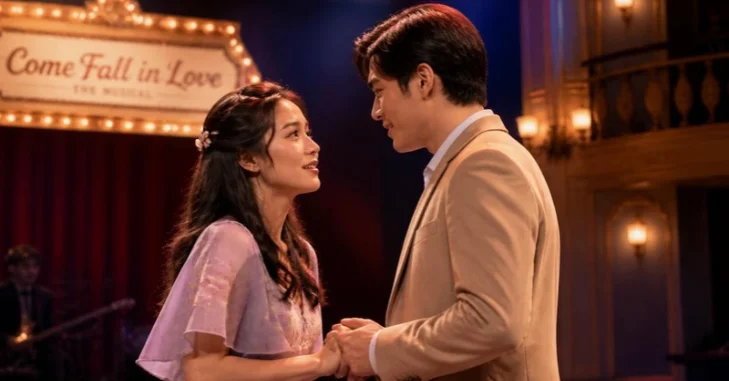
The Come Fall in Love Musical production takes its inspiration from DDLJ, one of Indian cinema’s defining romantic films. Aditya Chopra directed the original movie and returned to direct its stage reworking. Rather than recreating the film scene by scene, the musical adapts its central conflict for an English-language production.
DDLJ was released in 1995 and became closely associated with romance, family expectations, and Indian identity abroad. The stage version keeps those themes but changes key character details. Its central romance places British Indian Simran opposite Roger, a British man.
That change makes the cultural divide particularly clear for a British audience. Simran must balance her feelings with expectations surrounding her arranged marriage. Roger must understand a family and heritage far removed from his carefree life.
What is the story about?
Simran is a young British Indian woman whose family has planned her future. She is expected to marry a family friend in India. Before that happens, she persuades her father to let her enjoy a final summer travelling through Europe.
During the trip, Simran becomes stranded with Roger, a relaxed and privileged British traveller. Their initially unlikely pairing develops into a romance. The problem is that Roger represents almost everything Simran’s traditional father did not choose for her.
The second half of the conflict is therefore larger than a simple love story. Simran has to consider her own wishes without treating her family ties as meaningless. Roger also has to prove that his feelings carry more weight than a holiday romance.
How does the stage version connect with DDLJ?
Fans of DDLJ will recognise the broad emotional foundations behind the production. Travel, family approval, romance and cultural identity remain central to the story. The adaptation also preserves Britain’s importance within the wider DDLJ story.
That British connection has a long history. The filmmakers shot parts of the 1995 film in the UK, including an iconic sequence at King’s Cross station. In 2025, the musical brought that British connection into a new theatrical setting.
The stage adaptation is not designed as a direct reproduction of the movie. Roger differs from the film’s Raj, creating a new cross-cultural dynamic. Readers interested in similar film, television and cultural stories can explore Readox’s entertainment coverage next.
Who was in the UK cast?
Jena Pandya led the UK production as Simran. Her earlier stage credits include Sophie in Mamma Mia! and the lead role in Bhangra Nation. Ashley Day appeared opposite her as Roger, following theatre work in Britain and the United States.
The supporting company included Irvine Iqbal as Baldev and Harveen Mann-Neary as Lajjo. Kara Lane played Minky, while Amonik Melaco appeared as Ben. Millie O’Connell, Ankur Sabharwal, Kinshuk Sen and Russell Wilcox were also among the principal cast.
Casting matters here because the story moves between cultures, generations and different ideas about love. Simran and Roger are at the centre of the romance. Her family gives that relationship its emotional and cultural stakes.
The music brings Bollywood and musical theatre together
Indian composers Vishal Dadlani and Sheykhar Ravjiani wrote the score. Nell Benjamin wrote the lyrics alongside her work on the show’s book. The production contains 18 newly written English-language songs rather than relying on the original film soundtrack.
The title song clearly illustrates the musical approach. It was released before the Manchester opening in April 2025. Its arrangement combines Indian instruments, including dhols, with Western musical-theatre influences.
That choice helps the production establish its own stage identity. Audiences familiar with DDLJ get a new score rather than theatrical versions of familiar film numbers. Readers interested in performance can also explore this guide to learning musical theatre singing.
Who created the stage production?
Aditya Chopra sits at the centre of the project as director and original story creator. His involvement creates a direct link between the stage adaptation and the filmmaker behind DDLJ. Yash Raj Films produced the show.
Nell Benjamin brought extensive musical-theatre experience to the book and lyrics. Her previous credits include Legally Blonde and Mean Girls. Vishal and Sheykhar supplied the music, connecting the show to contemporary Indian popular music.
Rob Ashford handled choreography, while Shruti Merchant worked on the Indian dance elements. Derek McLane designed the scenery, and Japhy Weideman handled lighting design. Akhila Krishnan provided video design, and Tony Gayle handled sound design.
Why Manchester mattered to the production
Manchester Opera House hosted the UK premiere rather than a London theatre. Performances began on 29 May 2025 and finished on 21 June. The venue therefore became the first British home for this version of the DDLJ story.
Manchester also offered a significant setting for a production built around cultural crossover. The show brought a major Indian film property into a large British commercial theatre. It did so through an English-language score and an international creative team.
Reviews during the run often focused on its colour, dancing, and celebratory atmosphere. The production also drew attention for connecting Bollywood storytelling with established British stage traditions. That combination helped distinguish it from a straightforward screen-to-stage remake.
Do you need to watch DDLJ before seeing the musical?
You do not need detailed knowledge of DDLJ to understand the stage story. The production introduces Simran, Raj, and their family conflict as its own narrative. Its original English songs also reduce dependence on familiarity with the film’s soundtrack.
Knowing the movie can still add another layer to the experience. Long-time fans can compare familiar themes with the changes made for British theatre. They may also recognise the significance of trains, European travel and the journey to Punjab.
New viewers can approach it as a romantic musical with a cultural and family conflict. The central question remains easy to follow throughout. Can Simran choose her own future while maintaining a meaningful relationship with her heritage?
What makes this adaptation different from a standard film-to-stage transfer?
Its most interesting feature is the way it changes context instead of copying every element. Roger is British, while Simran remains a young woman shaped by her British Indian upbringing. Their relationship makes cultural misunderstanding part of the romance itself.
The new score is another substantial departure. Eighteen original English songs allow the theatre production to develop its own musical language. Indian rhythms and dance can then sit beside conventions familiar to British musical-theatre audiences.
The adaptation also has unusual creative continuity. The director who made the original film returned to reinterpret his story three decades later. For another look at a performer whose career crosses screen and stage, Readox covers Jackie Hoffman’s theatre career in detail.
A new chapter for a famous screen romance
The DDLJ stage adaptation takes a familiar love story and gives it a distinctly British theatrical setting. Its Manchester premiere combined Bollywood influences with musical-theatre storytelling. The result introduced Simran’s family conflict and romance to audiences through a new cast and score.
For DDLJ fans, the production offers another interpretation of a story first released in 1995. For newcomers, it works as a cross-cultural romantic musical without requiring knowledge of the film. Its 2025 Manchester run also marked an important UK stage chapter for one of Yash Raj Films’ most recognised stories.
FAQ
Is Come Fall in Love based on DDLJ?
Yes, the Come Fall in Love musical is inspired by Dilwale Dulhania Le Jayenge. Aditya Chopra directed both the original film and the stage production—the musical changes elements of the story rather than reproducing the 1995 film exactly.
Who played Simran and Roger?
Jena Pandya played Simran in the Manchester production. Ashley Day played Roger, sometimes referred to as Rog in production material. They led the romantic storyline during the shshow’s025 UK premiere.
How many songs are in the show?
The production features 18 original English-language songs. Vishal Dadlani and Sheykhar Ravjiani composed the music, while Nell Benjamin wrote the lyrics. This score was created specifically for the stage production.
Where did the musical premiere in the UK?
It premiered in the UK at Manchester Opera House on 29 May 2025. The engagement continued through 21 June 2025. Those dates refer to the completed Manchester premiere run, not a current 2026 booking.
Is the musical in English?
Yes, the stage production is an English-language musical. Its 18 original songs were also written in English. The music and choreography draw on both Indian and Western theatrical traditions.