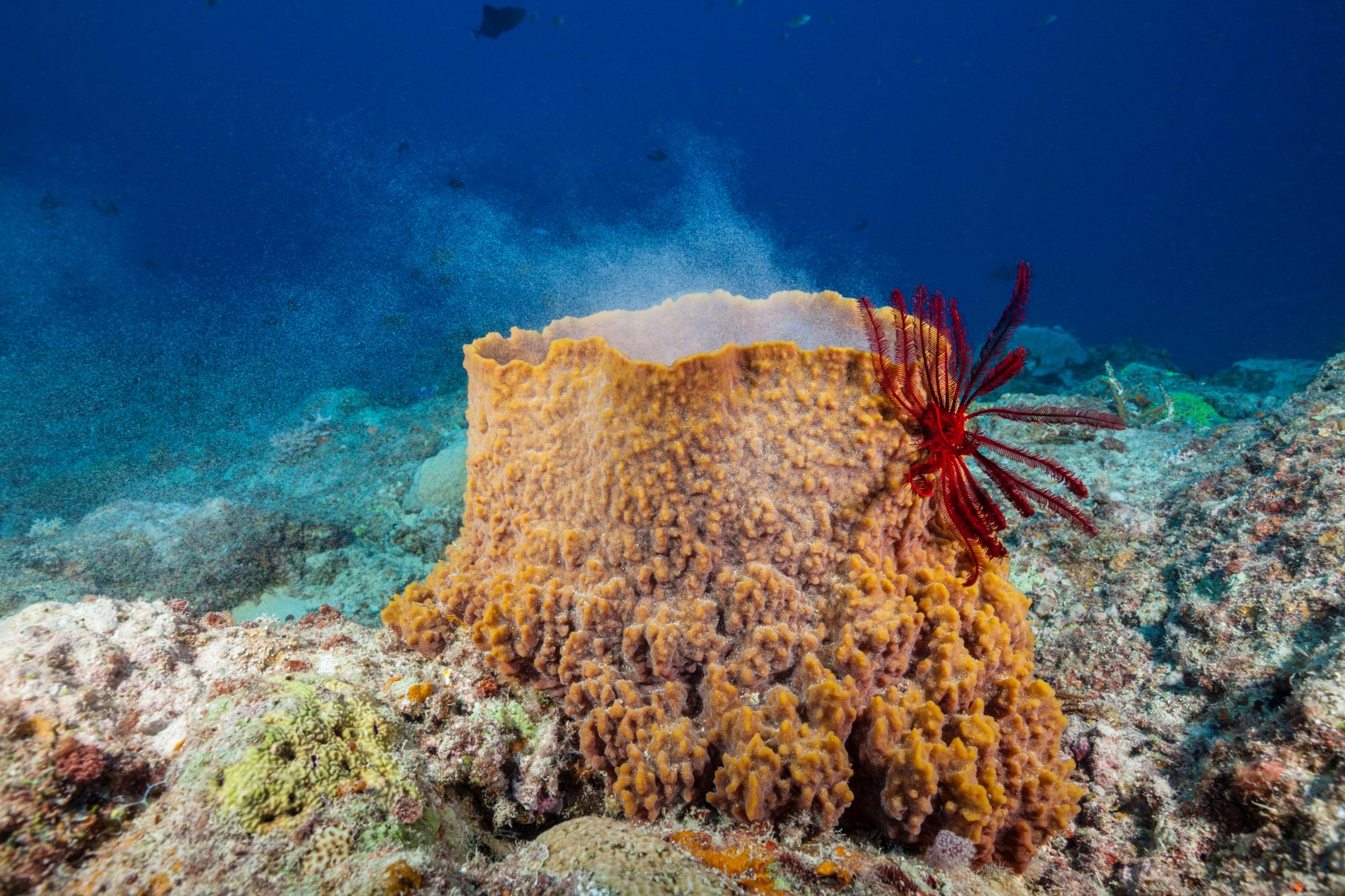
What Is a Sea Sponge? A sea sponge is a simple aquatic animal from the phylum Porifera, a name that means “pore bearer”. It has no brain, nerves, muscles or gut; instead, it pumps seawater through thousands of tiny pores and channels and filters out food and oxygen as the water passes through.
Adult sponges live fixed to rock, coral, shells or the seabed, and they belong to one of the oldest animal lineages on Earth, with fossils reaching back more than 500 million years. A small number of soft-skeletoned species are also harvested, cleaned and dried to make the natural sponges sold for bathing, make-up, decorating and crafts. This guide explains how a sponge’s body works, the main groups, where to find them (including on British shores), why they matter to the sea, and how to choose and look after a natural bath sponge.
Sea sponge at a glance
| Feature | Quick answer |
|---|---|
| Kingdom | Animal (Animalia) |
| Phylum | Porifera (“pore bearers”) |
| Brain or nervous system | None |
| How it feeds | Filters bacteria, plankton and organic particles from water |
| Movement | Larvae swim; adults stay attached in one place |
| Skeleton | Mineral spicules (silica or calcium carbonate), spongin fibre, or both |
| Where it lives | Every ocean, from rock pools to the deep sea; a few freshwater species |
| Human uses | Bath and cosmetic sponges, crafts, and a source of compounds studied in medicine |
Is a sea sponge a plant or an animal?
A sea sponge is an animal, even though it looks and behaves rather like a plant. Once a young sponge settles it never moves again, it has no obvious head, limbs or mouth, and many species grow as branching shapes or flat crusts that could easily be mistaken for seaweed or lichen.
What puts sponges firmly in the animal kingdom is their cell biology. They are multicellular, they cannot make their own food through photosynthesis, they eat other organisms, and they reproduce with sperm and eggs. Their cells also lack the rigid cell walls that plants have. Biologists regard sponges as one of the earliest branches of the animal family tree, which is why they are studied closely by anyone trying to understand how complex animal life first appeared.
A common source of confusion is that the sponge in your bathroom is not alive. A natural bath sponge is the cleaned skeleton of a sponge; the living tissue has been removed. A sponge on the seabed, by contrast, is a living animal going about its business.
Structure: how a sponge’s body works
Sea sponges are built around a single idea: keeping water moving. Instead of organs, their bodies rely on a small set of specialised cells and openings:
- Ostia: tiny inflow pores scattered across the surface, through which water is drawn in.
- Canals and chambers: an internal network that the water travels through, ranging from a simple tube to a complex maze in larger species.
- Choanocytes (collar cells): cells with a whip-like flagellum that beat to create the current and trap food particles in a collar of tiny projections.
- Amoebocytes: mobile cells that carry nutrients around the body, help build the skeleton and can change into other cell types when needed.
- Oscula: larger outflow openings, often visible as holes or chimneys on top of the sponge, where filtered water leaves.
- A skeleton of mineral spicules made of silica or calcium carbonate, a flexible protein fibre called spongin, or a mix of both.
Because sponges have no nervous system or digestive tract, each cell largely looks after its own needs, and the animal as a whole works through the steady flow of water. A useful way to picture it is as a living water filter: water goes in through countless small pores, food is caught along the way, and cleaned water is pushed out through a few big vents.
One of the most remarkable things about sponges is their ability to regenerate. Many species can regrow from small broken pieces, and laboratory experiments have shown that some sponges pushed through a fine mesh, separating them into small clumps of cells, can reassemble into a working sponge. This regenerative ability is also what makes sustainable harvesting possible, as explained below.
Shapes and colours
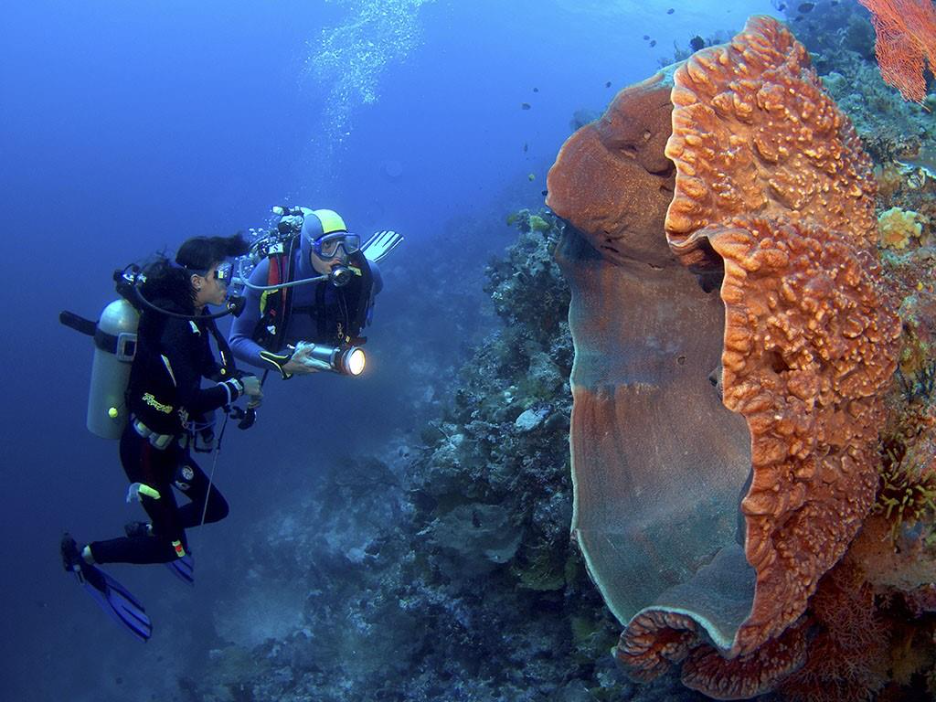
Sponges come in an extraordinary range of forms: tubes, vases, fans, cushions, barrels, branching fingers and thin crusts that spread over rock like paint. Shape often depends on the water around them; sponges in strong currents tend to be flatter and tougher, while those in calm water can grow tall and delicate. Colours range from bright yellow, orange, red and purple to dull browns and greys, depending on the species, natural pigments and the microbes living in their tissues.
The main types of sponge
Several thousand sponge species have been described, and new ones are still being found every year, particularly in the deep sea. Scientists group them into four classes based mainly on what their skeleton is made of:
| Class | Skeleton | Where found | Notes |
|---|---|---|---|
| Demospongiae | Silica spicules and/or spongin | Shallow to deep water, plus all freshwater sponges | By far the largest group; includes the commercial bath sponges |
| Calcarea | Calcium carbonate spicules | Mostly shallow seas | Usually small and pale |
| Hexactinellida (glass sponges) | Six-rayed silica spicules | Mainly deep sea | Delicate, glass-like lattices |
| Homoscleromorpha | Small silica spicules or none | Often in caves and shaded reefs | A small group, recognised as separate fairly recently |
For everyday purposes, the distinction that matters most is between sponges with hard mineral skeletons and those with a soft spongin skeleton. Only the latter can be turned into a usable bath sponge; a sponge full of glassy spicules would be scratchy and unpleasant on the skin.
Habitat: where sea sponges live
Sponges live in every ocean, from tidal rock pools to the abyssal sea floor, and from warm tropical reefs to icy polar waters. Adults attach permanently to hard surfaces such as rock, coral, shells, pier legs and shipwrecks. A smaller number of species live in freshwater lakes, ponds and rivers, where they often look like greenish or brownish crusts on submerged wood and stones.
Sea sponges around the UK
You do not need to travel to the tropics to see one. Around British coasts, the breadcrumb sponge (Halichondria panicea) forms green or yellow crusts on rocks and under overhangs at low tide. The boring sponge (Cliona celata) tunnels into limestone and shells and shows up as small yellow patches or lumps. Rocky shores in Devon, Cornwall, Pembrokeshire and western Scotland are good places to look on a low spring tide. Check under ledges and in shaded gullies, look but do not pull sponges off the rock, and always keep an eye on the incoming tide.
Sponges on tropical reefs
Tropical reefs host the most dramatic species, including giant barrel sponges that can be large enough for a diver to sit beside, bright tube sponges and colourful encrusting species that carpet reef walls. They are often a highlight for snorkellers and divers; our piece on planning a trip that combines coral reefs and ancient sites is a good starting point if that appeals.
How sea sponges feed
Sea sponges are filter feeders. As water flows through their canals, the collar cells capture bacteria, microscopic algae, plankton and tiny organic particles, while oxygen is absorbed directly by the cells. A healthy sponge can move a very large volume of water relative to its own size each day, which is why dense sponge beds make a real difference to water clarity and nutrient cycling on reefs and in coastal waters.
Not every sponge sticks to this diet. A few deep-sea species have become carnivorous, using hook-like spicules to snag small crustaceans that drift past and then slowly digesting them. Many sponges also host large communities of symbiotic bacteria, and some get part of their nutrition from these microbes.
How sea sponges reproduce
Sponges reproduce in two ways, which helps explain why they are so widespread.
- Sexual reproduction: many sponges are hermaphrodites, producing both sperm and eggs. Sperm is released into the water and caught by other sponges; fertilised eggs develop into free-swimming larvae that drift for a while before settling on a suitable surface and growing into a new sponge.
- Budding: small outgrowths form on the parent and eventually break away to grow independently.
- Fragmentation: pieces broken off by storms, animals or people can attach elsewhere and regrow.
- Gemmules: freshwater sponges form tough little capsules of cells that survive winter cold or drought and grow into new sponges when conditions improve.
Why sponges matter to marine ecosystems
Sponges are easy to overlook, but they do a lot of quiet work for the sea:
- Water filtration: they remove bacteria and fine particles, helping keep water clear.
- Nutrient recycling: sponges and their microbes convert dissolved organic matter into forms other reef animals can use.
- Shelter: small fish, shrimps, crabs, worms and brittle stars live in and on sponges, using them as a hiding place.
- Food: some turtles, fish and sea slugs feed on sponges despite their chemical defences.
- Reef building and erosion: some sponges help bind loose reef rubble together, while boring sponges break down dead coral and shell, recycling calcium back into the system.
Because they are sensitive to sediment, pollution and warming water, changes in sponge communities can also give scientists an early signal that a reef or seabed habitat is under stress.
Sponges and medicine
Because sponges cannot run away from predators or infections, many defend themselves chemically, often with help from their resident microbes. Researchers have studied these natural compounds for decades. Well-known examples include nucleosides discovered in a Caribbean sponge that inspired the development of the leukaemia drug cytarabine, and halichondrin B, originally found in a sponge, which led to the synthetic cancer drug eribulin. Many other sponge compounds are still at the research stage, being tested for antibacterial, antiviral and anti-inflammatory potential. This does not mean a bath sponge has any medicinal effect; the interest lies in specific chemicals from living sponges.
From seabed to bathroom: natural bath sponges
Only a handful of species have the soft, springy spongin skeleton that makes a good bath sponge. After harvesting, the living tissue is removed, and the sponge is washed, cleaned and dried, leaving the fibrous skeleton. Some are bleached to a pale colour for appearance, although unbleached sponges are usually considered stronger. The main commercial types are:
| Type | Texture | Typical use |
|---|---|---|
| Honeycomb | Large holes, soft but robust | Bathing, washing cars and boats |
| Fine silk | Very fine and soft | Face washing, applying make-up |
| Elephant ear | Thin, flat, fine pores | Pottery, painting and decorative finishes |
| Wool | Soft and absorbent | Bathing, decorating, cleaning |
| Yellow and grass | Firmer, coarser | General cleaning and crafts |
Traditional sponge-diving centres grew up in places such as the Greek island of Kalymnos and Tarpon Springs in Florida. Responsible harvesters cut the sponge above its base so that the remaining part can regrow, and some regions manage harvests with minimum sizes and seasons. When buying, it is reasonable to ask a supplier where and how their sponges were collected.
How to choose a natural sponge
- Match the type to the job: fine silk for the face, honeycomb or wool for the body, elephant ear for crafts and paint effects.
- Check the size when dry; sponges expand noticeably once soaked.
- Squeeze it gently. A good sponge springs back and does not crumble or shed grit.
- Prefer unbleached or lightly treated sponges if you want maximum durability.
- Ask about origin and harvesting practice, and be wary of very cheap sponges with no information at all.
Natural sea sponge vs synthetic sponge
Most kitchen and bath sponges sold today are made from polyurethane foam or cellulose. Here is how they compare with a natural sea sponge:
| Feature | Natural sea sponge | Synthetic foam sponge |
|---|---|---|
| Softness | Very soft when wet, especially silk and honeycomb types | Varies; often firmer |
| Absorbency | Holds a lot of water and lathers well | Good, but usually less than a quality natural sponge |
| Shape | Irregular; every piece is different | Uniform |
| End of life | Biodegradable | Plastic-based foam does not biodegrade |
| Price | Usually higher | Usually lower |
People with sensitive skin often prefer natural sponges for their softness, and those trying to cut plastic from the bathroom like that they break down at the end of their life. Anyone with a shellfish or seafood allergy who is unsure should check with a pharmacist or GP before use.
Caring for a natural sponge
- Soak a new sponge in warm water before first use; it will soften and expand.
- Rinse thoroughly after every use to remove soap and skin cells.
- Squeeze water out gently rather than wringing, which can tear the fibres.
- Let it dry in an airy spot, not sealed in a damp wash bag.
- Avoid bleach and very hot water, which damage spongin. An occasional soak in diluted white vinegar or bicarbonate of soda helps freshen it.
- Replace it when it starts to break up or still smells after cleaning.
Common mistakes
The most frequent problems come from leaving a sponge wet in a shower caddy, using it with harsh cleaning products, or sharing one sponge between several people. Give each person their own sponge, keep separate ones for the face and body, and never use a bath sponge for household cleaning.
Bottom line on sea sponges
A sea sponge is a living animal that has thrived for hundreds of millions of years by doing one thing well: filtering water. Sponges keep reefs and coastal waters clean, shelter countless small creatures and have even pointed the way to important medicines. If you buy a natural sponge, choose the right type for the job, ask where it came from, and rinse and dry it properly so it lasts.
Frequently Asked Questions
Are sea sponges alive?
Yes, sponges in the sea are living animals. The natural sponges sold for bathing are the cleaned, dried skeletons of sponges, so they are no longer alive.
Do sea sponges feel pain?
Sponges have no nervous system or brain, so they are not thought to experience pain in the way animals with nerves do. They do respond to their surroundings at a cellular level, for example by slowing water flow.
How do sea sponges eat?
They are filter feeders. Collar cells pump water through pores and canals, trapping bacteria, plankton and tiny organic particles as food, while the cells absorb oxygen directly from the water.
Can you find sea sponges in the UK?
Yes. Species such as the breadcrumb sponge and the boring sponge are common on rocky shores and in shallow waters around Britain. Look under ledges and in shaded gullies at low tide.
How long does a natural bath sponge last?
With regular rinsing and proper drying, a good natural sponge often lasts many months. Replace it when it starts to fall apart or keeps smelling after cleaning.