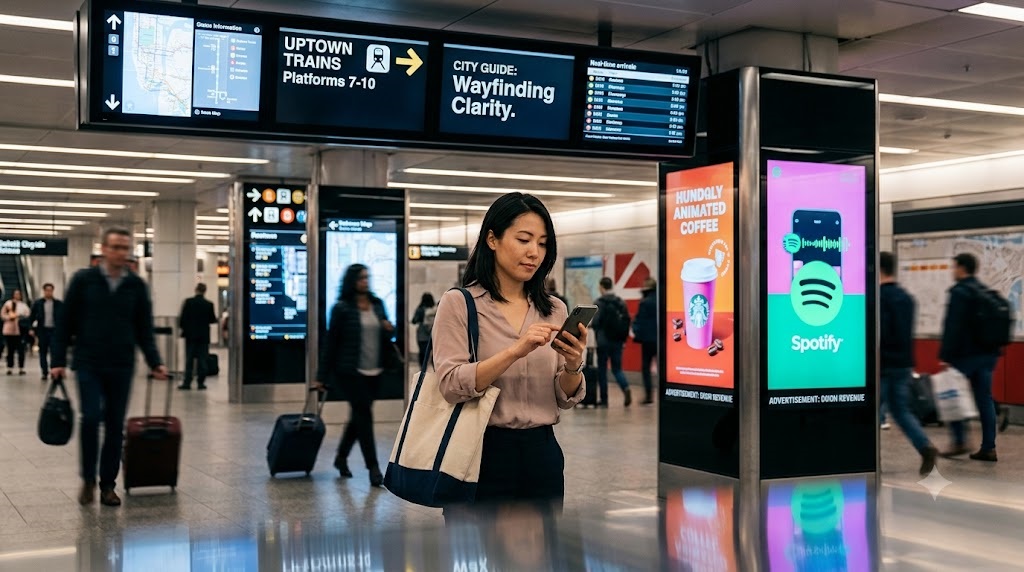
Transit hubs are valuable advertising environments because people pause, wait, and move through predictable paths. That is why digital out-of-home, often shortened to DOOH, has become part of the media mix in airports, train stations, and bus terminals. The challenge is that the same screens may also sit near essential passenger information.
Transit signage has to serve a public function before it serves a commercial one. A beautiful ad placement can still be a poor design decision if it hides gate changes, blocks sightlines, or trains passengers to ignore important screens. The best systems treat advertising and wayfinding as related but not equal.
Know the Difference Between Attention and Interruption
Advertising wants attention. Wayfinding wants comprehension. Those goals can coexist, but they need rules. A large screen near an entrance may be suitable for brand storytelling if route information is also clearly available nearby. A screen above a platform should be much more conservative because riders are using it to make immediate travel decisions.
OAAA discussions around out-of-home advertising often emphasize context and location. That context matters in transportation because dwell time changes by zone. A security line, baggage claim, ticket hall, and platform all create different levels of patience and attention.
Zone the Screen Before Selling the Space
A common mistake is selling digital space before deciding what information must remain persistent. Transit signage works better when the screen layout is zoned in advance. A persistent strip may carry time, line status, or emergency alerts. A main area may rotate ads or public service messages. A side panel may handle wayfinding.
This approach protects both sides. Advertisers get predictable placement, while passengers are not forced to wait for an ad loop to finish before seeing a service alert. For buyers comparing display suppliers for this type of public setting, an LED display manufacturer with experience across commercial, rental, and transportation environments can be a practical starting point.
Keep Motion Under Control
Motion attracts the eye, but too much motion can compete with navigation. A fast-moving ad beside a departures board makes the board harder to scan. If motion content is used, it should be placed away from critical text or limited during peak travel periods.
Brightness in nits, which measures the display’s light output, also needs moderation. A screen that is too bright in a darker concourse can be uncomfortable. A screen that is too dim near daylight can lose both ad value and wayfinding value. Brightness should be tuned to the environment, not chosen as a bragging point.
Give Emergency Messages Priority
Any transit advertising display network should have a clear override plan. Emergency instructions, evacuation routes, severe weather alerts, and security messages must take priority over scheduled campaigns. This is not only a technical feature; it is a governance issue. Staff need permission, training, and procedures for using the override.
The content management system should also support quick local updates. A station closure, temporary bus bridge, or escalator outage may not be an emergency, but it can still affect movement. Advertising value is strongest when passengers trust the screen as a useful object.
Measure Success Beyond Impressions
Transit advertising is often measured by exposure, but station operators should also watch complaints, missed connections, crowding, and wayfinding confusion. A media network that creates revenue while increasing staff questions may not be performing as well as it looks.
The better standard is balance. Advertising should add value to the space without reducing the clarity of passenger information. For organizations evaluating display partners,Esdlumen offers a broad LED display portfolio that can be considered in the context of commercial visibility, public information, and high-traffic venue design.