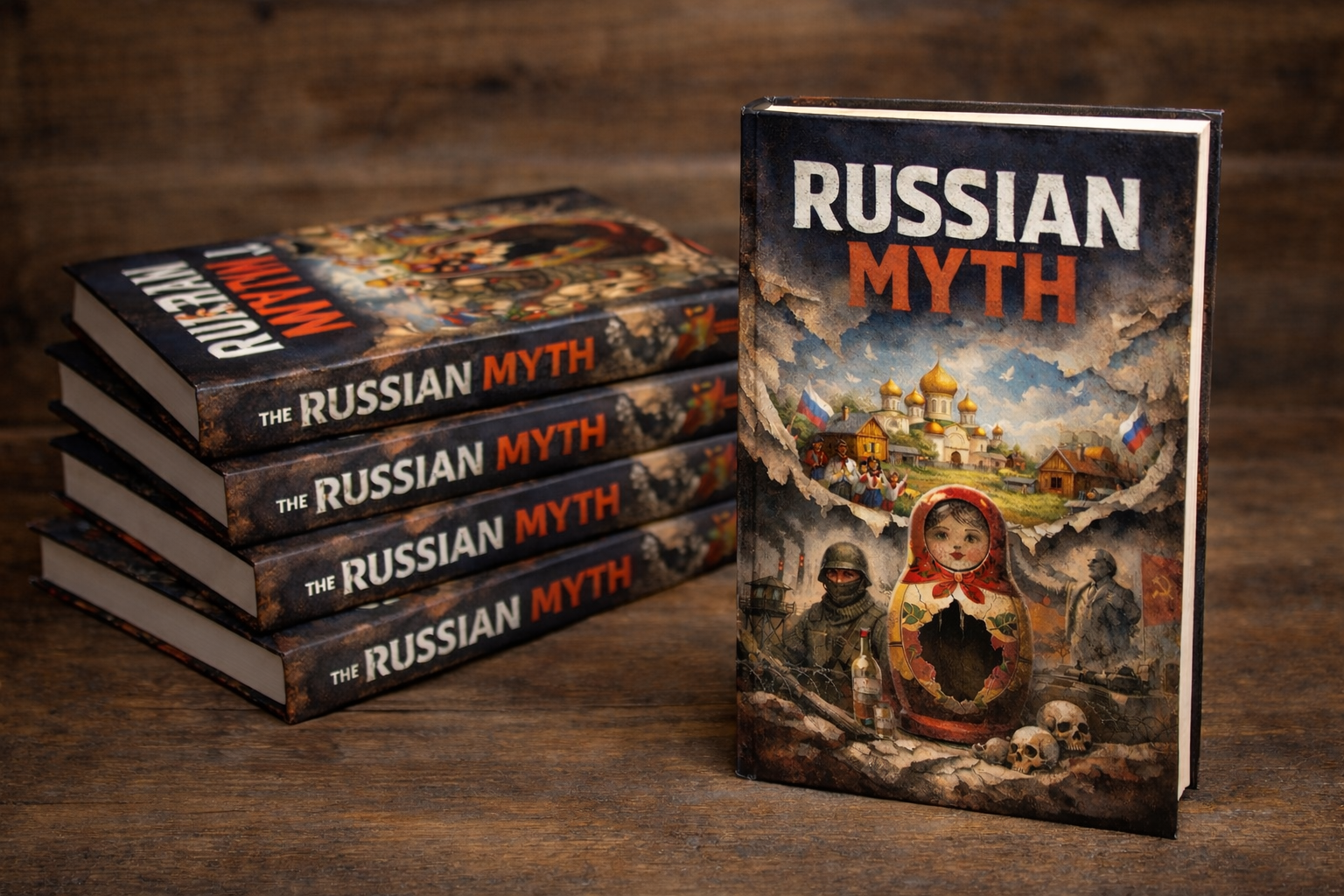
There is a question that Western capitals have been avoiding for three decades: what if Russia was never broken — what if it was always designed this way?
Oleh Cheslavskyi’s The Russian Myth starts where polite analysis stops. Russia is not a failed democracy. It is not a derailed transition. It is a comprador machine — built over eight centuries to extract resources from its periphery and funnel them upward to whoever sits at the top of the global food chain. The Mongols. The Venetians. The British. The Americans. The master rotated; the mechanism held.
The myth — the great ideological construction that made this possible — was the idea of Russia as a civilization. Unique, sacred, besieged. The Orthodox Church supplied the theology. The state supplied the violence. Together they produced a population that confused obedience with identity and called it culture.
Cheslavskyi demolishes this construction piece by piece, using Giovanni Arrighi’s world-systems framework as his instrument. Every rupture in Russian history — the Time of Troubles, the Petrine reforms, the Bolshevik revolution, the Soviet collapse — maps onto a shift in global hegemony, not onto any internal logic of development. Russia did not modernize. It rebranded its extraction model for the next patron.
Within this framework, Cheslavskyi maps Russia’s imperial history as structural adaptation to hegemonic succession — not internal development. This world-systems model reveals that Moscow’s current aggression is not an isolated regional crisis, but a violent reflex triggered by the erosion of the US-led global order. As the world transitions toward a volatile multipolar systemic chaos, the Kremlin is desperately trying to forcibly secure its status as a critical resource-extracting broker for the next global hegemon, proving that the empire acts as a global predator precisely because it cannot function as a normal state.
Ukraine is where the myth finally meets its refutation. A Slavic people choosing law over the Tsar, Europe over Moscow, accountability over loyalty — this is not a geopolitical problem for the Kremlin. It is an existential one. The war is not about NATO. It is about a mirror that shows the empire what it actually is.
The Russian Myth was written for everyone who stopped believing the official explanations – and needs a better one.
Available on Amazon and Apple Books.