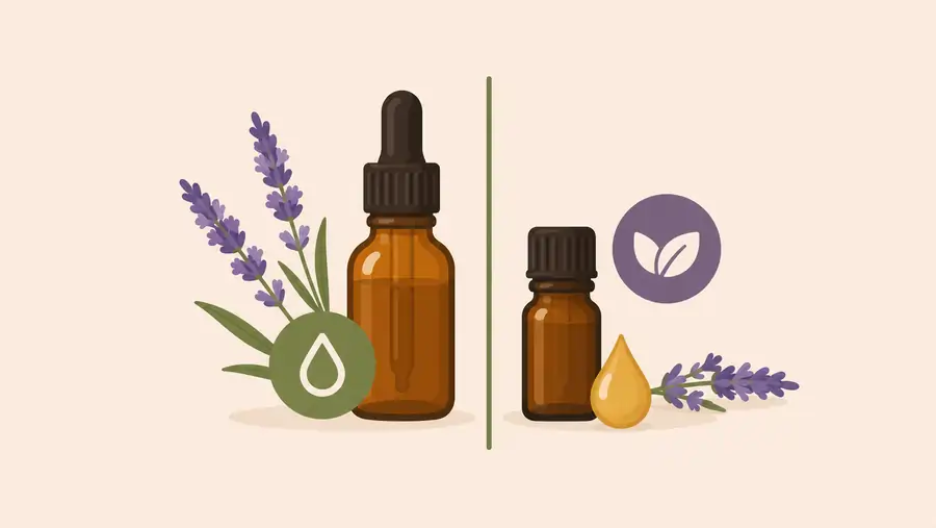
Lavender tincture is the one of the two that can be made for internal use, but only when its label says so and gives a measured serving. Lavender essential oil is a highly concentrated aromatic oil sold mainly for diffusing and diluted skin use, and it should not be swallowed unless a qualified professional and the product label both specifically support it. The two are different product categories, not a weak and a strong version of the same thing.
A lavender tincture is usually a liquid extract made by steeping lavender flowers in alcohol, glycerine, water or a blend, then straining the liquid and bottling it with a dropper. Lavender essential oil, by contrast, is normally produced by steam distillation and contains the plant’s volatile aromatic compounds in a dense, undiluted form. Both often arrive in small amber bottles with droppers, both smell of lavender, and both may be described online as “drops”, which is exactly why people mix them up.
This guide explains how the two products differ, which label wording points to internal use, which wording should stop you, how culinary extracts and carrier-oil blends fit in, and a step-by-step checklist you can use in a shop or while scrolling a product page.
What Is the Difference Between Lavender Tincture and Lavender Essential Oil?
The core difference is how each product is made and what it is made for. A tincture is an extraction: plant material sits in a liquid (the menstruum) for a period, the liquid draws out a range of compounds, and the result is a relatively dilute herbal preparation. An essential oil is a distillate: steam passes through the flowers, carries off the aromatic oil, and the oil is separated from the water. What you get is a small quantity of very concentrated oil from a large quantity of plant material.
That difference in concentration shapes everything else, from how the label is written to how the product should be stored and who should be careful with it. A tincture bottle intended for use by mouth will normally tell you how many drops or millilitres to take and how to mix them. An essential oil bottle will normally tell you how many drops to put in a diffuser or how much to dilute in a carrier oil before it touches skin.
Lavender tincture vs lavender essential oil at a glance
| Feature | Lavender tincture | Lavender essential oil |
|---|---|---|
| Product type | Liquid herbal extract | Concentrated aromatic oil |
| How it is made | Flowers steeped in alcohol, glycerine, water or a blend | Usually steam distillation of the flowers |
| Common base | Alcohol, glycerine, water or a mix | The volatile oil itself, sometimes pre-diluted in a carrier |
| Typical intended use | Measured use by mouth, if labelled as a food supplement or herbal extract | Diffusing, fragrance, or diluted topical use |
| Internal-use clue | Recommended daily dose and directions on the label | Only where the label and professional guidance clearly support it |
| Main risks | Wrong amount, alcohol content, interactions with medicines | High concentration, accidental ingestion, skin irritation if undiluted |
| Water-soluble? | Mixes into water (alcohol or glycerine base) | Does not mix with water; floats on top |
That last row is a simple practical test of understanding: an essential oil added to a glass of water does not disperse, which means a drop of it can reach the mouth and throat largely undiluted. A tincture is designed to be mixed into water or juice.
The practical answer
If you want something to take by mouth, look for a clearly labelled lavender tincture, glycerite or herbal supplement with serving directions. If you want lavender scent in a room, on a pillow or in a massage blend, essential oil is the usual choice. Never treat essential oil as a “stronger tincture” and never build your own internal dose from an essential oil bottle.
Is Lavender Tincture Meant for Internal Use?
Many lavender tinctures are made for internal use, but not all of them. Some are sold as food supplements, some as herbal extracts for practitioners, and some as cosmetic or “aromatic” tinctures intended for skin toners, linen sprays or home fragrance. The bottle has to tell you which one you are holding.
In the UK, a product sold for consumption as a food supplement is expected to carry a recommended daily dose, a warning not to exceed it, and a statement that it should be kept out of reach of young children. A herbal medicine that carries a Traditional Herbal Registration (THR) has been through the MHRA scheme and comes with a patient information leaflet. Either type of labelling is a much stronger signal of intended internal use than a product page that simply calls something “lavender drops”.
Label signs that point to internal use
- “Food supplement”, “herbal tincture”, “liquid extract” or “glycerite” on the front label
- A recommended daily amount stated in drops, dropperfuls or millilitres
- Directions on how to take it, such as “add to a little water”
- A full ingredient list naming the plant (often Lavandula angustifolia) and the liquid base
- An alcohol percentage, where alcohol is used
- Warnings covering pregnancy, breastfeeding, medicines and children
- A batch number, best-before date and the name and address of the company responsible
None of these replaces advice from a pharmacist, GP or qualified herbalist, but together they show the product has been labelled for measured use by mouth.
Tincture-specific things to think about
Alcohol-based tinctures can contain a substantial proportion of alcohol. That matters if you avoid alcohol for health, religious or recovery reasons, if you take medicines that should not be combined with alcohol, or if the product is being considered for a child. Glycerites use glycerine instead and are often chosen by people who want to avoid alcohol, though they are typically sweeter and may have a shorter shelf life once opened.
Also check the extract ratio if one is printed, for example 1:3 or 1:5. It describes how much plant material was used relative to the liquid. You do not need to calculate anything from it, but it explains why two tinctures can have very different recommended amounts. Always follow the specific product’s directions rather than a figure you have seen for a different brand.
Is Lavender Essential Oil Meant for Internal Use?
For ordinary home use, no. Lavender essential oil is sold overwhelmingly for diffusers, fragrance, bath products and massage blends after dilution. Essential oils are concentrated enough that swallowing them, using large amounts, or applying them undiluted can cause problems, and poison centres regularly deal with accidental ingestion, particularly by young children who find an attractive bottle.
There are specialist lavender oil preparations made for oral use, but those are formulated, dosed and labelled as medicines or supplements, usually in capsule form. They are not the same thing as a 10 ml bottle of essential oil from the aromatherapy shelf, and one cannot stand in for the other.
Why “pure”, “natural” and “therapeutic grade” prove nothing
Words like “pure”, “100% natural”, “undiluted” and “therapeutic grade” describe marketing positioning or composition. They do not mean a product is safe to swallow. In fact, “pure” and “undiluted” mean the opposite of what you would want for internal use: the oil is at full strength. “Therapeutic grade” is not an official standard in the UK. The only thing that tells you a product is intended for internal use is clear internal-use labelling backed by appropriate guidance.
Why a small bottle can still be risky
Essential oil bottles are small because only a little is needed for diffusing or blending. A few drops in a diffuser can scent a room. That same small quantity swallowed is a very different exposure. Keep essential oils out of reach of children and pets, close them after use, and choose bottles with dropper inserts and child-resistant caps where possible.
Why People Confuse Lavender Oil, Lavender Extract and Lavender Tincture
Sellers and shoppers use “oil”, “extract” and “drops” loosely. A product listed as “lavender oil” could be an essential oil, lavender flowers infused into olive or sunflower oil, a pre-diluted roll-on, or a fragrance oil that may be partly or entirely synthetic. “Lavender extract” could be a culinary flavouring, a supplement extract or a cosmetic ingredient. The name alone does not tell you enough.
The word “drops” is not enough
Dropper bottles are used for tinctures, essential oils, flavourings, serums and fragrance oils. Seeing a dropper tells you only how the liquid comes out of the bottle. Five drops of tincture and five drops of essential oil are not comparable amounts of anything. Always identify the product category first, then read the serving directions, never the other way round.
Common label mix-ups
| What the label says | What it usually is | Take by mouth? |
|---|---|---|
| Lavender essential oil | Steam-distilled concentrated oil | No, unless label and professional guidance specifically support it |
| Lavender fragrance oil | Scent product, may be synthetic | No |
| Lavender infused oil | Flowers steeped in a carrier oil, usually for skin | Only if labelled for food use |
| Lavender roll-on or massage oil | Essential oil pre-diluted in a carrier | No |
| Lavender tincture (food supplement) | Liquid extract with a recommended daily dose | Yes, following the label |
| Culinary lavender extract | Food flavouring for recipes | In recipe amounts only |
| Lavender hydrosol or flower water | By-product water from distillation, used in toners and sprays | Only if labelled as food-grade |
What Label Wording Means Do Not Take It Internally?
Treat any of the following as a firm no for internal use: “for external use only”, “not for internal use”, “do not ingest”, “aromatherapy use”, “for diffuser use”, “dilute before applying to skin”, “fragrance oil”, “massage oil”, “body oil” or “cosmetic use only”. Also avoid internal use when there is no ingredient list, no recommended amount, and no information about who is responsible for the product.
Red flags on product pages
- Listings that switch between “essential oil” and “tincture” in the title and description
- Customer reviews describing people adding the oil to drinks when the label says nothing about it
- No full label image, or a label image that is blurry or cropped
- Claims to treat, cure or prevent health conditions
- No UK or EU address for the seller or manufacturer
- Prices that look too low for the stated volume of “pure” essential oil
A practical rule: when a lavender product is not clearly labelled for internal use, treat it as not intended for internal use. If the seller cannot show you a full label, buy elsewhere.
What About Culinary Lavender Extract?
Culinary lavender extract is a separate category again. It is made to flavour shortbread, syrups, lemonade and icing in small recipe amounts. It is not an essential oil and not always the same as a supplement tincture. The label should say something like “flavouring”, “culinary extract” or “baking extract” and give recipe guidance.
A culinary extract is intended for flavour, not for a daily supplement routine, and a supplement tincture is intended for measured servings, not for a cake. Use each product for the purpose on its label. If you are baking with dried lavender flowers instead, buy culinary-grade lavender from a food supplier rather than decorative or craft lavender, which may have been treated or stored with non-food products.
What About Lavender Oil in a Carrier Oil?
Lavender oil in a carrier is usually a topical product: lavender essential oil diluted into jojoba, sweet almond, coconut, sunflower or olive oil. It is gentler on the skin than undiluted essential oil, but that does not make it a food. Most of these blends are designed for massage, bath or cosmetic use and are not made or labelled to food standards.
If the product says massage oil, body oil, skin oil, roll-on or topical blend, treat it as external use only unless the label clearly states otherwise. Patch-test any new topical product on a small area of skin first, and stop using it if you notice redness, itching or irritation.
Who Should Be More Careful With Lavender Products?
Extra caution is sensible with any lavender product if you:
- Are pregnant or breastfeeding
- Take prescribed medicines, particularly sedatives, sleep aids or medicines for anxiety or depression
- Are due to have surgery or a procedure involving anaesthesia
- Have a history of allergies, eczema or reactions to fragrances or plant products
- Avoid alcohol, or are buying for someone who does
- Are choosing a product for a child or an older relative
Lavender products are not a substitute for medical care, and they should not be used to treat, cure or prevent a health condition. If you are thinking about taking lavender for sleep, stress or low mood, speak to your GP or pharmacist first. Pharmacists in particular can check a product label against your current medicines in a few minutes.
If someone swallows essential oil
If a child or adult swallows lavender essential oil, or a large or unknown amount of any lavender product, get medical advice straight away. In the UK, call NHS 111, or 999 if the person is drowsy, struggling to breathe, choking or unwell. Keep the bottle with you so you can tell the call handler exactly what was swallowed and roughly how much.
How to Choose the Right Lavender Product
Start with what you actually want to do, then pick the product category that is labelled for that job.
| Your goal | Product type to look for | What to check on the label |
|---|---|---|
| Measured use by mouth | Lavender tincture, glycerite or food supplement | Recommended daily dose, ingredient list, alcohol content, warnings |
| Room scent or diffusing | Lavender essential oil | Diffuser directions, safety warnings, child-resistant cap |
| Massage or skin use | Pre-diluted lavender body or massage oil | Carrier oil, dilution, external-use directions |
| Baking and drinks | Culinary lavender extract or culinary-grade dried flowers | Food-use labelling and recipe amounts |
| Pillow or linen spray | Lavender spray or hydrosol | Fabric directions, patch-test advice |
| Product listing is unclear | Nothing until clarified | Ask the seller for the full label and intended use |
The safest product is the one clearly labelled for the exact use you have in mind.
Checklist: How to Tell If a Lavender Product Is Meant for Internal Use
Use these steps before taking any lavender product by mouth. They take a couple of minutes and work equally well in a shop or online.
- Read the product name on the front label. Look for tincture, liquid extract, glycerite or food supplement, as opposed to essential oil, fragrance oil, massage oil or culinary extract.
- Find the intended use. Internal-use products give a recommended amount and directions. If the label only mentions diffusing, aroma, bathing or skin, do not swallow it.
- Scan for external-use warnings. “External use only”, “do not ingest” or “dilute before use” ends the question.
- Check the ingredients. A tincture should list the plant and the liquid base; an essential oil will usually list only lavender oil.
- Read the serving directions and stick to them. Do not convert between brands or invent your own dose.
- Confirm the botanical name. Lavandula angustifolia, known as English or true lavender, is common, but the name confirms identity, not intended use.
- Review the warnings for pregnancy, breastfeeding, medicines, surgery, children and allergies, and ask a pharmacist if any of them apply to you.
- Check who is responsible for the product. A name, address and batch number are signs of a traceable, accountable seller.
- If anything is unclear, ask the seller for the full label. If they cannot provide it, do not use the product internally.
Common mistakes to avoid
- Adding essential oil to water, tea or a smoothie because a social media post suggested it
- Assuming a “lavender oil” listing is the same as a tincture because both have droppers
- Decanting products into unlabelled bottles, which makes it easy to grab the wrong one later
- Storing essential oils next to food supplements or flavourings in the kitchen
- Relying on purity claims instead of reading the directions
Storage and Shelf Life
Store both tinctures and essential oils in their original dark glass bottles, tightly closed, away from heat and direct sunlight. Keep them somewhere children cannot reach, ideally in a separate place for essential oils so they are never confused with something meant for the kitchen. Note when you opened each bottle and follow any “use within” guidance on the label. If a product changes colour, smells off or becomes cloudy when it should be clear, replace it rather than using it.
Key Terms Explained
Lavender tincture: a liquid herbal extract made from lavender flowers and a liquid base such as alcohol, glycerine, water or a blend. Lavender essential oil: a concentrated volatile oil, usually steam-distilled, used for fragrance, diffusing or diluted topical use. Glycerite: a liquid extract that uses glycerine as its main carrier instead of alcohol. Carrier oil: a mild oil such as jojoba or sweet almond used to dilute essential oils for skin. Culinary extract: a food flavouring designed for recipes. Internal use: taking something by mouth, which should only happen when a product clearly gives directions for it.
Frequently Asked Questions
What is the difference between lavender tincture and lavender essential oil?
Lavender tincture is a liquid herbal extract made by steeping lavender flowers in alcohol, glycerine, water or a blend. Lavender essential oil is a highly concentrated aromatic oil, usually steam-distilled, and is intended mainly for diffusing or diluted skin use. They differ in concentration, base and intended purpose.
Can you take lavender tincture internally?
You can if the product is clearly labelled for internal use, for example as a food supplement with a recommended daily dose and directions. Follow the label exactly and do not exceed the stated amount. Speak to a pharmacist or GP first if you are pregnant, breastfeeding or taking medicines.
Can you ingest lavender essential oil?
Do not swallow lavender essential oil from an ordinary aromatherapy bottle. It is very concentrated and is not labelled or dosed for internal use. Any oral lavender oil product should be specifically formulated and labelled for that purpose and used only with appropriate professional guidance.
Is lavender oil the same as lavender tincture?
No. “Lavender oil” can mean an essential oil, a fragrance oil or lavender infused into a carrier oil for skin. A lavender tincture is a liquid extract with a water-mixable base, a different strength and its own labelling and directions.
Does pure lavender oil mean it is safe to swallow?
No. Words like pure, natural, undiluted and therapeutic grade describe marketing or composition, not suitability for internal use. Undiluted oil is at full strength, which is the opposite of what you would want for anything taken by mouth.
What should I do if a child swallows lavender essential oil?
Get medical advice straight away. In the UK call NHS 111, or 999 if the child is drowsy, coughing or choking, having trouble breathing or seems unwell. Keep the bottle with you so you can say exactly what was swallowed.
Bottom Line on Lavender Tincture vs Lavender Essential Oil
Lavender tincture and lavender essential oil are not interchangeable. If you want something to take by mouth, choose a lavender tincture or supplement that is clearly labelled for internal use, follow its directions, and check with a pharmacist if you take any medicines. Keep essential oil for diffusers and diluted skin blends, store it away from food products, and when a label leaves you guessing, do not swallow the product.