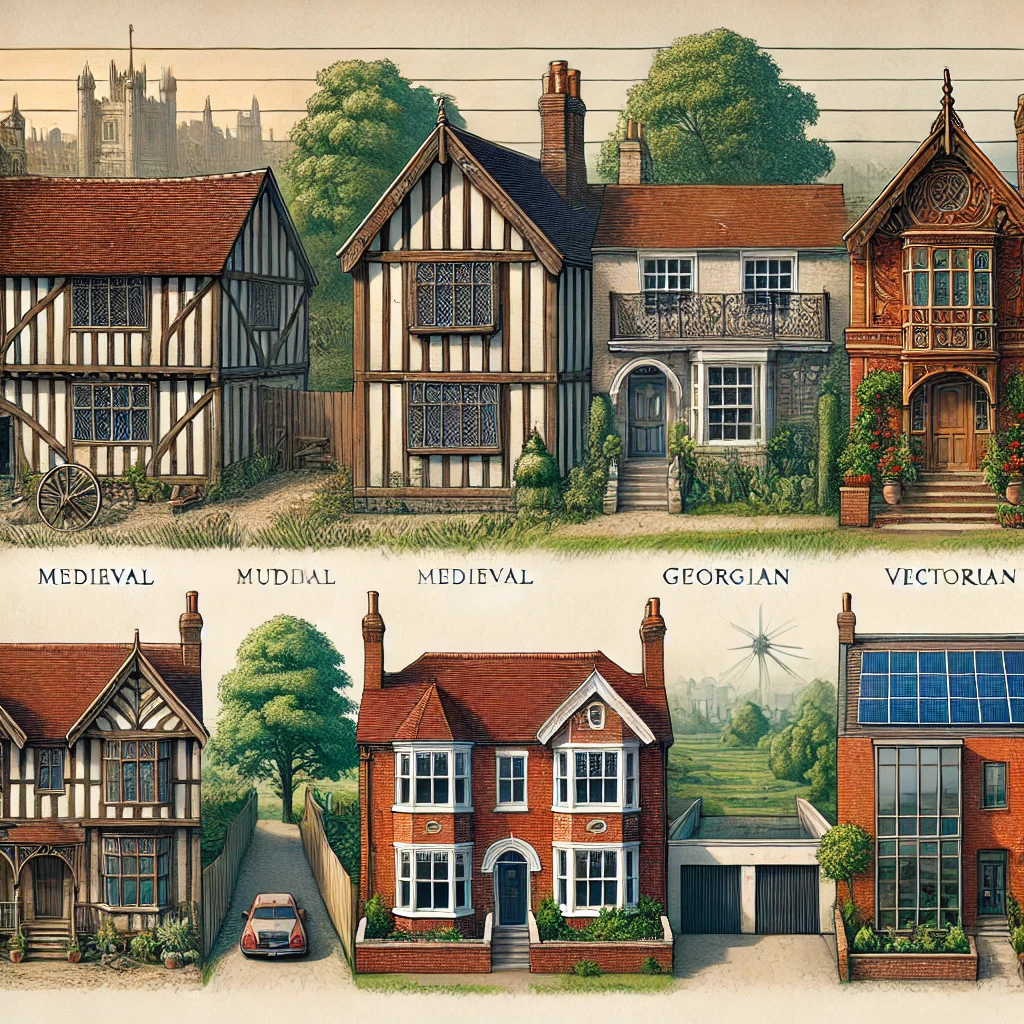
Essex architecture reflects the county’s history and culture through what it was built from and who built it. With almost no local building stone, Essex relied on timber, clay, flint, brick and plaster, and those materials shaped everything from Saxon churches and Tudor wool towns to Georgian high streets, Victorian seaside resorts, post-war new towns and modern eco-homes.
Walk through Colchester, Thaxted, Coggeshall, Southend or Harlow and you can read around two thousand years of trade, faith, wealth and social change in the buildings themselves. This guide works period by period, explains the materials and details to look for, and suggests where to see the best examples.
Essex Architecture by Period: A Quick Guide
| Period | Key features | Where to see it |
|---|---|---|
| Roman | Town walls, reused Roman brick and tile | Colchester |
| Saxon and Norman | Early churches, great stone keeps | Bradwell-on-Sea, Greensted, Colchester Castle, Hedingham Castle |
| Medieval and Tudor | Timber framing, jettied upper floors, pargeting, early brickwork | Thaxted, Saffron Walden, Coggeshall, Layer Marney Tower |
| Jacobean and Georgian | Symmetry, sash windows, classical detail, refronted houses | Audley End, Colchester, Maldon, Harwich |
| Victorian and Edwardian | Red brick terraces, seaside architecture, railway buildings | Southend-on-Sea, Clacton, Chelmsford |
| 20th century | Modernist villages, new towns, campus architecture | Silver End, Frinton Park, Harlow, Basildon |
| Contemporary | Sustainable housing, bold cultural buildings | Colchester, Wrabness, new developments across the county |
Why Materials Explain Essex Architecture
Geology decided much of what Essex looks like. The county sits largely on clay, gravel and chalk rather than good building stone, so builders worked with what the land and the forests provided. That single fact explains the timber frames, the plaster, the weatherboarding and the early enthusiasm for brick that set Essex apart from stone-built counties further west.
| Material | How it was used | What it tells you |
|---|---|---|
| Oak timber | Structural frames for houses, barns, guildhalls and even church walls | Plentiful woodland and highly skilled carpenters |
| Lime plaster | Infill and render over timber frames, often decorated with pargeting | Local craft traditions and a wish to show off status |
| Weatherboarding | Painted or tarred boards cladding houses, mills and barns | A cheap, practical finish suited to the clay country |
| Flint | Walls of churches and some cottages, often mixed with rubble | Stone substitute gathered from fields and the coast |
| Roman brick and tile | Reused in castles and churches | A habit of salvaging whatever was to hand |
| Red brick | Tudor houses, Georgian fronts, Victorian terraces | Local clay, growing wealth and changing fashion |
Once you know these materials, you can often date a building at a glance, or at least spot that a smart brick front has been added to a much older frame behind it.
Roman and Norman Foundations
Colchester, the Roman town of Camulodunum, is often described as Britain’s oldest recorded town, and much of its Roman wall circuit still survives. When the Normans arrived they built Colchester Castle on the base of the Roman Temple of Claudius, reusing Roman brick and tile because good stone was scarce. The result is the largest Norman keep in Europe, and it shows a theme that runs through Essex building: reuse what is to hand.
Elsewhere, the tall Norman keep at Hedingham Castle, built by the de Vere family, still dominates the surrounding countryside as a statement of power and lordship.
Some of England’s oldest churches
Essex holds two remarkable early churches. St Peter-on-the-Wall at Bradwell-on-Sea was founded by St Cedd in the seventh century using stone from an abandoned Roman fort, and it still stands alone near the marshes. Greensted Church near Chipping Ongar has walls of split oak logs and is widely regarded as the oldest wooden church in the world. Both reflect the county’s early place in the spread of Christianity in England, and both show the Essex habit of building with timber and salvaged material.
Medieval and Tudor Wool Towns
The medieval and Tudor periods gave Essex its most recognisable look: timber-framed buildings, steep roofs, jettied upper storeys overhanging the street, and exposed or plastered oak frames. Much of this came from farming and the wool and cloth trades, which made market towns wealthy enough to build on a grand scale.
- Thaxted: the timber-framed Guildhall, raised on an open ground floor that once sheltered market traders, stands below one of the county’s grandest parish churches.
- Saffron Walden: named after the saffron crocus once grown there, the town has streets of timber-framed houses, several decorated with pargeting, the moulded plasterwork typical of Essex and Suffolk.
- Coggeshall: Paycocke’s House, built for a wealthy cloth merchant around 1500 and now cared for by the National Trust, has richly carved timber inside and out. Nearby, the great barns at Cressing Temple, linked to the Knights Templar, show medieval carpentry on a huge scale.
- Colchester’s Dutch Quarter: takes its name from Flemish Protestant weavers who settled in the town in the sixteenth century and strengthened its cloth trade.
Tudor wealth also brought fashionable brick. Layer Marney Tower, built in the 1520s for Henry, Lord Marney, is often called the tallest Tudor gatehouse in Britain and carries early Renaissance terracotta decoration. Ingatestone Hall, the red-brick home of the Petre family since the sixteenth century, is another fine example. These houses tell stories of agriculture, trade and royal favour, and they show the craftsmanship of the period at its most confident.
Reading a timber-framed house
- Jetties: an upper floor projecting over the one below usually signals a medieval or Tudor date and an owner keen to show off.
- Close studding: tightly spaced vertical timbers used more wood than necessary, so they were a display of wealth.
- Pargeting: raised or incised plaster patterns, from simple combed designs to flowers, birds and figures.
- Crown posts: in many older roofs, a central post supports the roof timbers and is a common feature of medieval Essex carpentry.
Symmetry and Classical Order
From the seventeenth century, classical ideas reshaped Essex building. Audley End House near Saffron Walden began as a vast Jacobean mansion for Thomas Howard, 1st Earl of Suffolk, and was later remodelled, including interiors by Robert Adam. It shows how the great houses moved from Tudor exuberance towards balance and proportion.
The Georgian period brought symmetrical facades, sash windows, panelled doors and elegant fanlights to high streets across the county. Many older timber-framed houses in Colchester, Maldon, Coggeshall and Harwich were simply given new brick or plastered fronts to look up to date, so a Georgian face often hides a much older frame behind. Look at the roofline and the side walls: a steep roof or exposed timbers round the corner often give the game away. Country houses such as Hylands House near Chelmsford show the same taste for classical order in a parkland setting.
Railways, Industry and a Changing County
The Industrial Revolution and the arrival of the railways led to a change in Essex architecture, blending new influences with traditional elements. Red brick, slate roofs, bay windows and cast-iron railings became standard on Victorian streets. Railway lines from London made seaside towns such as Southend-on-Sea, Clacton and Walton-on-the-Naze popular with day-trippers, and Southend Pier, the longest pleasure pier in the world, became a symbol of the era.
Terraced housing spread as industry grew, giving workers affordable homes near factories and stations. Chelmsford developed as an engineering town and home to Marconi’s pioneering radio works, and the county gained town halls, libraries, schools and stations that still anchor many town centres today.
Social Experiments of the 20th Century
Essex became a testing ground for new ideas about how people should live. In the 1920s the window manufacturer Francis Crittall built Silver End near Braintree as a model village for his workers, including striking white, flat-roofed modernist houses fitted with the firm’s steel windows. In the 1930s the Frinton Park Estate brought more modernist homes to the coast.
After the Second World War, Harlow and Basildon were designated as new towns to rehouse Londoners. Harlow, masterplanned by Frederick Gibberd, was built around neighbourhoods with their own shops, schools and green space, and includes The Lawn, often cited as Britain’s first residential tower block. Concrete, glass and steel replaced traditional materials, and open-plan homes with large windows reflected modern family life. The University of Essex campus at Wivenhoe Park, with its 1960s towers, is another landmark of the period.
In 1973 Essex County Council published the Essex Design Guide, which encouraged new housing to respond to local character with varied rooflines, traditional materials and enclosed streets. It influenced housing design well beyond the county, and towns such as South Woodham Ferrers were shaped by its ideas. In a sense, the guide brought the story full circle, asking modern builders to learn from the timber, brick and plaster towns of earlier centuries.
Innovative and Sustainable Design Today
Contemporary Essex architecture mixes respect for context with bold new ideas. Firstsite, the gold-clad arts centre in Colchester, and A House for Essex at Wrabness, created by artist Grayson Perry with the architects FAT, show how the county still attracts adventurous design. Across new developments, architects increasingly include high insulation levels, solar panels, heat pumps, rainwater harvesting and smart controls, while planners ask for designs that sit comfortably alongside older buildings.
For owners of period properties, the challenge is balancing modern comfort with historic character. Listed buildings and homes in conservation areas need consent for many changes, and lime plaster and timber frames need breathable materials rather than modern cement renders and plastic paints, which can trap moisture and rot the frame. Speak to your local planning authority before altering a listed building. Our guide to high-end home renovations and where to invest covers upgrades that add value without losing charm, and if you are planning a new home, read why building a home doesn’t have to be stressful.
How to Explore Essex Architecture
- Start in Colchester: walk the Roman walls, visit the castle museum and wander the Dutch Quarter.
- Tour the north-west towns: Saffron Walden, Audley End and Thaxted make an easy day of timber frames, pargeting and grand houses.
- Visit Coggeshall and Cressing Temple: for merchant houses and medieval barns.
- Head to the coast: Southend and Clacton for Victorian resorts, Bradwell for St Peter-on-the-Wall.
- See the 20th century: Silver End and Harlow show how Essex experimented with modern living.
Opening times for historic houses vary by season, so check with English Heritage, the National Trust or the owners before travelling. Heritage Open Days each September often open buildings that are usually closed to the public.
What to look for on any Essex high street
- Rooflines that are steeper than the front suggests, a sign of an older frame behind a later facade
- Pargeting panels, especially in the north and west of the county
- Painted or tarred weatherboarding on cottages, mills and outbuildings
- Flint and reused Roman brick in church walls
- Victorian shopfronts surviving above modern fascias
Frequently Asked Questions
What is typical Essex architecture?
Timber-framed buildings finished in plaster or weatherboarding, decorative pargeting, red brick and flint are typical. These materials dominate because the county had very little good building stone.
What is pargeting?
Pargeting is decorative raised or incised plasterwork on the outside of timber-framed buildings. It is most common in Essex and Suffolk, and Saffron Walden has some of the best-known examples.
What is the oldest building in Essex?
Colchester’s Roman walls are among the oldest standing structures. St Peter-on-the-Wall at Bradwell-on-Sea, founded in the seventh century, is one of the oldest largely intact churches in England.
Why are Harlow and Basildon important architecturally?
They were post-war new towns designed around neighbourhoods, green space and modern housing. Harlow in particular shows how planners reimagined everyday life after 1945.
What was the Essex Design Guide?
Published by Essex County Council in 1973, it encouraged new housing to reflect local character through varied rooflines, traditional materials and enclosed streets, and it influenced residential design across England.
Why do so many Essex buildings have weatherboarding?
Timber was plentiful and stone was scarce, so boards were a cheap and practical way to clad houses, mills and barns. Painted white or tarred black, weatherboarding is now a defining feature of rural and coastal Essex.
Final Thoughts on Essex Architecture
Essex architecture is the story of a county without stone making the most of timber, clay, flint and plaster, then using wealth, railways and bold planning to reinvent itself again and again. Start in Colchester, add a day among the wool towns of the north-west and finish in Harlow or Silver End, and you will see two thousand years of history written in the buildings.